Specialty Stones
Violetish Blue Sapphire: Color, Origin, Rarity & Value
A slight violet cast keeps a blue sapphire in the top colour band. A strong purple cast takes it out. This guide covers what causes the tint, how labs record it, how it compares with pure Ceylon blue, and when it should change what you pay.
10 min read
By Naseef AR
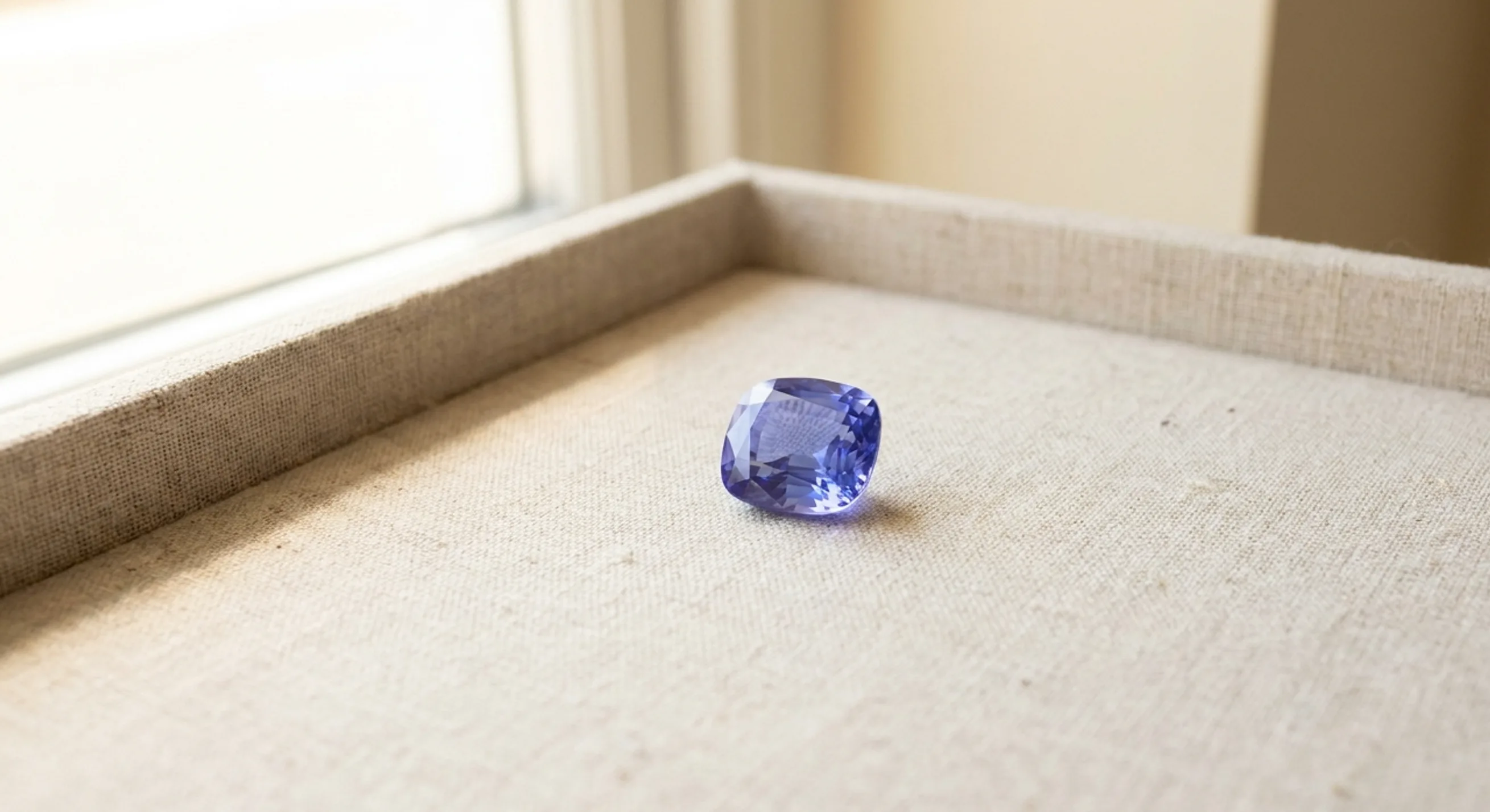
A violet blue sapphire is a blue sapphire with a violet secondary hue. Blue is the main colour and violet is the modifier, and on a lab report it usually reads "violetish blue." This is not a lesser category. The trade places the most valuable blue sapphires in a range from velvety blue to violetish blue, in a medium to medium-dark tone with strong to vivid saturation. So a slight violet cast keeps a stone in the top band. A strong purple cast, or a stone that tips over into purple, is a different matter. Where that line falls is what this guide is about.
What is a violet blue sapphire?
Gemmologists describe colour with three terms: hue, tone and saturation. Hue is split into a primary colour and a secondary one. On a stone described as "violetish blue," blue is primary and violet is secondary. Flip the order to "bluish violet" and violet becomes the main colour. At that point you are looking at a violet sapphire, not a blue one.
The trade is less careful with words. "Purple blue sapphire" turns up in listings for anything from a faint lavender cast to a stone that looks purple from across a room. When I use the term, I mean a stone that reads blue first, with violet showing at the edges and in the tone. Violet sits closer to blue on the colour wheel. Purple sits between blue and red. That difference matters when you price a stone.
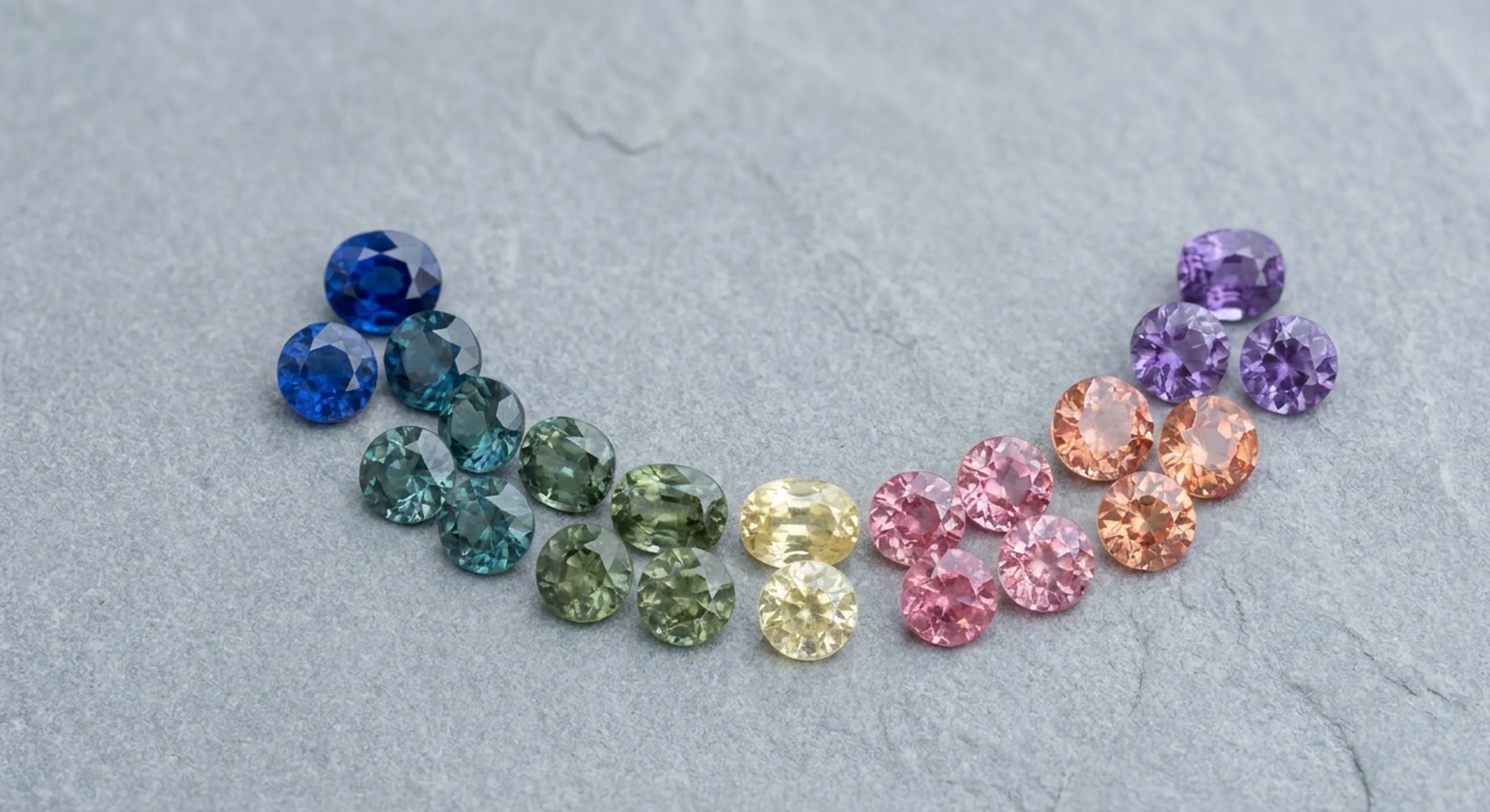
Among Ceylon sapphire colors, violetish blue sits between pure blue and the true purples. It overlaps the top blue grades: both royal blue Ceylon sapphire and cornflower can carry a slight violet themselves. If you want the whole range, from pink and padparadscha to yellow and purple, I cover it in the full Ceylon sapphire color spectrum.
Physically, nothing changes. It is still corundum: Mohs 9, refractive index about 1.762 to 1.770, specific gravity around 4.0. A violet tint has no effect on durability or wearability.
What causes the violet tint in blue sapphire?
Blue in sapphire comes from iron and titanium sitting next to each other in the crystal. The physics term is Fe2+ to Ti4+ intervalence charge transfer. It is the same cause in every blue sapphire, whatever the origin.
The violet is less settled. One explanation is that chromium, the element behind pink and red in corundum, is present alongside the iron and titanium. Pink-red laid over blue gives violet. Other references put the violet down to vanadium instead. The honest answer is that sources disagree, and both elements can be present in the same stone. For a buyer this is academic. No lab report tells you which trace element caused the tint. What counts is how the stone looks face-up.
Part of what you see face-up is a cutting decision. Blue sapphire is dichroic, meaning it shows two colours depending on the viewing direction. Looking down the optic axis, it tends to show violetish blue. At right angles to that axis, it tends to show greenish blue. Cutters prefer to orient the table so the violetish-blue direction faces up, because violet sells and green does not. A clean violetish blue face-up, with no green flashes, usually shows a cutter who oriented the stone properly. Orientation cannot add a violet the crystal's chemistry does not supply.
How do labs describe violetish blue on a report?
Most coloured-stone lab reports do not quality-grade the stone. They record weight, measurements, shape, cutting style and a colour description. They state whether the stone is natural or lab-grown and list any detectable treatments, and some add an origin opinion. The colour line is usually plain description: "blue" or "violetish blue."
Some labs, GRS among them, also print trade terms such as "Royal Blue" and "Cornflower Blue." So the same stone could carry a plain hue description from one lab and a trade name from another. Read the colour line itself, not just the headline name.
What to look for on a report:
- "Violetish blue" is not a warning. It describes the colour band the trade places at the top of the market.
- Violet or purple named as the main hue, with blue only as a modifier, means you are buying a violet or purple sapphire, and it should be priced that way.
- "Greenish blue" is the modifier that genuinely lowers value. Pure to slightly violetish blue is the most prized, and a green secondary hue pulls the price down.
Why does a violet blue sapphire look more purple under warm light?
The well-documented case is colour-change sapphire. These stones are blue to violet in daylight-equivalent light and violetish purple to strongly reddish purple under incandescent light. In Sri Lankan colour-change sapphires, the shift is linked to trace chromium and vanadium. Those are the same elements tied to the violet tint in ordinary violetish blues.
Ordinary blue sapphires can show a milder version of the same thing. Some Ceylon blues drift slightly toward violet under warm incandescent light, and a violetish blue carrying some of those traces may lean further. How far a given stone moves varies, so treat it as something to check, not something to assume. A stone that looks a clean violetish blue under daylight LEDs may look noticeably more purple under a warm restaurant bulb, or it may barely move.
Colour change and colour variation are also different things. A colour change is a shift between two named colours, such as blue to purple, and a lab report will name the stone a colour-change sapphire. Colour variation is a shift within one colour family, and it is priced as a standard stone. A violetish blue that warms up a little indoors is variation, not a colour-change stone, and it should not be sold to you as one.
How do Ceylon violet blues compare with pure blue?
Ceylon sapphires tend toward a lighter, more transparent violet-tinged blue than the deep royal blues of Burma or the darker, inkier blues of some Thai and Australian material. For a fuller comparison, see Ceylon vs Kashmir vs Burmese sapphire. That transparency is a big part of why Sri Lankan blue has its reputation. Cornflower blue, which many dealers consider the best-looking blue sapphire there is, is itself described as a medium to light blue with subtle violet undertones. In Ceylon material, a touch of violet is part of the house style, not a defect.
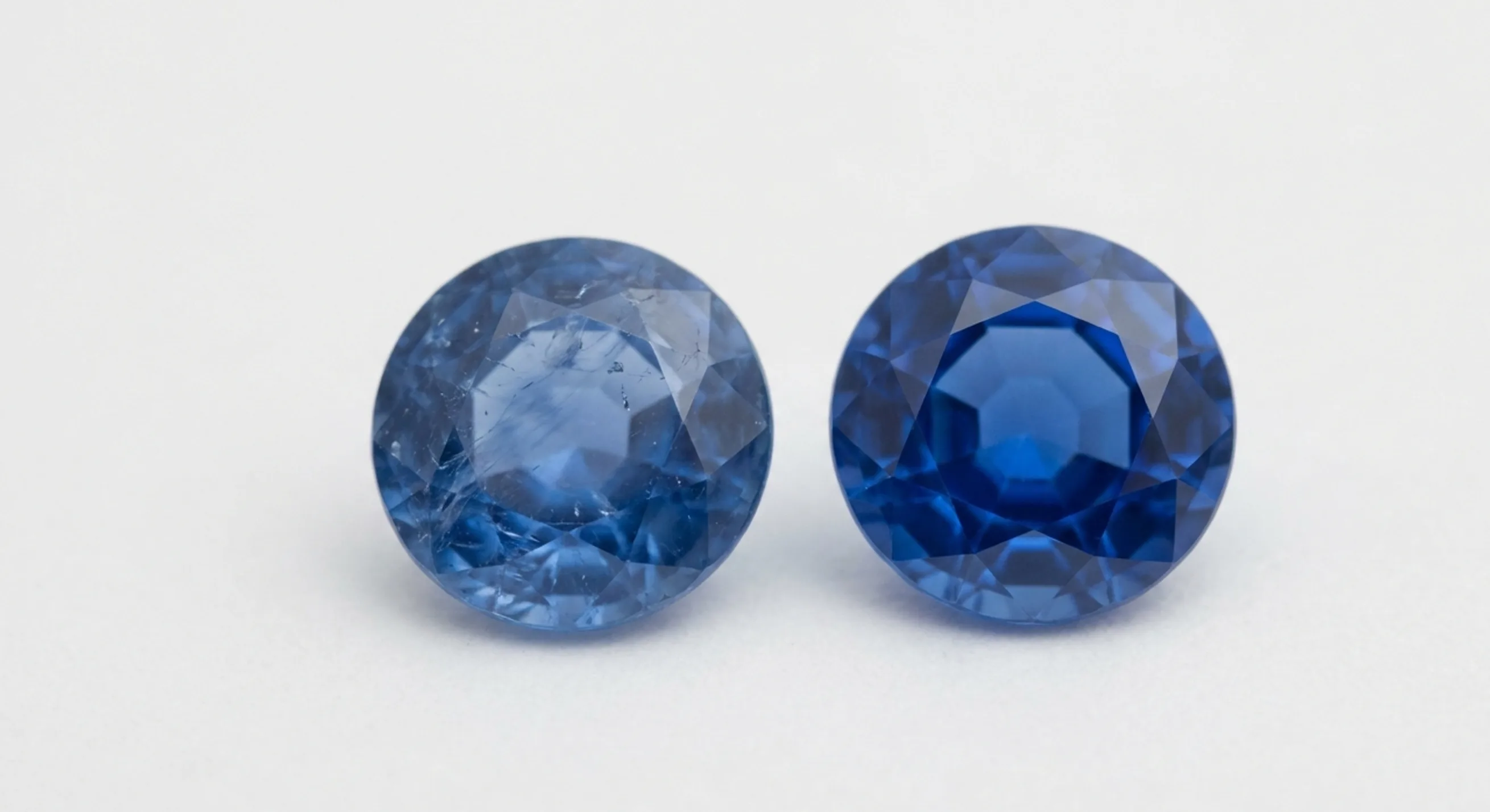
Royal blue is the deeper, more saturated end of the top band, running from pure blue to slightly violetish blue. Set a violetish Ceylon blue next to a royal blue and the violetish stone usually looks brighter and livelier, while the royal looks richer and heavier. Neither one is "better." They are different points on the top band, and which you prefer is a matter of taste.
Is a violet blue sapphire rare?
A slight violet modifier is common in Ceylon blue. Rarity is not about the violet itself. It is about everything that has to sit alongside it. A stone that holds a slight violet modifier, a medium to medium-dark tone, strong saturation and eye-clean clarity, and does not slide toward purple or gray as the light changes, is a much smaller group.
Then there is treatment. An estimated 90 to 95% of sapphires on the market, Ceylon included, are heated. Heat treatment is the accepted, disclosed industry standard, and a well-heated violetish blue is a fine stone in its own right. Unheated Ceylon sapphire is a very small share of global supply, and that scarcity is why it sits in the premium tier.
How much is a violet blue sapphire worth?
No source I trust prices violetish blue separately from pure blue, and that tells you something in itself. The market treats a slight violet modifier as part of the blue band.
Here is where the broader blue market sits:
| Segment | Typical range |
|---|---|
| Commercial heated, 1 to 3 ct | $500 to $2,500/ct |
| Most certified 1 to 3 ct Ceylon stones | $1,500 to $6,000/ct |
| Fine heated, rich blue to violetish blue, eye-clean, 1 to 3 ct | $3,000 to $8,000/ct |
| Fine unheated, 1 to 3 ct | $7,000 to $18,000/ct |
| Fine unheated Ceylon, top end | $20,000+/ct |
Size pushes price per carat up steeply, with clear steps at 1, 2, 3 and 5 ct. For fine unheated Ceylon blue, a 5 ct stone can cost four to five times more per carat than a 1 ct stone of the same quality.
The unheated premium depends on quality and size. For fine stones it is roughly two to five times the price of an equivalent heated stone: about 2x at 1 ct, about 3x at 3 ct and up to 5x at 5 ct and above. At commercial grades the gap narrows sharply.
When is a violet tint worth paying for?
Pay the full blue price when:
- The stone reads blue first, in daylight and indoors, with the violet showing as a secondary glow.
- Tone sits in the medium to medium-dark range and saturation is strong to vivid.
- The violet is clean, with no gray mixed in.
- The cutter has oriented the table to the violetish-blue direction, so there are no green flashes face-up.
Expect a lower price when:
- The violet is strong enough that the stone reads purple under warm light. At that point it is competing with purple sapphire, not top blue.
- Gray mixes with the violet and gives a dull steely lavender. Grayish blues sit well below the top band.
- The tone is too light, so the stone looks pale lavender rather than blue.
- The tone is too dark, so the violet turns inky and the stone goes black in low light.
- Green shows at the edges, usually because the stone was cut off-axis to save weight.
A slight violet modifier on a well-saturated stone is a reason to buy, not to haggle. A strong one that changes the stone's identity under ordinary room light is a fair reason to negotiate.
How to judge a violet blue sapphire before you buy
You cannot judge a violet modifier from one studio photo. It needs to be seen moving, ideally in more than one kind of light, alongside a lab colour description and a clear statement of treatment. That is why every stone Crestonne lists comes with its own video, a written treatment statement and a report from an independent laboratory (TGL, Guild or GIC). Watch how the colour behaves as the stone tilts, check the colour line on the report and read the treatment statement before you compare prices.
If you are after a particular balance, say a bright Ceylon blue with a slight violet glow that holds up under warm light, you can ask us to find one through the custom order form for a loose stone. Or browse the collections to see what is available now.
Common questions
Frequently Asked Questions
Is a violetish blue sapphire less valuable than a pure blue one?
Not if the violet is slight. The trade places velvety blue to violetish blue, in medium to medium-dark tone with strong saturation, in the top value band. Value drops when the violet is strong enough that the stone reads purple, or when gray or green modifiers show up.
What causes the violet tint in a blue sapphire?
The blue comes from iron and titanium. The violet is usually put down to trace chromium added to that iron-titanium blue, though some references credit vanadium. Both can be present in the same stone, and no standard lab report states which one caused the tint.
How is violet blue written on a lab report?
Most labs give a plain colour description such as "violetish blue" without a quality grade or a trade name. Some labs, such as GRS, print trade terms such as Royal Blue and Cornflower Blue, so read the actual colour line rather than just the headline name.
Will a violet blue sapphire look different under indoor lighting?
It can. Shifts toward violet or purple under warm incandescent light are well documented in colour-change and vanadium-bearing sapphires. For ordinary violetish blues the effect varies from stone to stone, so watch the stone on video and check how it behaves in different light before you buy.
Are most violet blue Ceylon sapphires heated?
Yes. An estimated 90 to 95% of sapphires on the market, Ceylon included, are heated, which is the accepted and disclosed industry standard. Unheated stones are a very small share of supply and sit in the premium tier, often selling for roughly two to five times the price of an equivalent heated stone.