Understanding
Padparadscha Color Guide: Pink, Orange & the Perfect Balance
Padparadscha covers only a narrow band of pastel pinkish orange to orangey pink. This grading map shows where that band starts and ends, and why a stone just outside it sells for a fraction of the price.
10 min read
By Naseef AR
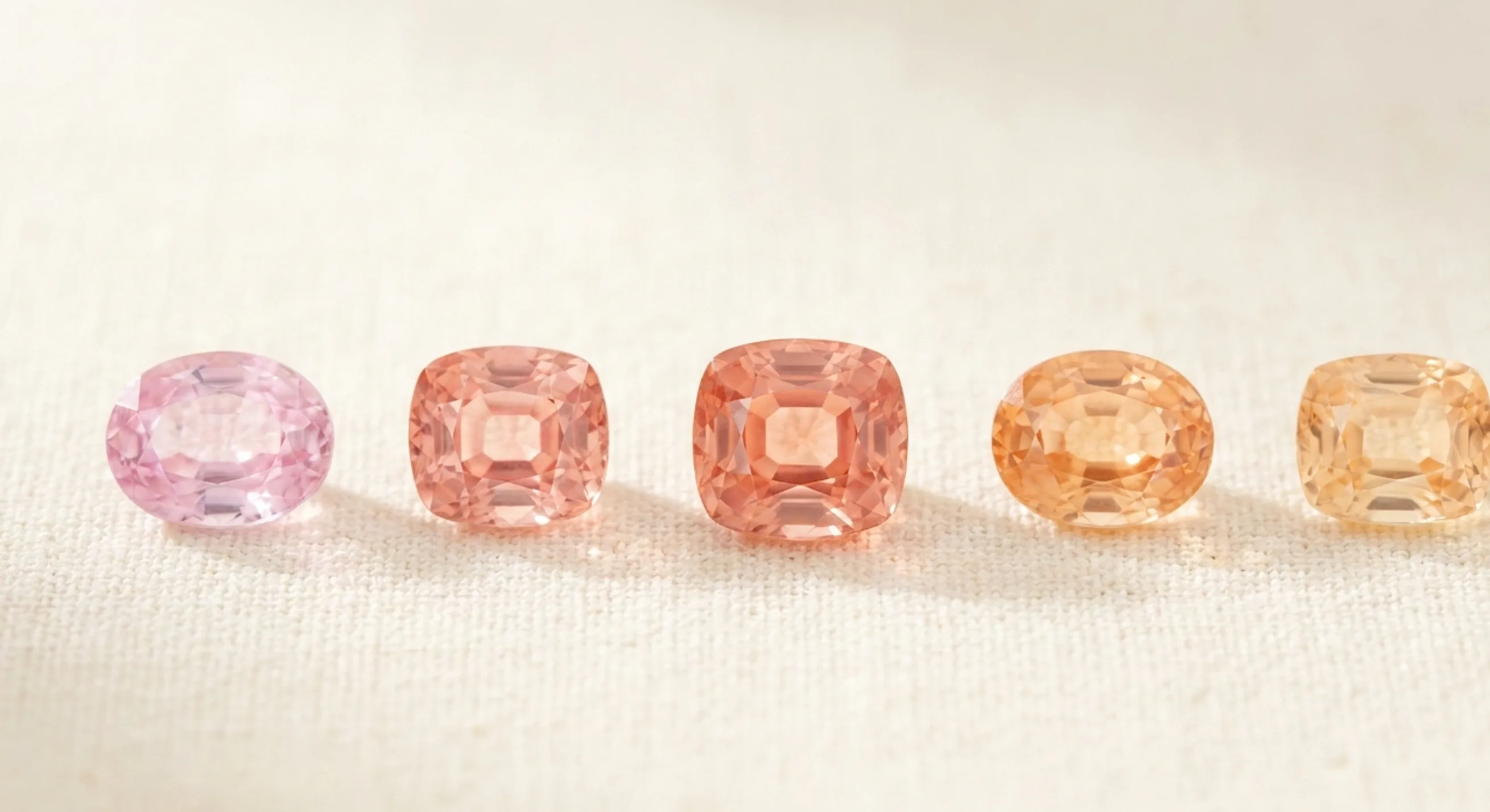
The padparadscha color range runs from orangey pink to pinkish orange. The tones are pastel, light to medium, with low to medium saturation, and the stone is judged in daylight. Push it too far toward pure pink or pure orange, let brown, grey or purple creep in, or diffuse it with beryllium, and the lab report will call it a pink orange sapphire instead. That one change of name can cut the price several times over. Here's exactly where the line sits.
Padparadscha also shifts between light sources, which I cover in why padparadscha looks different in each light. This one is about grading: how the labs decide what gets the name, and what to check before you buy.
What Is the Padparadscha Color Range, According to the Labs?
The working definition comes from the Laboratory Manual Harmonisation Committee (LMHC), and the current wording is Version 11, published in 2025. It says padparadscha is corundum of any origin whose overall colour is a subtle mix of pinkish orange to orangey pink, in pastel tones, with low to medium saturation. The stone has to be viewed in standard daylight, meaning a D50 (5000 K) to D65 (6500 K) source, ideally with a colour rendering index of 95 or higher.
Some of those words carry more weight than they appear to:
- "Any origin." Sri Lanka is the classic source, but a Madagascan or Tanzanian stone can carry the name if it fits. Origin is a separate line on the report.
- "Overall colour." The lab judges the face-up impression, not one corner of the stone.
- "Pastel." Padparadscha is a soft colour by definition. A deep, blazing orange-red is not a better padparadscha. It just isn't one.
- "Standard daylight." A stone that looks right only under a warm jeweller's spotlight hasn't passed anything.
GIA's older position, set out by Robert Crowningshield in 1983 and still quoted in the trade, says much the same: light to medium tones of pinkish orange to orange-pink. So the padparadscha color range has stayed fairly stable for forty years. The exclusions list is what's changed, and I'll get to that below.
On the gemmology: this is still corundum. It has a Mohs hardness of 9, a refractive index of about 1.762 to 1.770, and a specific gravity near 4.0. The pink comes from chromium. The orange comes from colour centres and trace iron. Getting both in balance in a single crystal is why padparadscha makes up less than 1% of global sapphire production, and it's a big part of why padparadscha is Sri Lanka's rarest sapphire.
How Much Pink and How Much Orange Should a Padparadscha Have?
The LMHC doesn't give a percentage. The trade does. The usual rule of thumb is that pink and orange should each make up roughly 30% to 70% of the colour, with the ideal close to 50/50. Treat it as a dealer's guide, not lab policy, but it's a useful way to picture the padparadscha color range as a line:
| Position on the scale | Typical description | Padparadscha? |
|---|---|---|
| Pure pink, a faint warm cast | Pink sapphire | No |
| About 70% pink, 30% orange | Orangey pink ("sunrise") | Yes, if tone and saturation fit |
| About 50/50 | Salmon, lotus | Yes, the classic centre |
| About 70% orange, 30% pink | Pinkish orange ("sunset") | Yes, if tone and saturation fit |
| Pure orange, a faint pink cast | Orange sapphire | No |
GRS uses two trade sub-names for the two halves of that band. "Sunrise" is mostly pink with orange (orangy pink). "Sunset" is mostly orange with pink (pinkish orange). Neither is wrong. Here's where taste comes in. Traditional Sri Lankan dealers tend to prefer a pink-dominant body colour. Many buyers in Europe and the US go for salmon or sunset tones. Every serious dealer agrees on one point, though: the stone should be neither too dark nor too light.
What Saturation and Tone Make a Good Padparadscha?
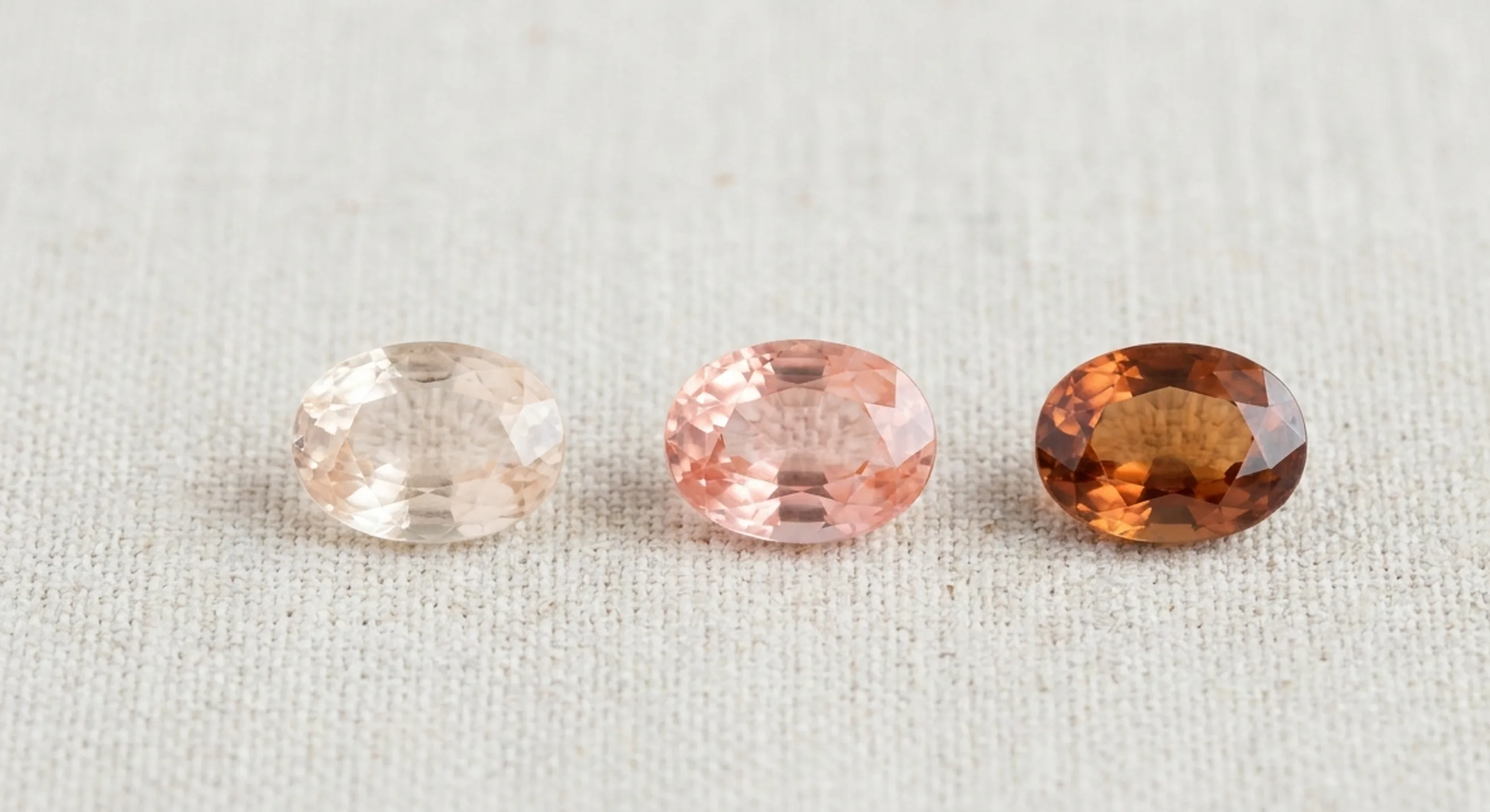
Hue gets the most attention, but tone and saturation matter just as much.
Tone is how light or dark the colour is. Light to medium is the target. Go darker and the orange tends to slide toward brown, and the pink toward a heavy rose. Go lighter and the stone turns into a washed-out peach that loses the push-pull between the two hues.
Saturation is how intense the colour is. The LMHC says low to medium. GRS lets its sunset type reach medium to strong. In practice, the best padparadscha quality sits at the upper end of medium: enough colour that the pink and orange both read clearly across a room, but soft enough to stay pastel. A stone at very low saturation looks greyish or milky, and that can be enough to lose the name.
Tone rules out many stones that have the right hue. A stone can be a perfect 50/50 salmon and still be one shade too dark, and at that point brown starts to show at the edges.
When Does a Pink Orange Sapphire Stop Being a Padparadscha?
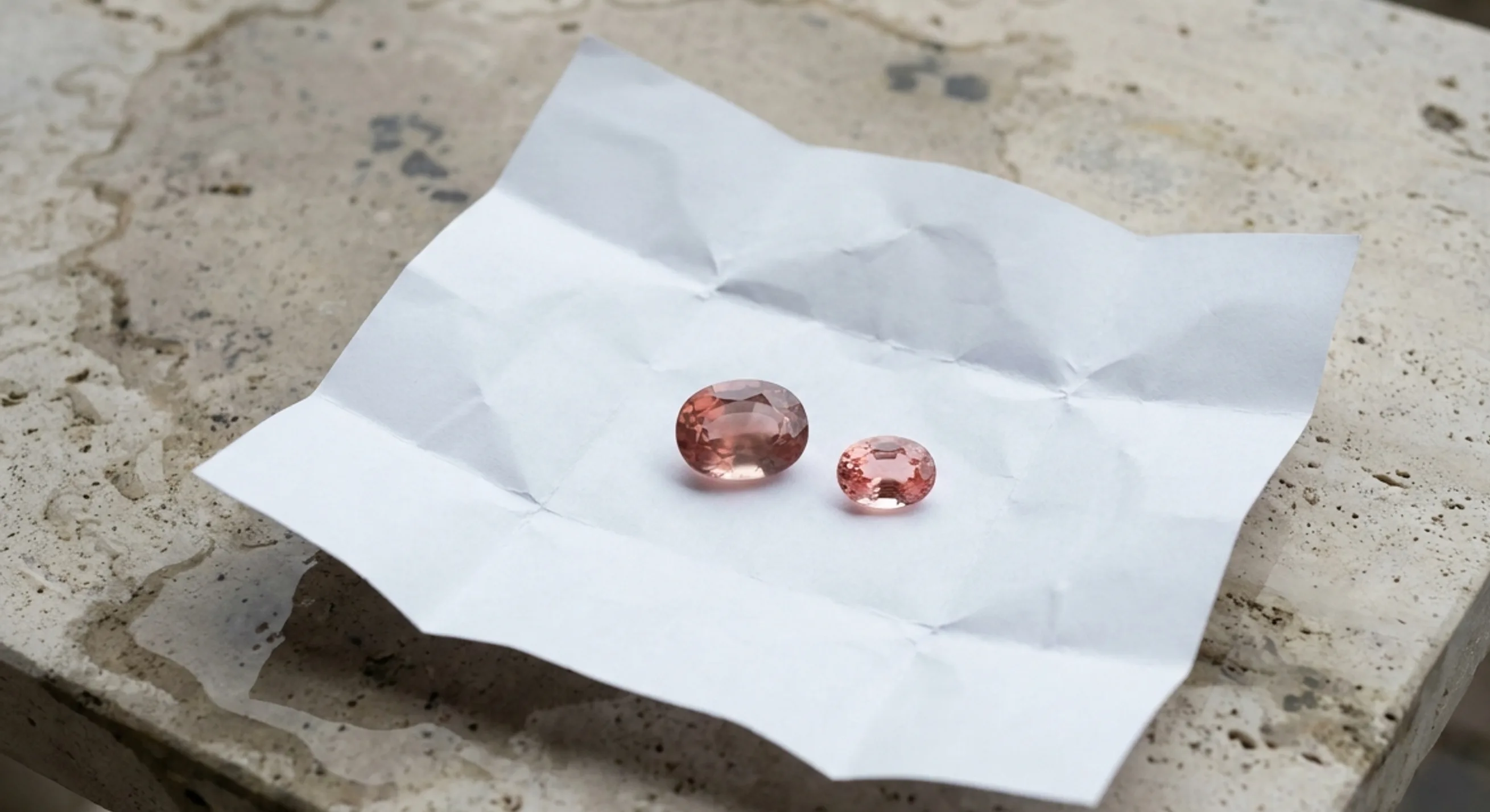
This is the part buyers rarely see written down. Under the 2025 LMHC wording, a lab will not use the term padparadscha if:
- Any colour modifier other than pink or orange is present. Brown, grey, purple and yellow all disqualify the stone. So does turbidity from tiny inclusions, which the V11 wording now names explicitly.
- The colour is clearly uneven. Major uneven colour distribution visible to the eye, face up and within about 30 degrees either side, rules the stone out.
- Yellow or orange staining in fissures affects the overall colour. Iron-stained fractures can fake an orange component that isn't really in the crystal.
- The stone has had lattice diffusion treatment, such as beryllium.
- The stone has been irradiated.
- The colour is unstable and moves out of range, for example to pink, in a stability test.
- The stone is dyed, coated, painted, varnished or sputtered.
One lab example makes the modifier rule clear: a pink-orange sapphire with a distinct purplish tone was reported only as "Purplish Pink Sapphire." It had the right two hues, but a third one got into the mix and the name was gone.
A faint smoky veil or a band of zoning often shows only in flat daylight or when the stone is tilted, which is why a stone that looks right under a strong indoor lamp can still fail. A stone just outside the padparadscha color range isn't a bad stone. It belongs in a different price bracket, and it should be sold as what it is: a pink orange sapphire.
Is a Heated Padparadscha Still a Padparadscha?
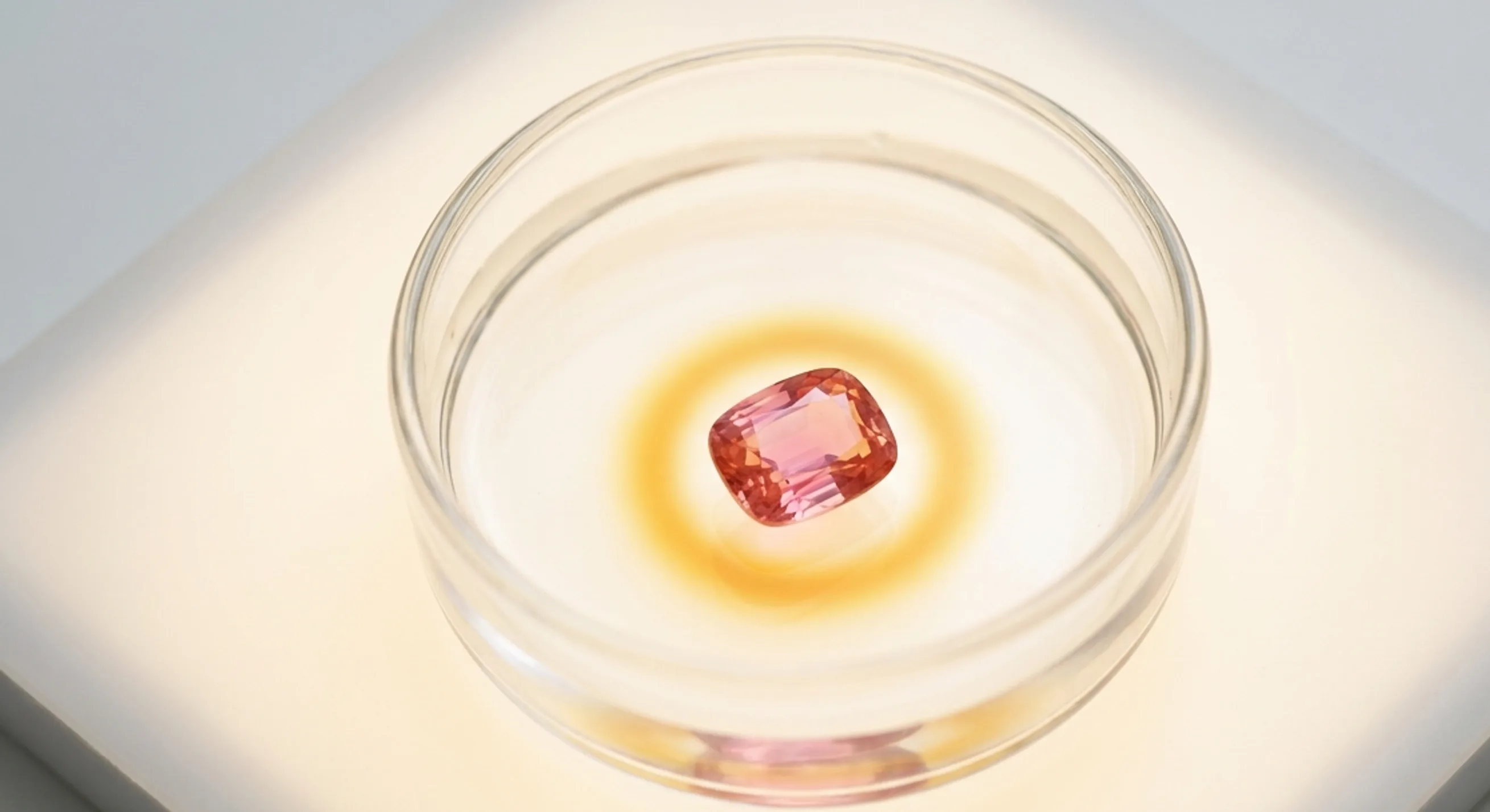
Yes. The LMHC is explicit that the name applies to both unheated and heated stones. Conventional heating is standard, accepted practice across the sapphire trade. It clears silk, evens out colour and brings out what the crystal already holds. Most fine Ceylon sapphire on the market is heated, and a heated padparadscha with the right colour is a padparadscha in every sense that matters. Unheated stones cost more simply because they're rarer, and collectors pay for that rarity.
Beryllium diffusion is another matter entirely. It's high-temperature heating above 1800°C that drives beryllium into the crystal and adds yellow, orange or brown colour. It first appeared around 2001 to 2002, when a flood of orange to orangy-pink "padparadscha-like" sapphires reached the market. Labs report these stones as lattice or diffusion treated. They don't call them padparadscha, even when the colour fits perfectly.
The usual clue shows up under immersion: a yellow or orange rim around a pink core. That's the reverse of natural Ceylon zoning, where the colour sits in the crystal's growth structure rather than in a skin from the outside in. You shouldn't have to spot this yourself, because the lab report should say it. It's still worth knowing why a cheap, perfectly coloured "padparadscha" with no report should worry you.
Why Do Labs Run a Color Stability Test on Padparadscha?
Since November 2018, a colour stability test has been mandatory for any corundum of padparadscha-like colour. The rule came after padparadscha-like sapphires from Ambatondrazaka in Madagascar, on the market from 2017, were found to shift from pinkish orange to pink over a few weeks. The orange was a temporary colour centre, not a permanent part of the stone.
The harmonised method is simple. The lab places the stone close to a strong LED or halogen lamp with little or no UV, roughly a 100 W lamp at 5 to 10 cm, for at least three hours, then checks whether the colour has moved. If it drifts out of the padparadscha color range, it loses the name.
The seven LMHC member labs that apply the harmonised definition are CGL, CISGEM, DSEF, Gübelin, GIA, GIT and SSEF. Look for a report from one of these labs, and don't treat a stone as padparadscha until its report uses the name.
How Does Color Affect Padparadscha Price?
Colour is the main driver of value, ahead of size and clarity. For stones around one carat, the bands look like this:
| Quality tier (around 1 ct) | Indicative price per carat |
|---|---|
| Near-padparadscha, no designation | US$800 to 2,500 |
| Good colour, documented | US$3,000 to 6,000 |
| Vivid, balanced | US$6,000 to 12,000 |
| Exceptional Ceylon | US$12,000 to 20,000+ |
The gap between the first row and the second is the value of the name itself. Size makes the curve steeper. Fine stones above 3 carats run around US$15,000 to 20,000+ per carat. Above 5 carats it's roughly US$25,000 to 50,000+, and past 10 carats there are too few stones to price at all. The auction benchmark is a 28.04 carat padparadscha ring that sold at Christie's in November 2017 for US$2,472,000, about US$88,000 per carat.
Treatment status changes the price too. As a guide, a fine 3 carat heated stone can reach about US$10,000 per carat, while a similar unheated stone can reach about US$20,000. In lower qualities, heated and unheated sell for about the same. In fine qualities, the unheated premium often runs 50% to 100%. Both are legitimate choices. The question is whether you're paying for colour or for colour plus rarity.
How to Judge the Padparadscha Color Range When Buying
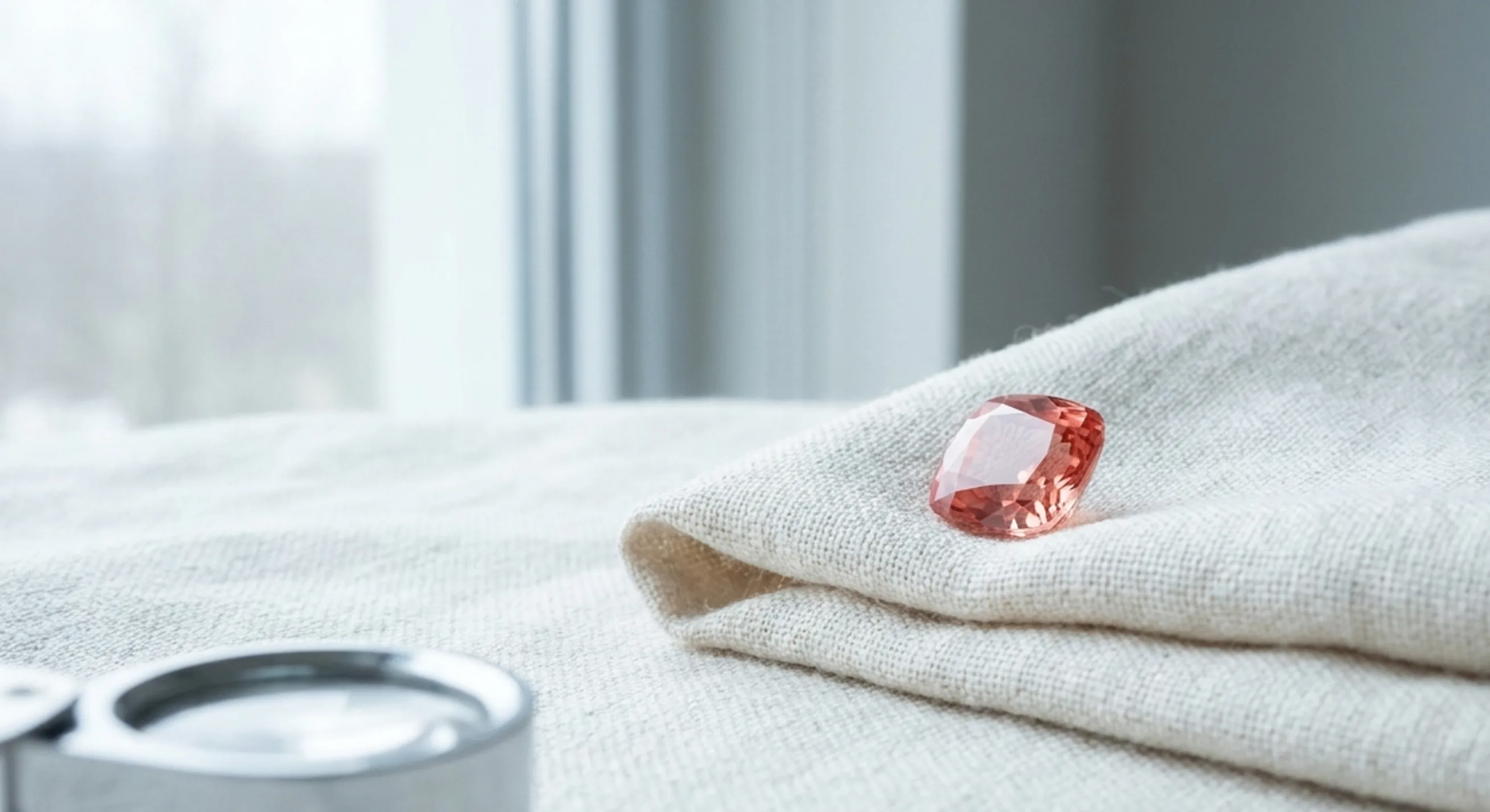
What to check, in order:
- Daylight first. Ask for video in natural daylight, ideally overcast or north-facing light, not just a studio photo. A warm lamp can turn almost any pink orange sapphire into a fake padparadscha on screen.
- Name both hues. Can you see pink and orange as two separate colours? If one swamps the other, the stone is probably outside the band.
- Hunt for the third colour. Look at the edges and the pavilion for brown, grey or purple. Even a faint veil counts.
- Tilt it. Look about 30 degrees off the table in each direction. Colourless windows or bands that show at those angles are what the zoning rule is about.
- Read the report. It should come from an LMHC lab, name the stone as padparadscha, state heat or no heat, and confirm there's no diffusion.
Those five checks cover what matters most for padparadscha quality.
If you'd like me to find a stone in a particular part of the padparadscha color range, pink-leaning sunrise or salmon-centre sunset, heated or unheated, start a loose stone custom order and I'll look for candidates that fit. You can also browse the Crestonne collections.
Common questions
Frequently Asked Questions
What colours count as padparadscha?
Only a subtle mix of pinkish orange to orangey pink, in pastel tones of light to medium depth with low to medium saturation, judged in daylight. Stones that are pure pink, pure orange, or carry brown, grey or purple modifiers fall outside the definition used by the major labs.
Is a heated padparadscha still a real padparadscha?
Yes. The lab definition explicitly covers both heated and unheated stones, and conventional heating is standard practice in the sapphire trade. Unheated stones are the rarer, premium tier. Beryllium-diffused stones are not called padparadscha, even when the colour looks right.
What is the ideal pink to orange ratio in a padparadscha?
No lab sets a fixed ratio, but the trade rule of thumb is that each hue should contribute roughly 30% to 70% of the colour, with a near 50/50 balance often considered ideal. Pink-leaning stones are called sunrise, and orange-leaning stones are called sunset.
Why would a lab call my stone a pink orange sapphire instead of a padparadscha?
The most common reasons are a brownish, greyish or purplish modifier, a tone that is too dark or too light, uneven colour zoning visible face up, iron staining in fissures, diffusion treatment, or colour that fades in the mandatory stability test.
Which labs can certify a stone as padparadscha?
The seven LMHC member labs that apply the harmonised definition are CGL, CISGEM, DSEF, Gübelin, GIA, GIT and SSEF. A report from one of these, stating heat status and confirming no diffusion, is the document to look for.