Understanding
Why Padparadscha Sapphire Looks Different in Each Light
One padparadscha can look pink under one bulb and salmon in north daylight. This guide covers the chemistry behind that shift, how it differs from true colour change and from fading, and how to check a stone in every light before buying.
8 min read
By Naseef AR
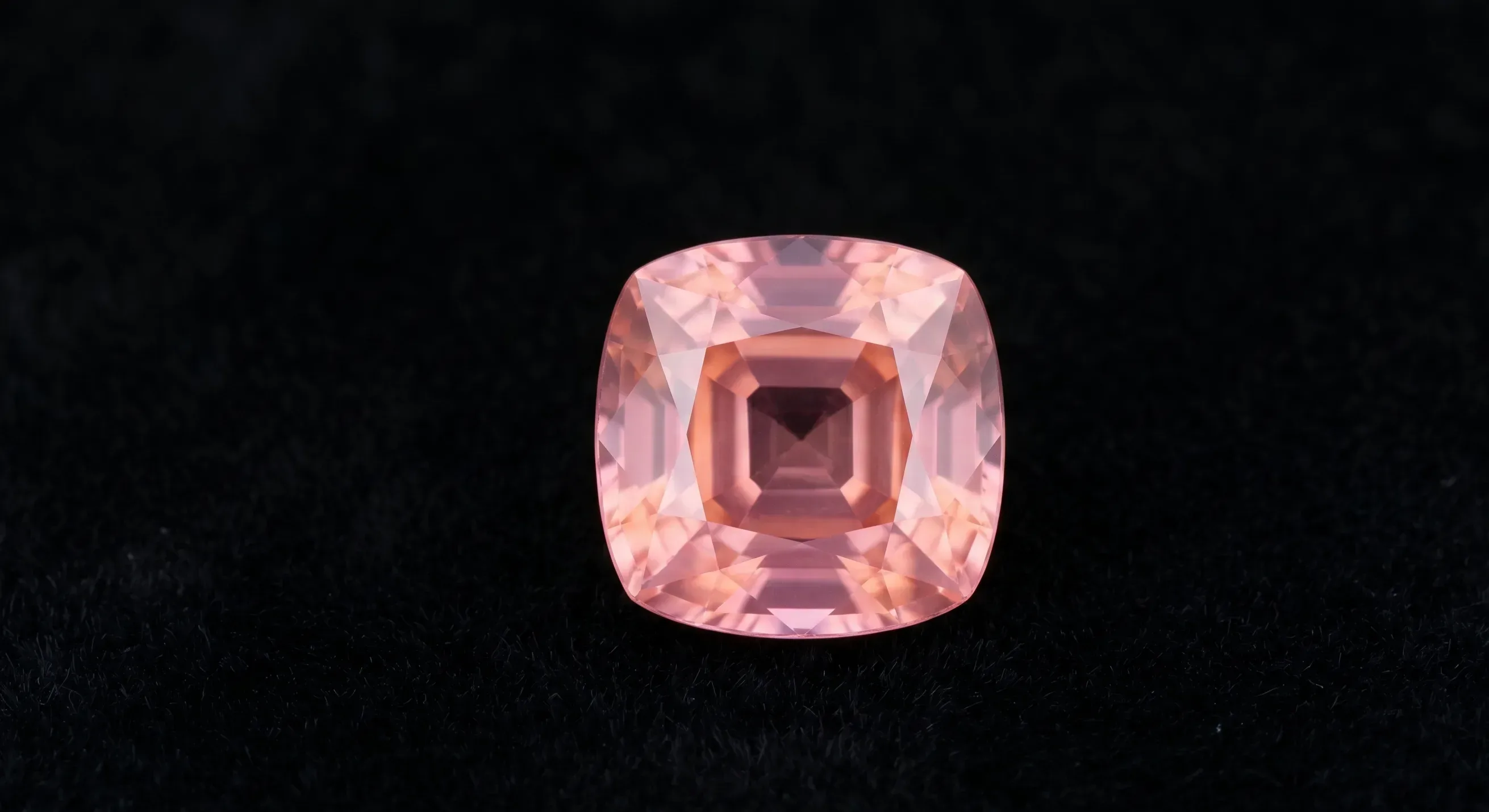
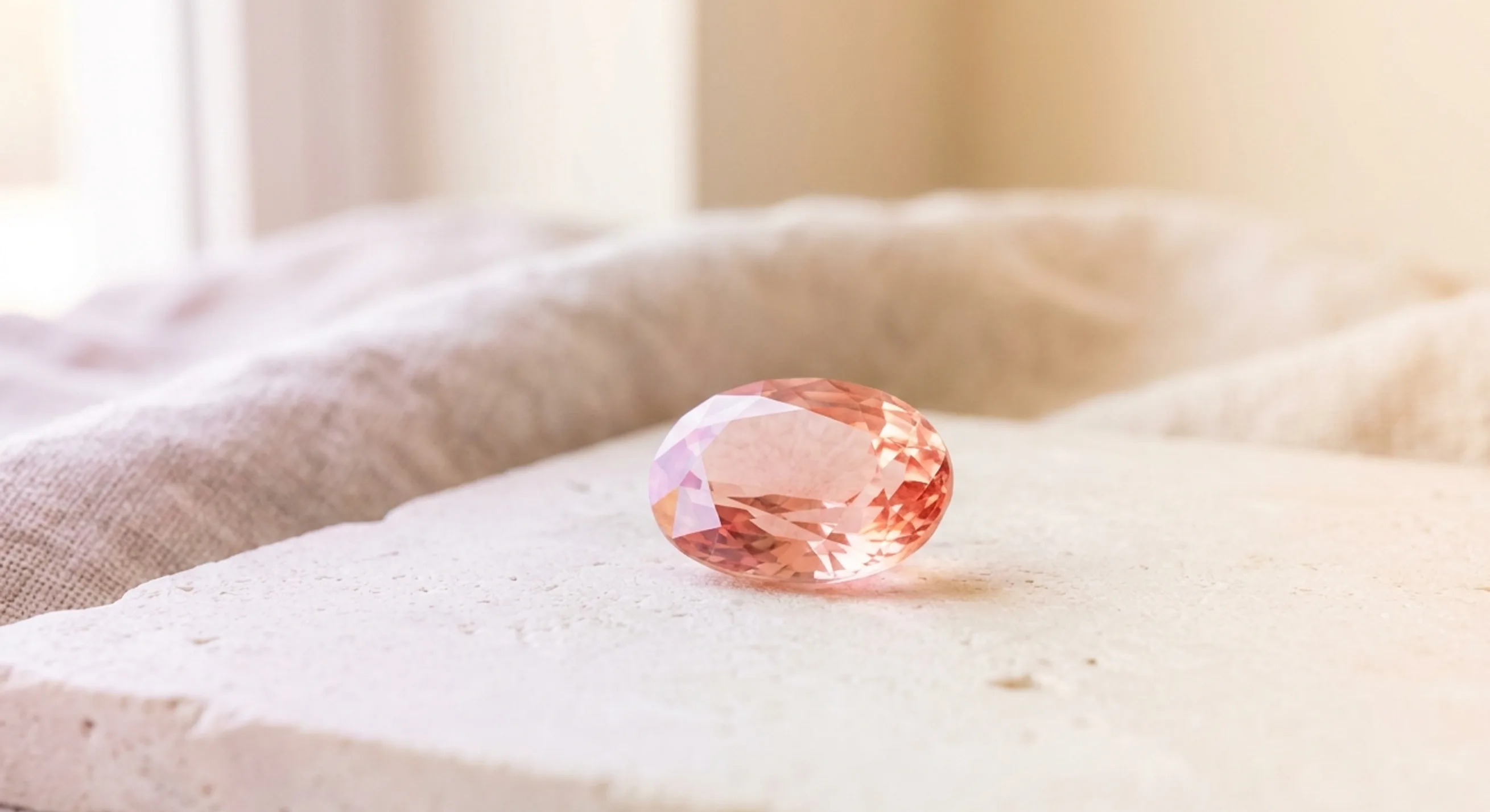
A padparadscha looks different in each light because its colour is two colours stacked together. Chromium gives it a stable pink. On top of that sits a yellow-to-orange from colour centres, which are tiny structural defects in the crystal that absorb blue light. Each light source feeds those two parts in different amounts, so the balance leans pinker under one bulb and more salmon in north daylight. That is padparadscha lighting in one sentence. The rest of this guide is about reading the shift: what is normal, what should worry you, and how to check a stone before you buy it.
What causes the pink and orange in padparadscha?
Start with the pink. Chromium (Cr3+) in the corundum lattice absorbs light in two main bands, one around 410 nm in the violet and one around 560 nm in the yellow-green. Take those out of white light and what reaches your eye leans toward red with a little blue. That reads as pink. In a padparadscha the chromium absorption is weak, so the pink is soft rather than ruby-hot. It is also stable. Light and time do not touch it.
The orange is the more interesting half. It comes from yellow colour centres, which absorb broadly across the blue. Take blue away from a pink stone and it slides toward pinkish orange. Some colour centres are rock solid. Others are fragile and can bleach under strong light or heat, which comes up again later in this piece.
Iron has a quieter role. Ceylon material tends to be low in iron, and iron is what dampens chromium's red fluorescence. With little iron in the way, a Sri Lankan stone can pick up a faint red glow from the ultraviolet in daylight. That is part of why fine Ceylon pads look lively outdoors instead of flat. For how the labs judge the balance between the two tones, see the padparadscha color guide.
So you have two absorbers that respond to different parts of the spectrum. Change the light falling on them and you change which one wins.
How does padparadscha lighting change the colour you see?
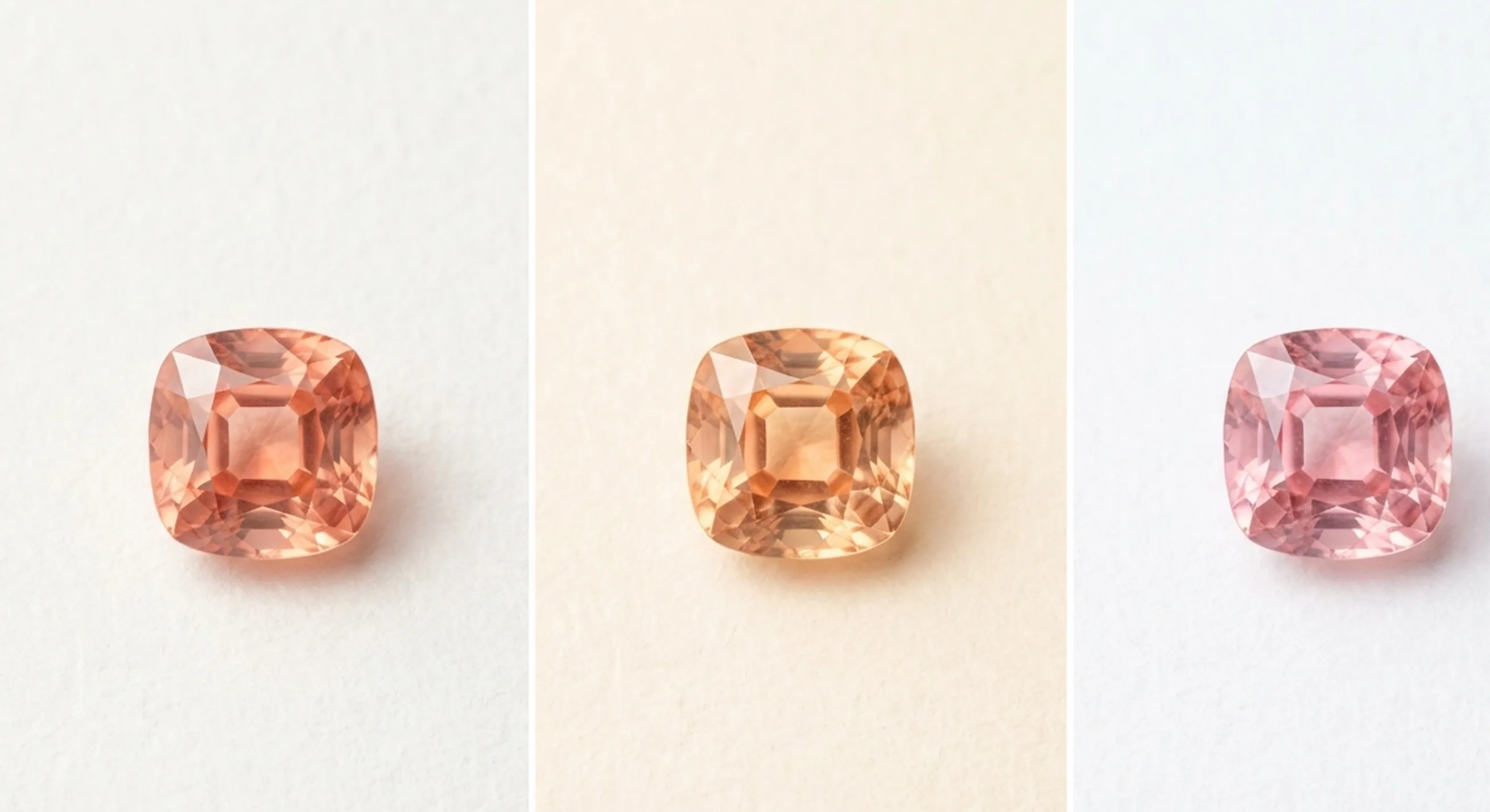
Every light source has its own spectrum, its own mix of red, green and blue. A sapphire can only give back what the light puts in.
- North daylight has the broadest, most even spectrum you will find, with plenty of blue and a little UV. It is also the official reference. The LMHC definition says padparadscha is judged in normal daylight and describes a subtle pink-orange to orange-pink mix, with pastel tones and low to medium saturation. GIA's range is light to medium pinkish orange to orange-pink.
- Incandescent and halogen bulbs are heavy on red and light on blue. They also give off a small amount of UV.
- Warm LEDs (around 2700K to 3000K) copy the warmth of incandescent light, but their spectra are spiky and contain almost no UV.
- Daylight-balanced LEDs come closer to daylight, though they have a strong blue peak.
- Cool fluorescent tubes give off light in narrow bands with gaps between them, so colours can look odd under them.
Padparadscha lighting is a moving target because the stone sits so close to the line between two hues. Put a blue sapphire under a warm bulb and it is still blue. A padparadscha has no such margin. A small change in the light is enough to tip it from orange-pink to pink-orange, or back again.
Does padparadscha look pinker or more orange indoors?
On this question guides contradict each other, and so do dealers. Some say warm indoor light pulls a padparadscha toward orange and salmon, while cool light brings out the pink. Others say the reverse: pinker under incandescent, and more orange (sometimes with a touch of brown) in daylight or under fluorescent tubes.
Both can be true. The direction depends on each stone's own balance between chromium and colour centres, so two stones that match in daylight can move in opposite directions under the same bulb.
The direction matters less than the distance. A good padparadscha moves, but it stays a padparadscha. It should look balanced across lights, and never turn plain pink in one room and plain orange in the next. So when you compare daylight vs indoor light, the question is not which way the stone moves. It is whether it stays in range. A stone that loses most of its orange under one light also deserves a fade test, because unstable orange is the bigger risk (see below).
Is this the same as sapphire color change?
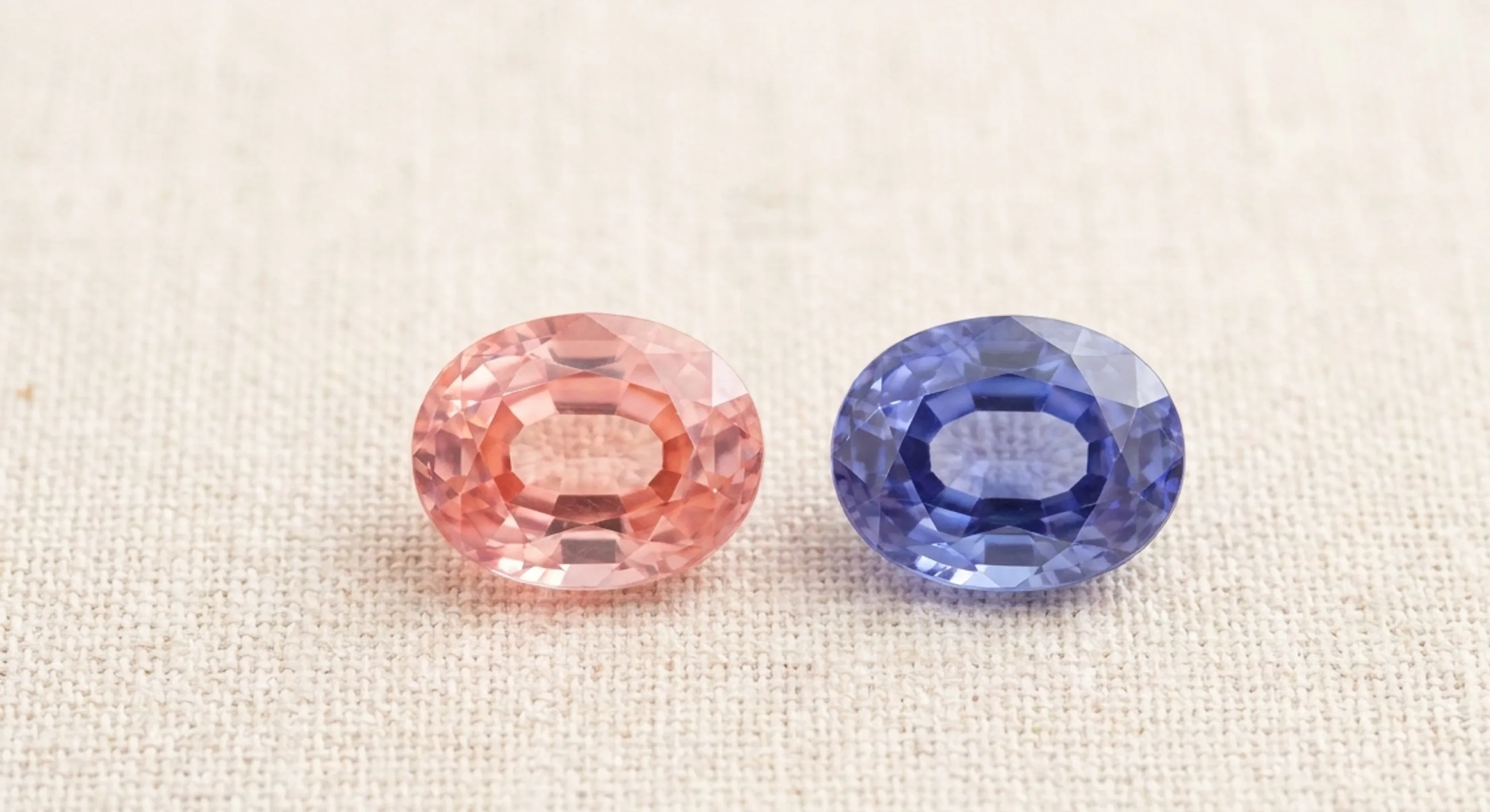
No. True colour change, often listed as sapphire color change, is a different effect with a different cause. It comes from vanadium, sometimes with chromium, which has a broad absorption band centred near 570 nm. These stones are blue or violet in daylight, fluorescent light or daylight-balanced LED. Under incandescent light, tungsten or candlelight they turn purple, pink or reddish purple. That is a full change between two named colours, not a variation inside one colour.
A padparadscha's shift between lights stays inside a single colour family. If a "padparadscha" goes from salmon to violet, it is not a padparadscha.
Can padparadscha colour fade?
This question separates a normal lighting shift from a real problem. Some padparadscha-type sapphires carry unstable colour centres. Expose them to light and the orange bleaches out, leaving a pink stone. A study of 48 padparadscha-type sapphires from Madagascar and Sri Lanka found only 9 that were fully stable. The rest either shifted slightly within the padparadscha range or drifted out of it altogether. In that work the unstable stones, mostly Madagascan, went from pinkish orange to pink within weeks of ordinary daylight. A short dose of UV brought the orange back, but only for a while.
That is why the major labs, GIA among them, run a colour stability test before they call a stone padparadscha. The stone spends at least three hours close to a strong lamp and is then graded again. If the colour is still in range, the name stands. Sunlight causes the same change, just more slowly.
There is a twist. Some sapphires gain orange from ultraviolet light, then drift back in the dark to their ground state, often purplish pink or pink. This fading and charging driven by UV is called tenebrescence. It is not a lighting shift, and it is not true colour change either.
Treatments are part of this picture. Irradiation can create or strengthen orange colour centres in pink sapphire, and that orange may fade in daylight. Some irradiation is hard to detect directly, which is another reason labs rely on fade tests. Beryllium diffusion can also produce colours that look like padparadscha.
Standard heat treatment, the industry norm, is reassuring here. Heating sapphire to 1200 to 1300°C or more normally bleaches out unstable colour centres, so a heated padparadscha keeps the colour it has when it leaves the furnace. Whether a stone is heated or unheated, what you want to avoid is unstable colour sold without testing. Stable colour that stays in range is also part of why padparadscha is Sri Lanka's rarest sapphire.
How to judge padparadscha lighting before you buy: a checklist
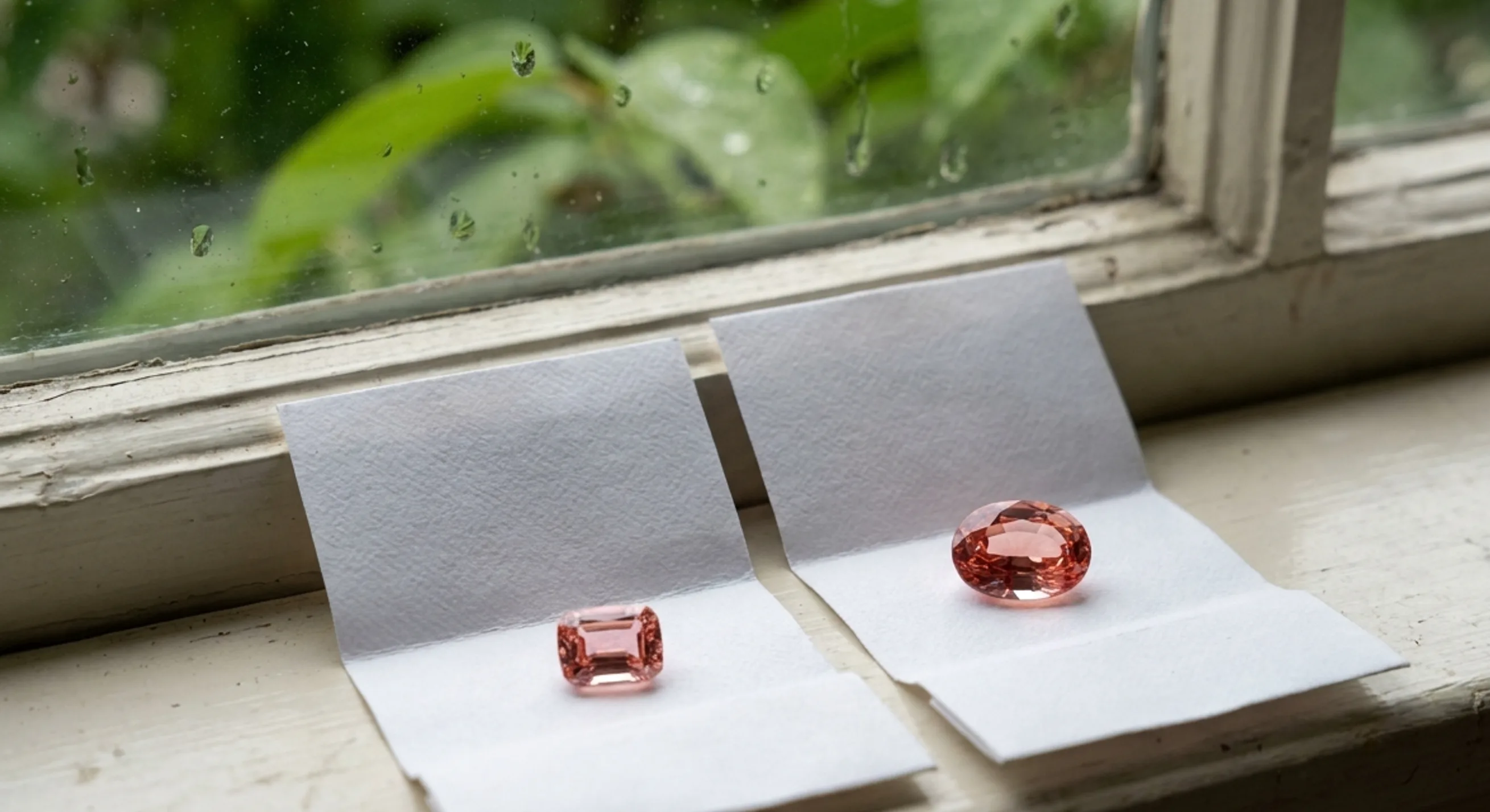
This routine works whether the stone is in front of you or on a seller's video.
- Start in north daylight. Use indirect light in mid-morning or early afternoon, never direct sun. This is the reference light the definition is based on.
- Move to a warm bulb. Incandescent or a 2700K LED. Note which way the colour moves.
- Then try a cool source. A fluorescent tube or a daylight-balanced LED. Note the shift again.
- Ask whether it stays pink-orange in all three. Movement is normal. Leaving the colour family is not.
- View it on white paper or a white tray. Black velvet and skin both distort colour.
- Read the report. Look for a padparadscha designation from GIA, SSEF or Gübelin, which means the stone has passed a stability test, and for a clear statement on heat.
- Ask about every treatment by name. Heat, beryllium diffusion, irradiation.
- Ask for video in more than one light. A photo shows one controlled light and cannot show the shift.
- Question saturation that goes beyond pastel. The definition calls for low to medium saturation. Vivid orange plus vivid pink is a reason to dig further.
Point 8 is where online buying usually goes wrong. A studio photo of a padparadscha is accurate in exactly one light. Ask for footage shot the same day in north daylight and under a warm indoor bulb, so you see how the stone moves between lights before you pay, not after.
If you would like a padparadscha chosen this way, tell me the size, shape and tone you are drawn to, and I'll look for loose stones that fit. Start a loose stone request, or browse the Crestonne collections.
Common questions
Frequently Asked Questions
Why does my padparadscha look pink indoors but orange outside?
Padparadscha colour has two parts: a stable pink from chromium and a yellow-to-orange from colour centres that absorb blue light. Warm indoor bulbs and daylight have different spectra, so they feed those two parts differently. Some stones go pinker indoors and some go more salmon. The direction depends on each stone's balance. What matters is that it stays pink-orange in every light.
What is the best light for viewing a padparadscha sapphire?
Indirect north daylight. The LMHC definition of padparadscha uses normal daylight as the reference. After that, check the stone under a warm bulb and a cool or daylight-balanced LED to see how far it moves.
Is a padparadscha's lighting shift the same as a colour-change sapphire?
No. True colour-change sapphire contains vanadium. It shows a full change between two named colours, usually blue or violet in daylight and purple or reddish purple under incandescent light. A padparadscha only moves within the pink-orange family.
Can padparadscha colour fade over time?
Some stones with unstable colour centres can fade from pinkish orange to pink in daylight, sometimes within weeks. Irradiated stones may fade too. This is why GIA and LMHC labs run a stability test under strong light for a few hours before they call a stone padparadscha. Standard heat treatment normally bleaches out unstable colour centres, so a properly heated stone's colour is stable.
Why does a padparadscha look different in photos?
A photo shows the stone in one light only, and studio lights and editing can push the colour toward pink or orange. Ask for video in north daylight and under a warm indoor bulb, shot the same day, so you can see how far the stone moves between lights.