Understanding
Colorless Gemstones: Natural White & Transparent Stones
The six natural colorless stones worth knowing, plus moonstone's milky cousins, compared on hardness, fire, durability, treatment and price.
11 min read
By Naseef AR
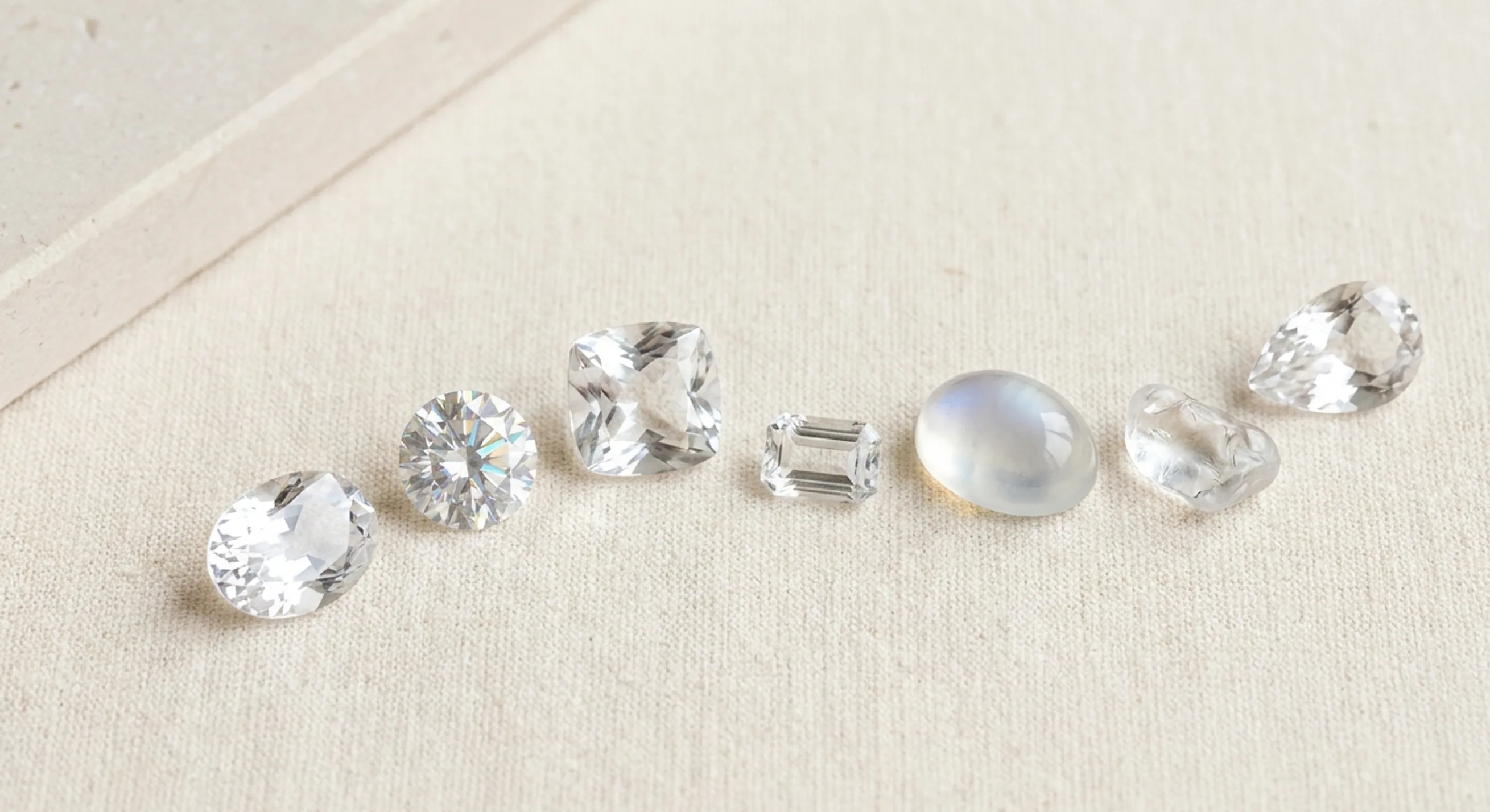
In the trade, white gemstones are colorless gemstones: transparent stones with no visible body color. The natural ones worth knowing are white sapphire, colorless zircon, colorless topaz (usually sold as "white topaz"), goshenite, danburite and colorless spinel. Moonstone and its milky relatives form a separate group, and they are the ones that actually look white. These stones are not interchangeable. Sapphire is Mohs 9 and top stones reach about US$1,500 per carat. Topaz often sells for US$5 to 15 per carat. Zircon has the most fire. Here is how they differ, and how to tell them apart.
What is the difference between white, colorless and transparent gemstones?
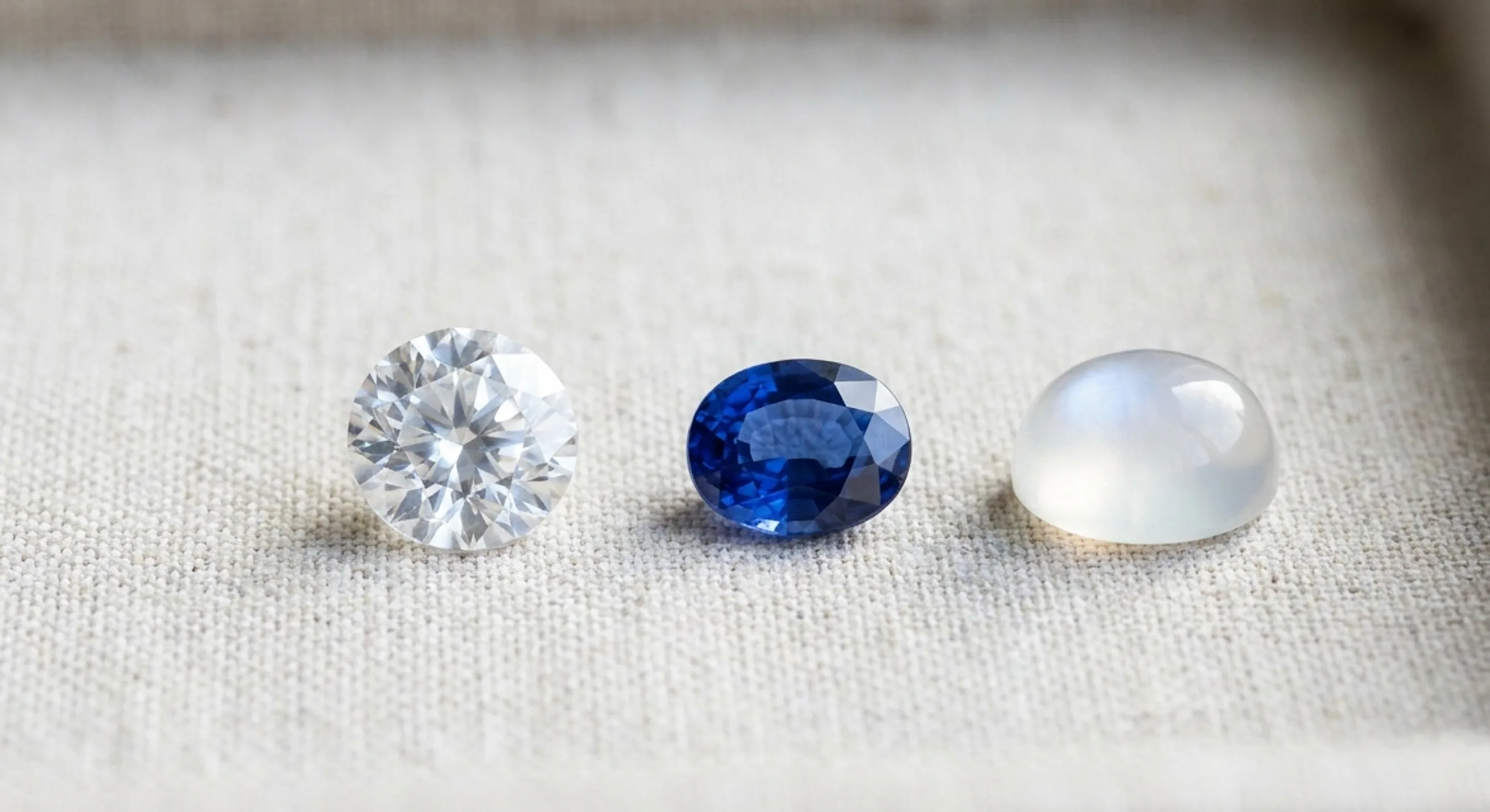
People use these words as if they mean the same thing. They don't, and mixing them up is how buyers end up with the wrong stone.
Colorless is the gemological term. It means the stone has no body color, or so little that you can't see it face-up. It works as a scale, not a yes-or-no. Plenty of stones sold as colorless have a faint tint that only shows against a white card.
White is trade shorthand for colorless. When a dealer says "white sapphire" or "white zircon", they mean a clear stone with no color, not one that is white like milk. Labs are stricter about names and use "colorless" for every species, so a report says colorless topaz or colorless sapphire where the trade says white topaz or white sapphire.
Transparent describes how light passes through a stone, not what color it is. A royal blue sapphire is transparent. So is a padparadscha. Every colorless gemstone is transparent, but most transparent gemstones have a color.
Milky means translucent. Light enters the stone, scatters off fine inclusions or internal structure, and comes back soft and diffused. Moonstone and milky quartz belong here. To the eye these stones really are white, and they behave nothing like a faceted colorless sapphire.
A simple rule: if you want sparkle, look for colorless and transparent. If you want glow, look for milky.
Which natural white gemstones are there?
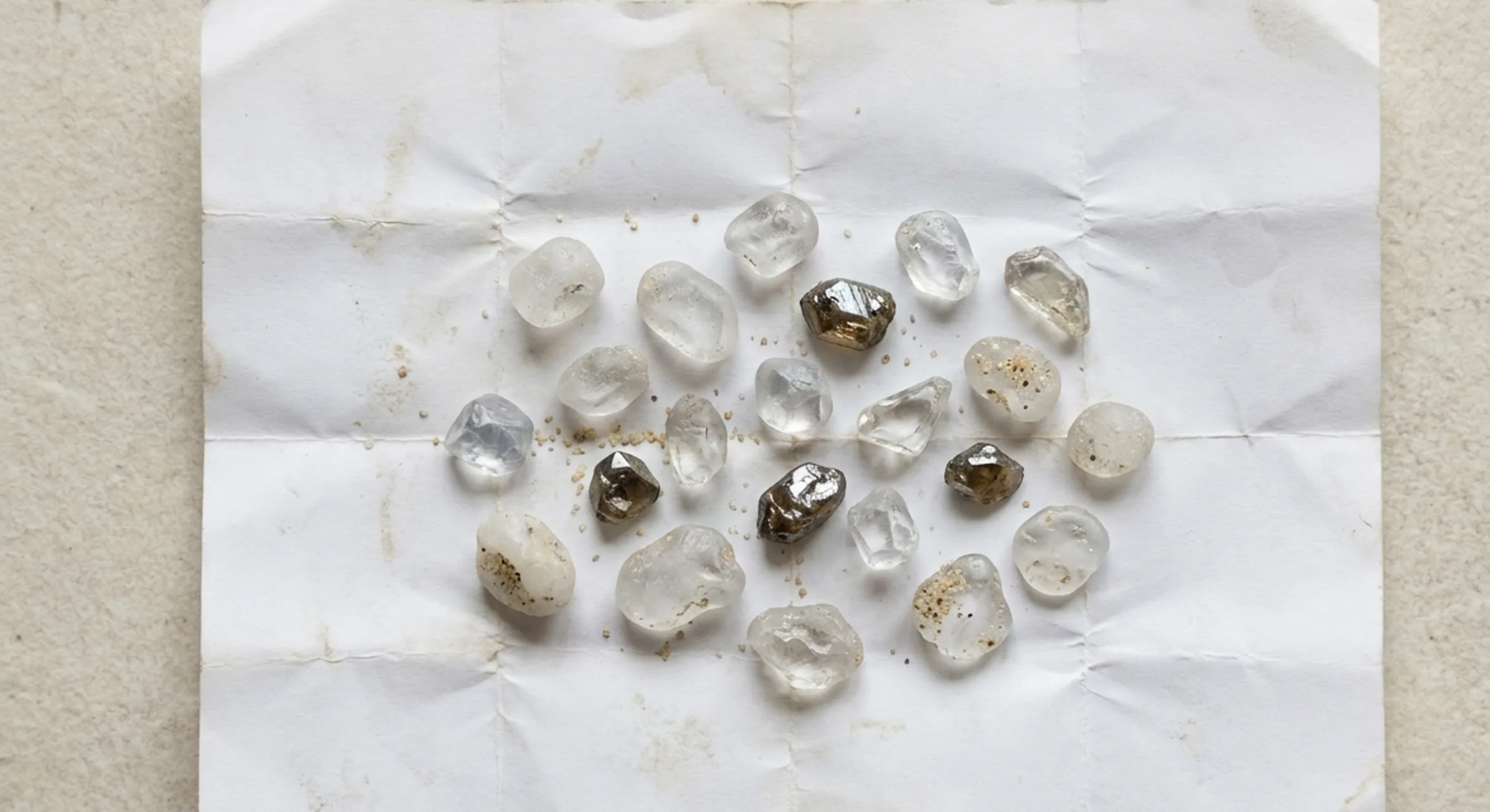
Six colorless species cover nearly everything you will see in fine jewelry, and then there is the milky group. Sri Lanka produces several of them. Its gem gravels yield colorless sapphire, zircon, topaz and quartz, and occasionally spinel. Goshenite and danburite mostly come from other countries.
White sapphire
White sapphire is colorless corundum: Mohs 9, refractive index 1.76 to 1.77. Diamond is Mohs 10 with an RI of 2.42. That difference in RI is why a white sapphire doesn't look like a diamond. Its brilliance is crisp and bright, but it shows far less rainbow fire. It reads as icy rather than flashy, and a well-cut stone is beautiful in its own way.
Ceylon is considered the most desirable origin for white sapphire. Price guides disagree, but commercial stones generally fall between US$50 and 500 per carat. Top gems with high transparency and a precise cut reach about US$1,500 per carat. Cloudy or poorly cut stones sell well below that. Lab-created white sapphire costs roughly US$50 to 150 per carat, so with a natural stone you are paying mainly for natural origin and the quality of the cut. Heat treatment is common and accepted. My guide to natural white Ceylon sapphire covers grading and origin in more depth.
Colorless zircon
Zircon has the most fire of any stone here. Its dispersion comes close to diamond's, so a well-cut colorless zircon throws real spectral color under a spotlight. It is also strongly doubly refractive. Look through the table with a loupe and the back facet edges appear doubled, which makes it easy to identify.
Its weakness is wear. Zircon sits at Mohs 6.5 to 7.5 and its facet edges are brittle, so years of daily knocks can chip the junctions. It is a great choice for earrings and pendants. In a ring it needs a protective setting.
Value is the other reason to buy it. Colorless zircon of 1 to 2 carats often trades at about US$15 to 80 per carat, and high-quality stones of 1 to 3 carats at about US$60 to 120. Zircon prices have been rising in the trade, but they are still far below sapphire or diamond. Much of the commercial white zircon on the market comes from Cambodia or Myanmar and is heated from brown rough. That is standard practice and usually disclosed. Zircon is not cubic zirconia, which is a synthetic. You can read more about Sri Lankan material in my piece on colorless Ceylon zircon.
Colorless topaz
Topaz is Mohs 8, inexpensive, and easy to find in large clean pieces. Colorless is the least valuable topaz color, typically US$5 to 15 per carat, with some fine stones listed at up to around US$50. It looks glassy and bright but shows little fire. The catch is perfect cleavage: a sharp knock in the wrong direction can split it, even though it is harder than zircon. Colorless topaz is also the starting material that gets treated to make blue topaz.
Goshenite
Goshenite is colorless beryl, the same species as emerald and aquamarine, at Mohs 7.5 to 8. Large clean crystals are fairly easy to find, so the price per carat rises only slowly with size. Entry-level material runs about US$3 to 10 per carat, good commercial stones US$10 to 30, fine stones US$30 to 60, precision-cut stones US$50 to 100, and collector pieces US$100 to 200 or more. Goshenite has a calm, watery look, and a precise cut makes more difference to it than to most stones.
Danburite
Danburite is a calcium borosilicate at Mohs 7 to 7.5. It is crisp and bright, with more life than you would expect at its price. Typical retail is around US$50 per carat, and stones over 15 carats reach roughly US$115 per carat. For reference, one 8.73 ct oval sold for about US$450 in total. It's an underrated choice for a large statement stone.
Colorless spinel
Spinel is Mohs 8, singly refractive (so no facet doubling), durable, and has no cleavage. Truly colorless natural spinel is rare, and dealers say they seldom see it even at trade shows. One example: a natural 1.35 ct Burmese stone priced at around US$275 per carat.
The problem is that most "white spinel" for sale is synthetic flame-fusion material. It has been made for more than a century as a stand-in for diamond and white sapphire, and it is worth a few dollars per carat. If you are paying a natural-stone price, ask for a lab report.
Moonstone and the milky cousins
These stones really are white. Moonstone is a feldspar at Mohs 6 to 6.5. It shows adularescence, the floating blue or silvery sheen that Sri Lankan moonstone is famous for. Milky quartz belongs in the same group. They are usually cut as cabochons rather than faceted, and they are judged on glow and sheen rather than brilliance. They are softer and cleave more easily than sapphire, so they work better in pendants and earrings than in rings worn every day.
How do white gemstones compare on hardness, sparkle and price?
Here is the field guide in one table. Prices are typical ranges from across the market. Treat them as a guide, not a quote.
| Stone | Mohs | Look | Typical price per carat | Treatment note |
|---|---|---|---|---|
| White sapphire | 9 | Crisp brilliance, low fire | US$50 to 1,500 | Heating common and accepted |
| Colorless zircon | 6.5-7.5 | Strong fire, facet doubling | US$15 to 120 | Heating routine |
| Colorless spinel (natural) | 8 | Bright, single refraction | Example around US$275 | Synthetics are the main risk |
| Danburite | 7-7.5 | Crisp and lively | Around US$50 to 115 | Ask for disclosure |
| Goshenite | 7.5-8 | Calm, watery | US$3 to 200+ | Ask for disclosure |
| Colorless topaz | 8, perfect cleavage | Glassy, low fire | US$5 to 50 | Base material for blue topaz |
| Moonstone | 6-6.5 | Milky glow, sheen | Varies widely | Ask for disclosure |
For comparison, cubic zirconia costs a few dollars per carat, with better-cut stones at around US$5 to 20. Lab-created white sapphire is about US$50 to 150.
Which white gemstone is the most valuable?
Among natural white gemstones, sapphire. Fine Ceylon white sapphire can reach around US$1,500 per carat. Documented natural colorless spinel comes next and is arguably rarer, but so few stones trade that prices are hard to pin down. Fine goshenite, danburite and zircon follow, and topaz comes last.
Heated white sapphire is the industry norm. Heating improves transparency and clears faint residual color, and a heated stone is an honest, fully legitimate gem. Unheated stones are the premium tier. They command a higher price because fewer come out of the ground clean enough without treatment, and a lab report from GIA, SSEF or Gübelin confirming "no indications of heating" is what supports that premium.
The most valuable stone isn't always the right one for you. For a ring you'll wear every day, sapphire or natural spinel will handle the knocks. For a big cocktail stone on a budget, danburite, goshenite or topaz give you size without a sapphire price. If you want fire, choose zircon and set it with some protection.
How can you tell if a white gemstone has a faint tint?
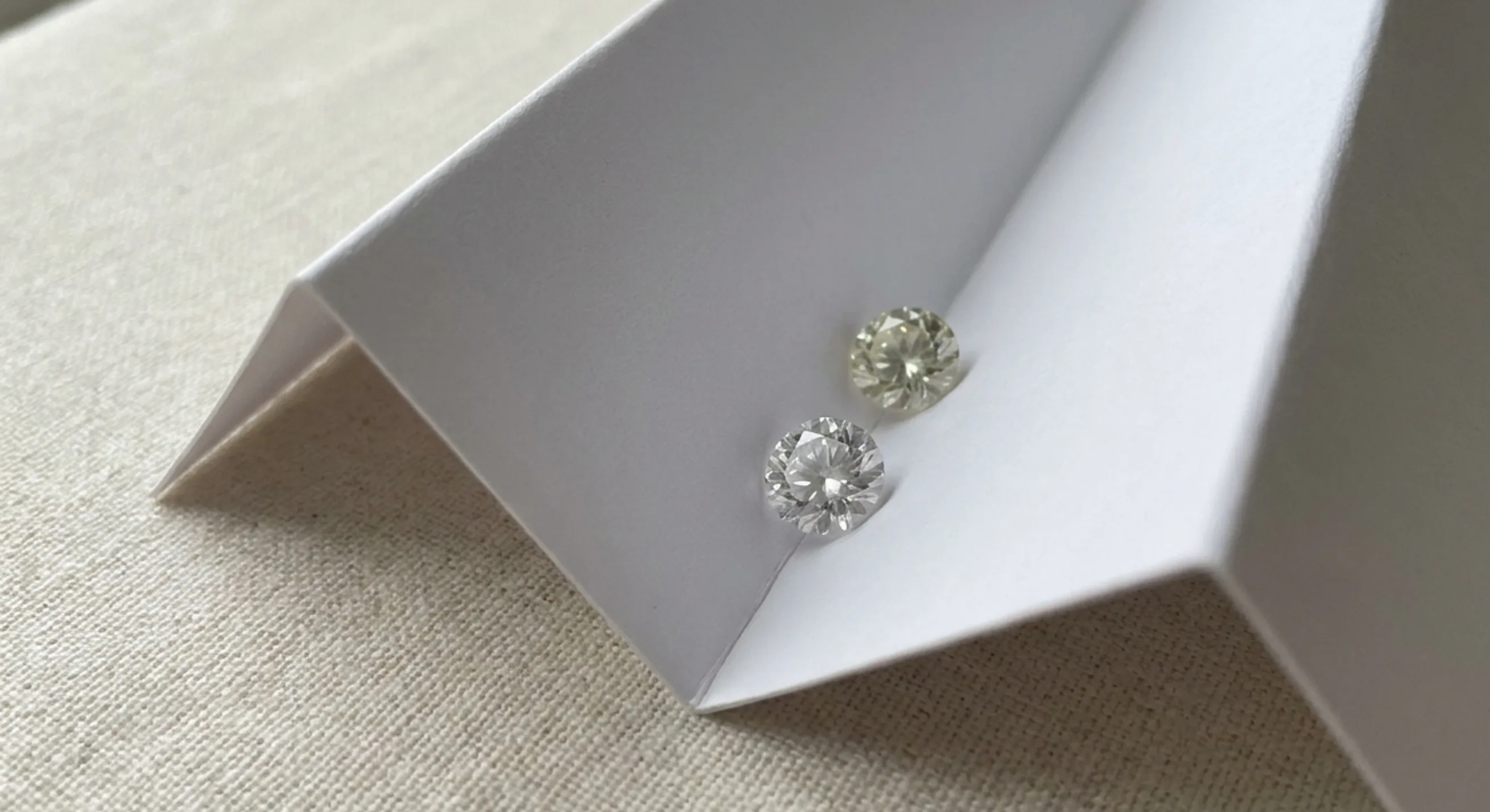
Many stones sold as colorless are really near-colorless, with a whisper of yellow, gray, brown or blue. That isn't a flaw in itself. A faint warm tint often looks lovely in yellow gold. It should just be reflected in the price. Here is how to check:
- Use a white card. Fold a sheet of plain white paper into a V, rest the stone in it table-down, and look through the side of the stone. Face-up, the brilliance hides color. Through the side, any tint shows.
- Use neutral daylight. Indirect daylight from a north-facing window is ideal. Warm bulbs add yellow, and the cold blue-white LEDs in many jewelry cases wash it out.
- Compare against a reference. Next to a truly colorless stone, a near-colorless one shows its tint at once. On its own, your eye adjusts to it.
- Check transparency as well as color. Fine silk or cloudiness makes a white sapphire look sleepy, and those stones sit at the bottom of the price range.
Photos are where tint usually gets lost. Bright studio lighting and pure-white backgrounds can bleach a faint tint out of an image. So ask the seller to describe any tint in plain words and to show you the stone on video, in daylight, on a white card. Every stone Crestonne lists comes with its own video.
Are white gemstones heated or irradiated?
Some are, routinely. Here is the honest picture:
- White sapphire: Heating is common and accepted. It removes faint color and improves clarity. Unheated stones are the premium tier and should come with a lab report.
- Colorless zircon: Heating is routine. Most commercial white zircon starts out as brown rough, and good listings say "heated" plainly.
- Colorless topaz: It is the base material that gets irradiated and heated to make blue topaz. If you're buying a colorless stone, ask whether it has been treated. A good seller will tell you straight away.
- Colorless spinel: Treatment isn't the main issue. Synthetic material is. A lab report separates natural from flame-fusion.
- Goshenite, danburite and moonstone: Ask for disclosure. A lab report settles any doubt on a significant stone.
Treatment status should always be in writing. For the stones Crestonne sells, treatment is stated on every listing, and every stone comes with a lab report.
Choosing your white stone
Colorless gemstones reward buyers who know what they're looking at. Pick sapphire for durability and value, zircon for fire, spinel for rarity, and danburite, goshenite or topaz for size on a budget. Look at every stone on a white card in daylight before you decide.
If you want a natural white stone sourced from Sri Lanka, cut to your spec and documented properly, start a loose stone request and I'll look for stones that match. You can also browse the Crestonne collections.
Common questions
Frequently Asked Questions
What is the hardest natural white gemstone after diamond?
White sapphire. It is colorless corundum at Mohs 9, just below diamond's 10. That makes it the most practical natural colorless stone for a ring worn every day.
Is white topaz the same as white sapphire?
No. Colorless topaz (the correct name for 'white topaz') is Mohs 8, has perfect cleavage and usually costs US$5 to 15 per carat. White sapphire is Mohs 9, much tougher in daily wear, and generally sells for US$50 to 1,500 per carat depending on quality.
Which white gemstone has the most sparkle?
Colorless zircon. Its dispersion comes close to diamond's, so it shows strong rainbow fire. White sapphire has crisp brilliance but much less fire. Zircon is softer and its facet edges chip, so it needs a protective setting in rings.
Is white spinel natural?
Most white spinel on the market is synthetic flame-fusion material worth a few dollars per carat. Natural colorless spinel exists but is rare, so if you are paying a natural-stone price, ask for a report from a recognized lab such as GIA, SSEF or Gübelin.
Are heated white sapphires worth buying?
Yes. Heating is the industry norm for white sapphire. It improves transparency and clears faint residual color, and a heated stone is a legitimate natural gem. Unheated stones are the premium tier and should come with a lab report confirming no indications of heating.