Understanding
White Sapphire vs Diamond: What's the Difference?
A side-by-side look at white sapphire and diamond on sparkle, hardness, daily wear, price per carat and identification. It includes what Sri Lankan cutters do to make white sapphire brighter, and an honest view of when a diamond is the better buy.
11 min read
By Naseef AR
White sapphire vs diamond comes down to three trade-offs. A diamond returns more light and throws far more colored fire. It is harder, 10 on the Mohs scale against sapphire's 9. And it costs several times more. A fine one-carat colorless Ceylon sapphire typically sells for about $200 to $700 per carat. A natural one-carat diamond in a commercial H to I, SI grade starts around $2,800. Sapphire gives you a crisp, icy white look, no cleavage, and a natural mined stone for a fraction of the money. Diamond gives you maximum sparkle and less upkeep.
That's the summary. The detail matters because most people asking this question have a budget and a picture of a ring in mind. A wrong choice usually shows later, when the stone looks flatter than expected under indoor light. Below is where white sapphire wins and, just as plainly, where it doesn't. For background on the stone itself (origin, treatment, grading), read my guide to natural white Ceylon sapphire. This piece stays on the head-to-head.
White sapphire vs diamond: which one sparkles more?
Diamond, and it isn't close. Two numbers explain why.
Refractive index measures how strongly a stone bends light. White sapphire sits at 1.762 to 1.770. Diamond is 2.417. The higher the number, the more light a well-cut stone can trap and send back toward your eye. That returned white light is brilliance.
Dispersion measures how much a stone splits white light into spectral colors, the red, orange and blue flashes people call fire. Sapphire's dispersion is 0.018. Diamond's is 0.044, well over double. For reference, cubic zirconia is around 0.060, which is why cheap CZ can look almost rainbow-like.
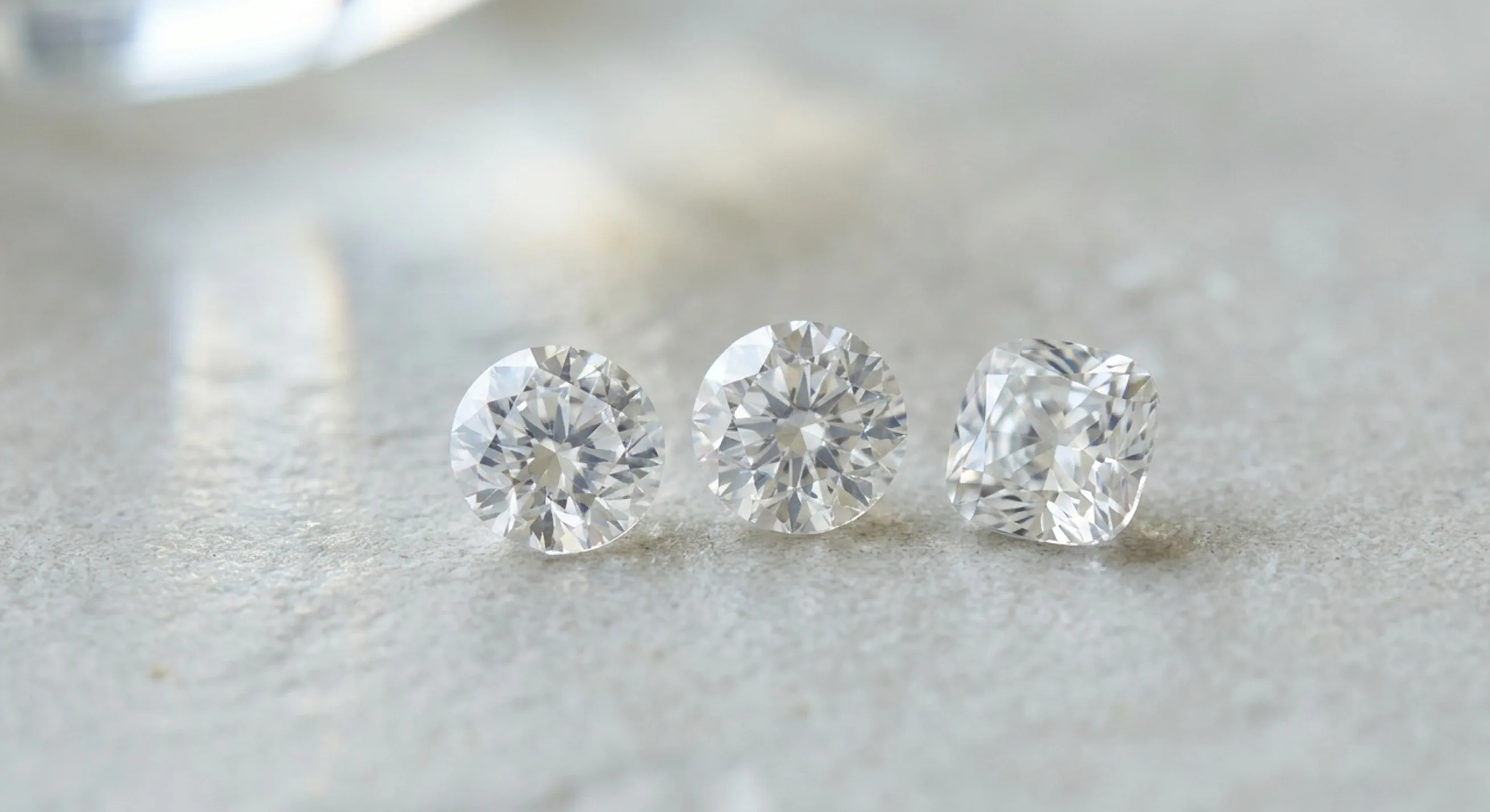
In practice, a well-cut diamond shows a sharp pattern of black and white contrast with frequent colored flashes as it moves. A well-cut white sapphire shows broader, softer flashes of white light, very little color, and a cleaner, glassier look. Some buyers prefer that calmer look. But if fire is what you picture when you think of a ring, sapphire will not give it to you.
The lower refractive index has a second, less obvious consequence. Every gem has a critical angle. Light that strikes a pavilion facet at a glancing enough angle reflects back up through the top; light that hits more head-on escapes out the back. Diamond's critical angle is about 24.4 degrees, which gives cutters a generous margin. Corundum's is about 34.5 degrees. That narrower window makes white sapphire far less forgiving. A diamond cut slightly off still looks bright. A white sapphire cut slightly off looks like glass with a hole in the middle.
How do Sri Lankan cutters make white sapphire brighter?
This is where the source and the cutter matter more than with almost any other stone.
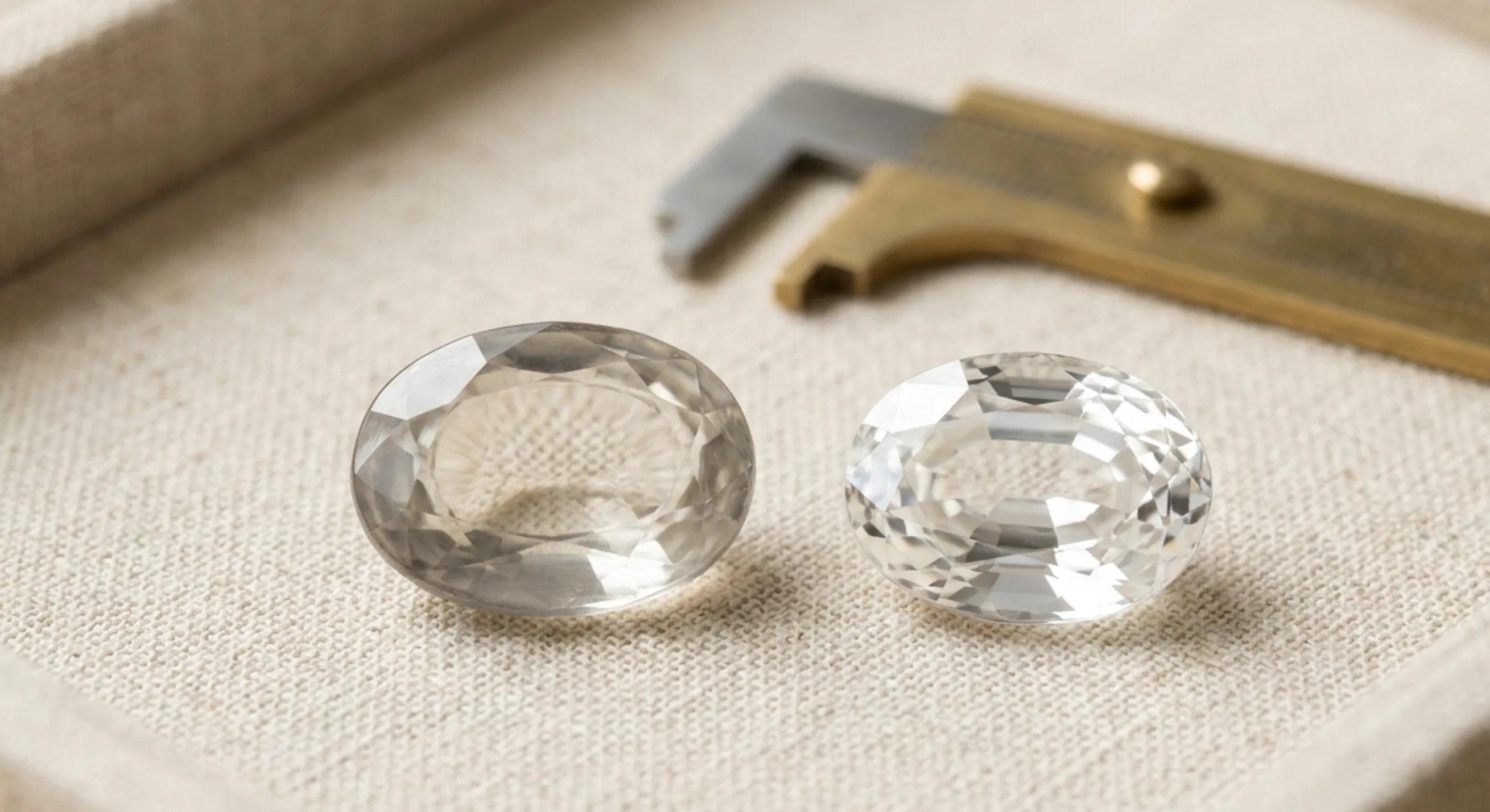
Traditional Sri Lankan cutting, what the trade calls a native cut, was built to save weight. Rough is sold by the carat, and a deep, bulging pavilion keeps more of it. With blue sapphire that can work, because depth intensifies color. With a colorless stone it backfires. There's no color to hide behind. A pavilion that's too steep sends light out the sides and the stone goes dark, which cutters call extinction. One that's too shallow lets light pour straight through the middle: a window.
For corundum, the pavilion angles that keep light inside sit around 42 to 43 degrees, slightly steeper than the 40.75 to 41 degrees considered ideal for a round diamond, because of that larger critical angle. Published recommendations vary by a few degrees, and experienced faceters work anywhere from about 42 to 44 depending on the crown and the stone's tone.
Correcting a native-cut pavilion to these angles always costs weight, because the cutter has to grind away the bulge that was kept to hold carats. That lost weight is the price of brightness in white sapphire. It is also why a well-cut stone costs more per carat than a native-cut stone of the same weight.
Shape matters too. Rounds, ovals and cushions with brilliant-style pavilions give white sapphire the most light return. Step cuts like emerald and Asscher are lovely in sapphire, but they trade sparkle for long, mirror-like flashes. If brightness is the goal, a brilliant pavilion is the safer choice. Very elongated shapes need care, because a bow-tie shadow shows more readily in them.
Is white sapphire as hard as a diamond?
No, but for daily wear the gap between the two stones is smaller than the Mohs numbers suggest.
Sapphire is 9 on Mohs; diamond is 10. The scale isn't linear, and the step from 9 to 10 is far larger than the step from 8 to 9. Diamond is much harder in absolute terms. In daily life, though, a 9 is plenty. Ordinary household dust contains quartz, which is softer than sapphire and can't scratch it.
Hardness is resistance to scratching. Toughness is resistance to chipping and breaking, and here sapphire has an advantage: it has no cleavage. Diamond has cleavage directions, planes along which it can split if struck hard at the wrong angle. A knock against a granite worktop can chip a diamond girdle. Neither stone is indestructible. A thin girdle or a sharp pointed tip is vulnerable in both, so protective prongs or V-tips on corners are worth it either way.
A white sapphire worn daily for years can show slight softening of the facet junctions. A lapidary can repolish that. Either stone is a sound choice for an everyday ring.
Does white sapphire get cloudy over time?
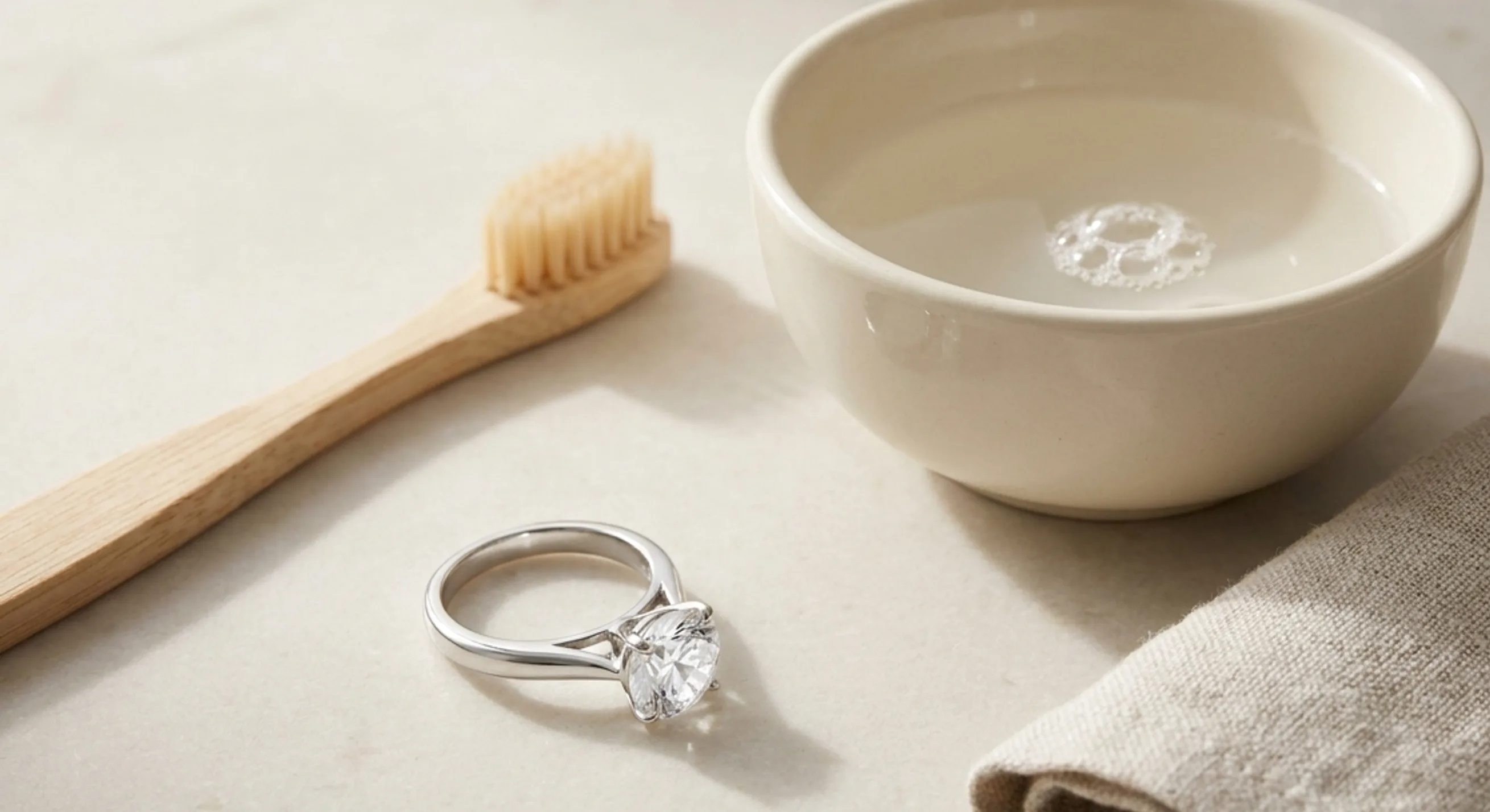
The stone itself doesn't change. The surface does. Skin oil, hand cream and soap film settle on the pavilion, and because white sapphire has a lower refractive index it depends more on clean facets to bounce light back. A greasy film on the back of the stone lets light leak out, and the stone looks hazy. Diamonds dull too, as anyone who has inspected an uncleaned engagement ring knows, but the higher refractive index hides it for longer.
So white sapphire needs more frequent cleaning. If you wear it daily, a weekly scrub behind the stone with warm water, mild dish soap and a soft toothbrush keeps it bright. Choose a setting with an open gallery so you can actually reach the pavilion. Closed-back settings trap grime and make any white stone look tired.
How much cheaper is white sapphire than diamond?
Price is where the two stones differ most.
Natural white sapphire spans a wide range, roughly $50 to $1,500 per carat, with cloudy or poorly cut stones at the bottom. For the stones people actually shortlist, a fine near-colorless to colorless, eye-clean Ceylon stone of one carat sits around $200 to $700 per carat. Above 2 carats, per-carat prices climb to roughly $600 to $1,500.
| Stone (around 1 ct) | Typical price |
|---|---|
| Fine colorless Ceylon white sapphire | $200 to $700 per carat |
| Natural diamond, H to I, SI | $2,800 to $4,000 |
| Natural diamond, G to H, VS2 | $4,000 to $6,000 |
| Natural diamond, F to G, VS1 | $5,500 to $8,500 |
| Natural diamond, D to E, VVS | $9,000 to $16,000+ |
| Lab-grown diamond | about $800 to $1,200 on average, from around $250 direct |
As a rough rule, a natural white sapphire costs 5 to 10 times less than a comparable natural diamond. Against lab-grown diamond the gap narrows sharply, and sometimes disappears. I'd rather say that than pretend otherwise. If you're choosing a natural Ceylon sapphire over a lab-grown diamond, it should be because you want a mined, natural stone with its own look, not purely on price.
One sizing note. Sapphire is denser than diamond (3.98 to 4.10), so a one-carat sapphire faces up slightly smaller than a one-carat diamond. Compare by millimetres, not carats.
Why does an unheated colorless sapphire cost more?
Heat treatment is the industry norm: roughly 90 to 95 percent of sapphires on the market have been heated. In white sapphire, heating clears faint grey, yellow or blue tints and dissolves the fine silk that makes a stone look sleepy. It's stable, permanent and accepted across the trade, and much of the best-looking white on the market has been heated. A heated white sapphire is a legitimate, durable gem.
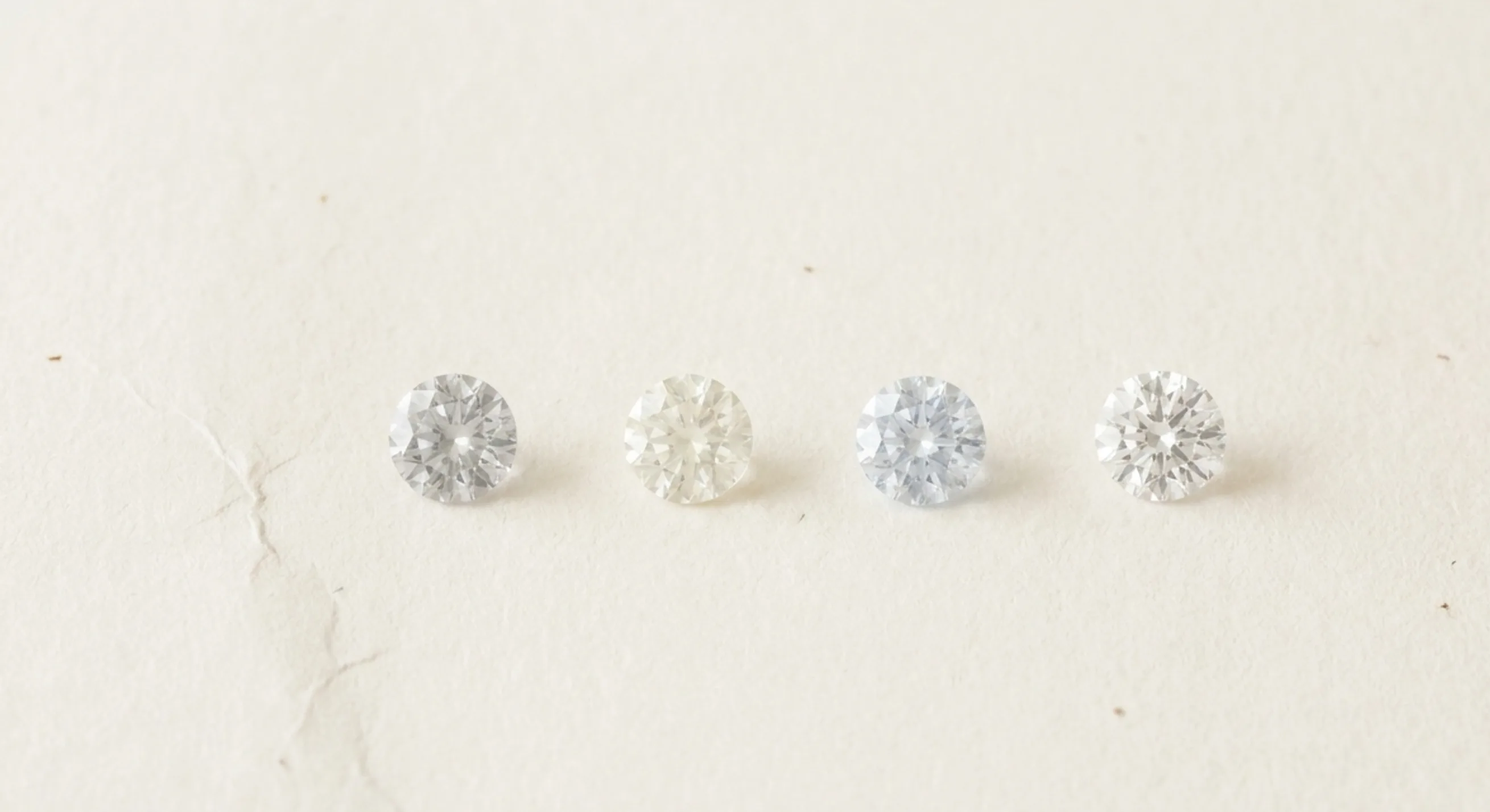
Unheated stones are the premium tier because nature rarely cooperates. Most white rough from the Ratnapura and Elahera gravels carries a whisper of grey or yellow that you notice the moment you set it on white paper or next to a white diamond. A stone that faces up truly colorless and clean without any heat is a small fraction of what comes out of the pits. In current retail listings, unheated colorless Ceylon whites with lab reports sell for around $500 to $600 per carat, roughly three times the price of comparable heated stones. GIA, SSEF and Gübelin can all report "no indications of heating," and on an unheated stone that report is what you're paying for.
White stones are also the easiest gems to flatter in photographs. A spotlight and a black background will make a tinted, windowed sapphire look like a diamond. So ask to see any white stone on video in plain daylight against a white card, as well as under spot lighting, face-up and tilted. That shows any tint or window before you commit. Every stone Crestonne lists comes with its own video and a lab report.
How can you tell a white sapphire from a diamond?
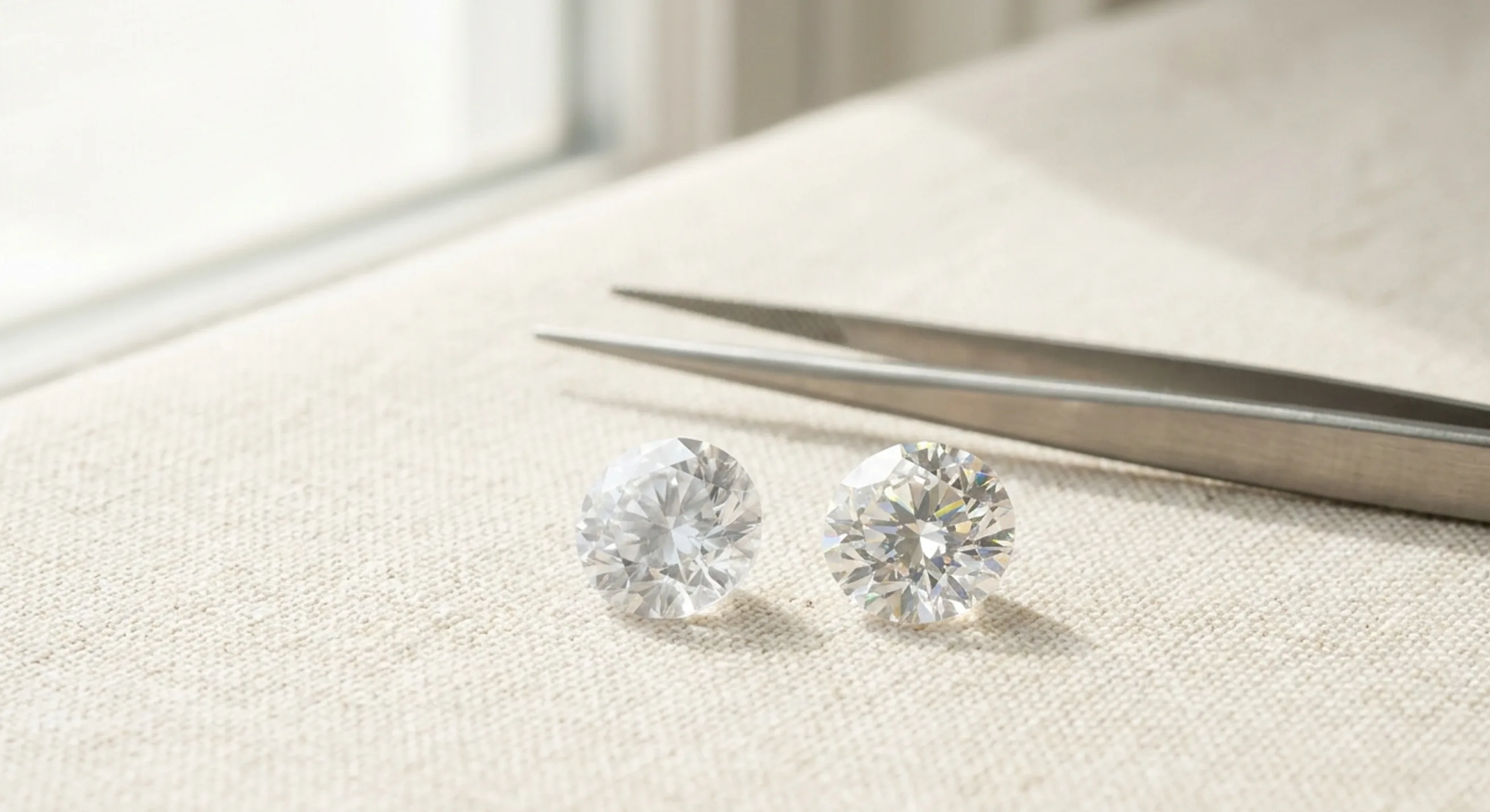
Side by side, the easiest giveaway is fire. Tilt both stones under a single light source, such as a phone torch or a desk lamp. The diamond throws orange and blue flashes. The sapphire flashes mostly white.
Other clues:
- Size for weight. At the same carat weight, the sapphire looks a touch smaller.
- Inclusions under a loupe. Natural sapphire often shows fine silk, healed fingerprints or small crystals. Diamonds show feathers and pinpoints. Useful, but not decisive for an untrained eye.
- Handheld testers. A thermal tester is a quick screen, but these tools have known blind spots (they read moissanite much like diamond, for instance). Treat any handheld test as a first pass, not a verdict.
- Ignore the folk tests. The breath-fog and newsprint tricks are unreliable. A well-cut sapphire can hide print and a poorly cut diamond can show it.
The definitive answer is a lab report. GIA, SSEF and Gübelin will identify natural corundum and state whether there's evidence of heat.
When is a diamond the better choice?
Crestonne sells sapphire, but a diamond is the better buy in some cases. Choose a diamond if:
- Fire is the point. If the ring in your head flashes color, sapphire will disappoint you.
- You won't clean it. A diamond tolerates neglect better before it looks dull.
- You want maximum scratch resistance. For very heavy manual work, the extra hardness counts.
- Price parity with lab-grown suits you. If a natural stone isn't important to you and lab-grown fits the budget, you get more sparkle for similar money.
Is white sapphire a good diamond alternative?
For the right buyer, yes. A white sapphire is a natural, mined gem, tough, free of cleavage, and bright when it's cut properly, at a price that leaves room for a better setting or a larger stone. Its look is calmer and icier than diamond, and plenty of people choose it for exactly that reason. If you're weighing it against moissanite, lab-grown diamond and others, I cover the wider field of diamond alternatives separately.
If you have chosen white sapphire, the cut decides everything. Tell me the shape, size and budget you have in mind, and whether you want heated or unheated, and I'll look for a Ceylon stone cut to proper angles. Start a loose stone request here, or browse the Crestonne collections to see how our stones are documented.
Common questions
Frequently Asked Questions
Can you tell a white sapphire from a diamond by eye?
From across a room, a well-cut white sapphire reads as a bright white stone. Up close, yes: it shows much less colored fire than a diamond, because its dispersion is 0.018 against diamond's 0.044. It has a calmer, glassier brilliance. Some buyers prefer that look.
Which is more durable, white sapphire or diamond?
Yes. White sapphire is 9 on the Mohs scale and has no cleavage, so it resists both scratching and splitting well. Diamond is harder at 10, but it can chip along cleavage planes if struck. Either stone works for daily wear in a protective setting.
How much does a 1 carat white sapphire cost compared to a diamond?
A fine colorless 1 carat Ceylon white sapphire typically costs about $200 to $700 per carat. A natural 1 carat diamond ranges from roughly $2,800 for H to I, SI grades up to $16,000 or more for D to E, VVS. Lab-grown 1 carat diamonds average around $800 to $1,200.
Is a heated white sapphire a bad buy?
No. Heating is the industry norm, applied to roughly 90 to 95 percent of sapphires, and it permanently clears faint tints and silk. A heated white sapphire is a stable, legitimate gem. Unheated stones are a rarer premium tier and should come with a lab report confirming no indications of heating.
Why does my white sapphire look cloudy?
Almost always it's surface film, not the stone. Oil, lotion and soap on the pavilion let light leak out, and white sapphire shows this sooner than diamond. Scrub behind the stone with warm water, mild soap and a soft toothbrush, and it will brighten straight away.