Specialty Stones
Ceylon Zircon: The Underrated Natural Gemstone
Ceylon zircon is a natural gemstone, completely different from synthetic cubic zirconia. Sri Lanka, especially Matara, has supplied colourless 'Matura diamond' zircon and bright blue zircon for centuries. Here is what Ceylon material is, what it costs, and how to buy it.
Published Updated 10 min read
By Naseef AR
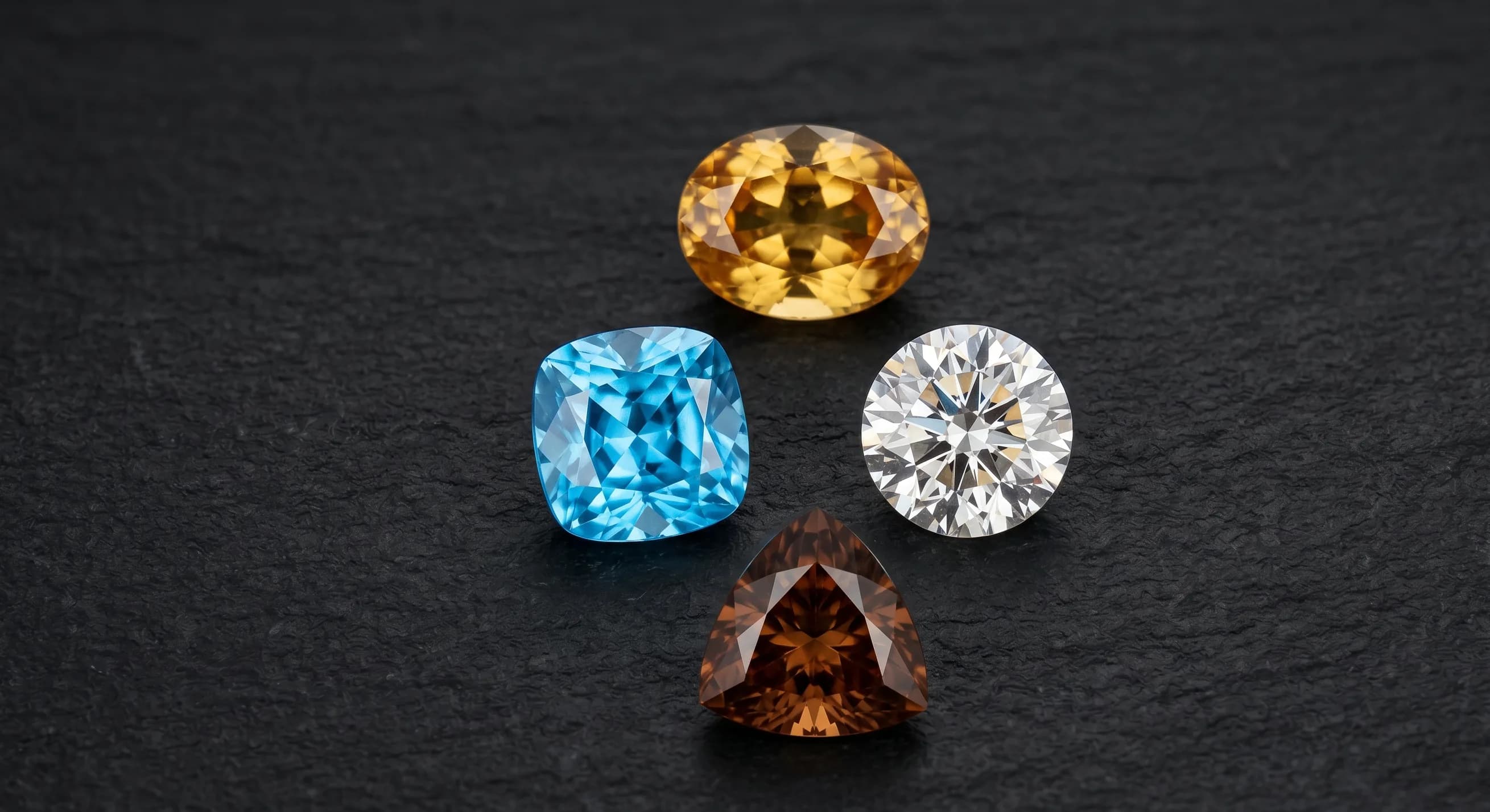
Ceylon zircon is a natural gemstone, a zirconium silicate (ZrSiO4) mined for centuries from Sri Lanka's alluvial gem gravels, particularly around Matara on the southern coast and Ratnapura in the wet zone interior. It is not cubic zirconia. Cubic zirconia is a synthetic material developed in 1976 for the costume jewellery trade. The two share three letters and a marketing accident; they share nothing else. Natural Ceylon zircon has a refractive index of 1.92 to 2.01 (higher than sapphire and approaching diamond), dispersion of 0.039 (second only to diamond among natural transparent gems), and Mohs hardness 6 to 7.5. Ceylon zircon comes in blue, colourless, golden, honey, brown, and rarer green or champagne, with heat-treated blue zircon Sri Lanka material being the most commercially significant variety.
This guide covers what Ceylon zircon is mineralogically, why it is constantly confused with cubic zirconia, where Sri Lankan blue zircon actually comes from, what each colour costs in 2026, and the practical buyer checklist.
What Is Ceylon Zircon?
Zircon is a primary mineral, meaning it crystallises directly from molten rock rather than forming through alteration of an existing mineral. The chemical formula is zirconium silicate, ZrSiO4. Pure zircon is colourless. The colours seen in the gem trade come from trace elements and from the slow accumulation of radiation damage in stones containing tiny amounts of uranium and thorium, which is the same property that makes zircon so useful for radiometric dating in geology.
Sri Lankan zircon comes almost entirely from the same alluvial gem gravels that produce sapphire, spinel, chrysoberyl, garnet, and tourmaline. The historically important deposit is around Matara on the southern coast, which gave the trade the old name "Matura diamond" for clean colourless Ceylon zircon. Ratnapura, Embilipitiya, and Elahera also produce zircon in mixed-gravel mining operations. The extraction method is identical to the rest of the Ceylon family, which means Ceylon zircon natural gemstone material carries the same ethical sourcing story as Ceylon sapphire from the same gravels.
Zircon vs Cubic Zirconia: The Crucial Difference
The single biggest misconception about Ceylon zircon is that the name has anything to do with cubic zirconia. It does not. Compare:
| Property | Natural Ceylon Zircon | Cubic Zirconia |
|---|---|---|
| Origin | Mineral, mined from earth | Synthetic, lab-grown |
| Composition | ZrSiO4 (zirconium silicate) | ZrO2 (zirconium dioxide) |
| Mohs hardness | 6.0 to 7.5 | 8.0 to 8.5 |
| Refractive index | 1.92 to 2.01 | 2.15 to 2.18 |
| Dispersion | 0.039 | 0.060 |
| Crystal system | Tetragonal | Cubic |
| First known | Antiquity (classical trade) | 1976 (Soviet laboratory) |
| Price per carat | USD 50 to 500 | Pennies |
Natural zircon has been used in jewellery since at least classical antiquity. References to "jacinth" or "hyacinth" in old gem texts refer to the orange-brown zircon variety. The confusion with cubic zirconia is essentially a 20th-century accident. When the Soviet lab synthesis was commercialised, the marketing department wanted a name that hinted at high refractive index, and "cubic zirconia" stuck because the synthetic mineral is composed of cubic-crystal zirconium oxide. For the buyer, the two are not in the same category, the same price bracket, or the same shop.
The practical zircon vs cubic zirconia test in the hand: zircon shows strong birefringence (it is doubly refractive), so under a 10x loupe the back facet edges visibly double when viewed through the table. Cubic zirconia is singly refractive and shows no doubling. The doubling is the single most reliable visual identifier short of a refractometer reading.
Blue Zircon Sri Lanka: How It Is Made and Where It Comes From
Almost all the blue zircon in the modern jewellery trade starts as brown zircon and is heat-treated to blue. The treatment is a low-temperature reducing-atmosphere bake, about 800 to 1000 degrees Celsius, which alters the colour centres in the brown rough and produces a stable, bright blue. The colour is permanent under normal wear and light. This is a standard, accepted treatment disclosed on every reputable invoice as "H" or "heat-treated."
The two practical sources of blue zircon today are Cambodia (the Ratanakiri deposit, which dominates current commercial supply) and Sri Lanka, with smaller production from Myanmar and Tanzania. Cambodian blue zircon is typically a bright neon "swimming pool" blue and is the volume product on the market. Sri Lankan blue zircon Sri Lanka material tends to be slightly cooler and more saturated, with a denser body colour, though the difference is subtle and requires side-by-side comparison.
Untreated blue zircon does exist but is genuinely rare. Most material sold as "natural blue zircon" without further explanation is heat-treated, which is fine and expected. Disclosure on the invoice is what matters.
Ceylon Zircon Colours Beyond Blue
Sri Lanka has historically produced the widest colour range of any zircon source.
Colourless zircon is the historical Ceylon speciality, traded for centuries as "Matura diamond" because clean colourless material with strong dispersion and high refractive index reads remarkably like a diamond at first glance. The trade name survives in Sri Lankan dealer slang.
Yellow and golden zircon runs from clean canary yellow through warm honey-gold. This is one of the prettiest colours in the species and is typically untreated. Sri Lankan material in this colour is well represented.
Brown and "jacinth" zircon is the classical orange-brown variety referenced in antique jewellery texts. Often heat-treated to remove the brown component and produce either blue or colourless material, but unheated brown zircon with a clean cinnamon body is a legitimate collector's stone.
Green zircon is rarer and shifts toward olive. Some Sri Lankan green zircon is what gemmologists call "low" type, meaning radiation damage has partially broken down the crystal structure (the material is "metamict"). Metamict zircon has lower hardness and softer optics; it is collected as a curiosity rather than worn.
Champagne and pink zircon appear in small parcels but are not consistent commercial production.
"Matura Diamond" and the Historical Ceylon Trade
The colourless zircon trade out of southern Sri Lanka predates the modern diamond market. Dutch and Portuguese gem buyers in the 17th and 18th centuries returned to Europe with clean colourless Ceylon zircon set as "diamonds," and a portion of what was sold as diamond in colonial-era European jewellery is in fact Matura zircon. The name "Matura" is the old colonial spelling of Matara, the town on the southern coast that was the principal trading hub for the variety.
The reason zircon worked as a diamond substitute is straightforward. Its refractive index (1.92 to 2.01) is the second-highest of any natural transparent gem after diamond itself (2.42), and its dispersion (0.039) sits second only to diamond's (0.044) among natural colourless gems. A well-cut colourless zircon shows fire that no other clear gem except diamond can match. The give-away under a loupe is the strong birefringence, which diamond does not show.
How Much Does Ceylon Zircon Cost in 2026?
Indicative 2026 dealer-to-end-buyer prices for eye-clean, well-cut Ceylon material:
| Variety | 1 to 3 ct | 3 to 5 ct | 5 ct + |
|---|---|---|---|
| Blue zircon, heated, fine saturation | USD 80–200/ct | USD 150–350/ct | USD 250–500/ct |
| Colourless (Matura diamond), well-cut | USD 50–120/ct | USD 100–200/ct | USD 150–300/ct |
| Golden/honey yellow, untreated | USD 60–150/ct | USD 100–250/ct | USD 200–400/ct |
| Cinnamon/jacinth brown, untreated | USD 40–100/ct | USD 80–180/ct | USD 150–300/ct |
| Green or champagne, collector | USD 100–300/ct | USD 200–500/ct | USD 400–800/ct |
These figures sit below comparable Ceylon sapphire and even comparable Ceylon spinel pricing, which is part of why zircon remains underrated. For the closest neighbour-species pricing comparison, the spinel vs sapphire guide covers the spinel benchmark, and the Sri Lankan garnet guide covers the closest entry-level Ceylon material.
Is Ceylon Zircon Durable Enough to Wear?
Zircon sits at Mohs 6 to 7.5 depending on type. "High" zircon, the well-crystalline gem material that the trade actually sells, is at the top end of that range, around 7.0 to 7.5. The headline number is acceptable, but zircon has a separate problem the hardness scale does not capture: it is brittle. The facet edges of cut zircon chip more easily than corundum or spinel facet edges if knocked against a hard surface, which is why antique zircon jewellery often shows rounded, abraded facet junctions.
Practically, this means zircon is excellent for earrings, pendants, brooches, and protected ring settings (bezel, halo, or low-profile). It is not the right stone for an unprotected solitaire engagement ring intended for daily wear. Clean with warm soapy water and a soft brush. Avoid ultrasonic and steam cleaners, which can stress brittle stones.
A Note from the Parcel Table
Last year a dealer in Ratnapura showed me a paper of rough zircon, roughly thirty crystals, mostly 2 to 6 carats, all brown to honey-yellow, from a parcel that had come in from a small-scale mining operation outside Embilipitiya. He set aside about ten of the stones to send to a heat house in Beruwala. Three weeks later the same parcel came back: the ten brown crystals had transformed into clean, bright blue cut stones in the 1 to 3 carat range. The colour shift was complete and uniform. No diffusion, no surface effect, no fading. Just a low-temperature reducing-atmosphere bake that flipped the colour centres in the rough.
The point of the story is that "natural blue zircon" and "heat-treated blue zircon" describe the same starting material, separated by a furnace cycle. The treatment is honest, disclosed on every reputable invoice, and produces a colour that has been on the market under the same name for over a century. The only reason to specify "unheated" is if you specifically want the rarer untreated material at a meaningful price premium. For most buyers, heated blue zircon is exactly what they want, and the H designation on the invoice is the only documentation they need.
For collectors looking further into Ratnapura's underappreciated species, the Sri Lankan tourmaline guide covers the underrated elbaite-dravite varieties, and the Sri Lankan garnet guide covers the closest entry-level Ceylon material.
Where to Buy a Ceylon Zircon
The honest checklist:
- Species named on the invoice. "Zircon" stated explicitly. Never accept "zircon" used as shorthand for cubic zirconia, which it sometimes is at the lower end of the trade.
- Country of origin stated. "Sri Lanka" or "Ceylon" for Ceylon material. Cambodian blue zircon trades at a different price band and reads slightly different in the hand.
- Treatment status stated. "H" or "heat-treated" for blue and most colourless. Untreated yellow and brown should be labelled "no treatment."
- A laboratory report from GIA, GRS, or a comparable major lab for any stone above 2 carats or USD 300 in total value. Particularly important for confirming species: natural zircon, treated topaz, and synthetic spinel can look superficially similar at small sizes.
- A daylight photograph alongside the studio shot. Blue zircon in particular can look more saturated under jeweller-shop tungsten than in cool northern daylight, and saturated photography of any blue stone is one of the recurring complaints in the trade. At Crestonne we shoot every stone in both natural northern daylight and controlled tungsten and publish both frames so the buyer sees the stone as it will actually wear.
- A protective setting recommendation if the stone is going into a ring. Zircon needs a bezel or halo for daily-wear pieces.
If you want a Ceylon zircon sourced this way, direct from a named Ratnapura or Matara dealer with species and treatment documented, tell us your specifications (variety, colour, carat range, budget) and we will source it for you. You can also see what is currently in the Crestonne collection before deciding whether to commit to a custom search.
Common questions
Frequently Asked Questions
Is Ceylon zircon the same as cubic zirconia?
No. Ceylon zircon is a natural mineral, zirconium silicate (ZrSiO4), mined for centuries from Sri Lanka's alluvial gem gravels around Matara and Ratnapura. Cubic zirconia is a synthetic material, zirconium dioxide (ZrO2), invented in a Soviet laboratory in 1976 and produced for the costume jewellery trade. They share three letters and a marketing accident; they share nothing else. Natural zircon is doubly refractive (facet edges visibly double under a 10x loupe), has fire second only to diamond among natural gems, and trades at USD 50 to 500 per carat depending on colour. Cubic zirconia is singly refractive and trades at pennies per carat.
What is a 'Matura diamond'?
Matura diamond is the historical trade name for clean colourless zircon mined from the area around Matara on Sri Lanka's southern coast. Pre-1900, colourless Ceylon zircon was a recognised diamond substitute in European jewellery because its refractive index (1.92 to 2.01) is the second-highest of any natural transparent gem after diamond, and its dispersion (0.039) is second only to diamond's (0.044) among colourless natural stones. Dutch and Portuguese gem buyers in the 17th and 18th centuries returned to Europe with parcels of Matura zircon set as 'diamonds,' and a portion of what was sold as diamond in colonial-era European jewellery is in fact Ceylon zircon. The name survives in Sri Lankan dealer slang.
How is blue zircon Sri Lanka material made?
Almost all blue zircon in the modern trade starts as brown zircon rough and is heat-treated to blue. The treatment is a low-temperature reducing-atmosphere bake, around 800 to 1000 degrees Celsius, which alters the colour centres in the brown crystal and produces a stable, bright blue. The colour is permanent under normal wear and light. This is a standard, accepted treatment disclosed on every reputable invoice as 'H' or 'heat-treated.' Untreated blue zircon does exist but is genuinely rare; most stones sold as 'natural blue zircon' without further explanation are heat-treated, which is expected and not a defect.
How much does a Ceylon blue zircon cost in 2026?
Heat-treated Ceylon blue zircon in the 1 to 3 carat range typically runs USD 80 to 200 per carat for clean, well-saturated material. The 3 to 5 carat range moves to USD 150 to 350 per carat, and stones above 5 carats with strong saturation reach USD 250 to 500 per carat. Sri Lankan blue zircon prices sit slightly above the comparable Cambodian production from Ratanakiri because the Sri Lankan saturation tends to be cooler and denser, though the difference is modest. Untreated colours such as honey-yellow and cinnamon-brown trade lower, USD 40 to 250 per carat across the same size range.
Is Ceylon zircon durable enough for daily wear?
Gem-quality 'high' zircon sits at Mohs 7.0 to 7.5, which is acceptable hardness. The separate concern is brittleness: zircon facet edges chip more easily than corundum or spinel facet edges if knocked against a hard surface, which is why antique zircon jewellery often shows rounded facet junctions. Zircon is excellent for earrings, pendants, brooches, and protected ring settings such as bezel or halo. It is not the right stone for an unprotected solitaire engagement ring intended for daily wear. Clean with warm soapy water and a soft brush. Avoid ultrasonic and steam cleaners, which can stress brittle stones.