Specialty Stones
Spinel vs Sapphire: The Misidentified Royal Gem
Spinel is a separate mineral from sapphire, but for centuries the two were confused in royal jewelry. Here is how to tell them apart, why spinel commands a fraction of sapphire's price, and why Sri Lankan red spinel is one of the most undervalued natural gemstones today.
Published Updated 10 min read
By Naseef AR
Spinel and sapphire are two different minerals that were historically confused in royal jewelry because they occur side by side in Sri Lankan and Burmese gem gravels and share overlapping colors. Sapphire is corundum (aluminum oxide, Al₂O₃), rates 9 on the Mohs scale, and is doubly refractive. Spinel is magnesium aluminum oxide (MgAl₂O₄), rates 8 on Mohs, and is singly refractive. Those two gemological tests (hardness and refractive index) definitively separate them. Most "rubies" in the British, Russian, and Iranian crown jewels before the 19th century turned out to be spinels once modern gemology could distinguish the two. Today spinel trades at a fraction of sapphire pricing, which makes it one of the most undervalued natural gemstones in the modern market.
What's the Physical Difference Between Spinel and Sapphire?
Two minerals, two chemical formulas, two crystal structures.
Sapphire is corundum, aluminum oxide (Al₂O₃). It crystallizes in the trigonal system, which means it has two different refractive indices depending on the direction of light travel through the crystal. Trace elements produce color: iron and titanium give blue, chromium gives red (which we call ruby), iron alone gives yellow, and a chromium-iron combination gives the pink-orange of padparadscha.
Spinel is magnesium aluminum oxide (MgAl₂O₄). It crystallizes in the cubic system, which means it has a single refractive index regardless of direction. Chromium produces red. Cobalt produces the prized "cobalt blue" spinel. Iron produces black, grey, and various brown-reds. Pink, orange, lavender, and violet spinels are all colored by combinations of these trace elements.
The practical differences you can test:
- Hardness. Sapphire is Mohs 9; spinel is Mohs 8. Both are hard enough for everyday wear. Sapphire is slightly more scratch-resistant; spinel is slightly tougher against chipping at prong contact points.
- Refractive index. Sapphire reads 1.762 to 1.770 with a birefringence of 0.008 to 0.009 on a refractometer. Spinel reads a single value at 1.712 to 1.736. A gemologist separates them in thirty seconds.
- Inclusions. Sapphire typically shows silk (fine rutile needles) or liquid fingerprints. Spinel shows characteristic octahedral (eight-sided) crystal inclusions, often arranged in geometric patterns that resemble constellations under the loupe.
The Black Prince's Ruby and the Rest of Crown-Jewel History
The most famous misidentified gemstone in the world is the Black Prince's Ruby, set in the front of the British Imperial State Crown. It is 170 carats, roughly egg-sized, and is not a ruby. It is a red spinel.
The stone was acquired by Edward of Woodstock, the Black Prince, in 1367 as payment after the Battle of Nájera. For five centuries it sat in the English crown jewels as "the Black Prince's Ruby," worn by Henry V at Agincourt and by every subsequent English monarch at coronation. Only in the 19th century, when gemological analysis had advanced enough to distinguish corundum from spinel, did jewelers determine the stone was spinel.
The Black Prince's Ruby is not an isolated case. The Timur Ruby (361 carats, also in the British crown jewels) is a spinel. The Coronation Ruby is a spinel. Several large red stones in the Russian Imperial collection and the Iranian crown jewels are spinels. Until the mid-1800s the distinction simply wasn't made. Any large red stone from the gravels of present-day Afghanistan (the historic Kuh-i-Lal mines), Burma, or Sri Lanka was called a ruby, regardless of whether it was corundum or spinel.
This matters because most of what European royal tradition considered "the great rubies of history" were, under modern classification, spinels. Spinel was a court gemstone at the highest level of the European monarchy. Its modern obscurity is an artifact of 19th-century reclassification rather than any quality problem with the stone itself.
How to Tell Spinel from Sapphire (and Ruby)
For a buyer without a refractometer on hand, three practical checks:
1. Color character. Fine red spinel typically has a slightly more pure "stop-sign red" without the hint of orange or the slight pinkish modifier that distinguishes fine Burmese ruby. Blue spinels read slightly grayer or more indigo than top Ceylon blue sapphire. This is subjective and should never be the only test, but it is informative.
2. Look at inclusions under a loupe. Spinel often shows small octahedral (eight-sided) crystal inclusions, sometimes in regimented geometric arrays. Sapphire shows silk inclusions (rutile needles), liquid fingerprints, or color zoning bands. An experienced gemologist can often separate the two by inclusion character alone.
3. Ask for a laboratory report. Any reputable seller provides one. GIA, SSEF, Gübelin, and Lotus Gemology all test refractive index on every colored stone submitted and report species definitively. If origin matters (and for spinel it increasingly does), request a report that identifies source.
For more on reading gem lab reports, see our guide on how to read a GIA sapphire certificate. The same report structure applies to spinel with a single-word change in the species field.
Sri Lankan Red Spinel: The Undervalued Collector's Gem
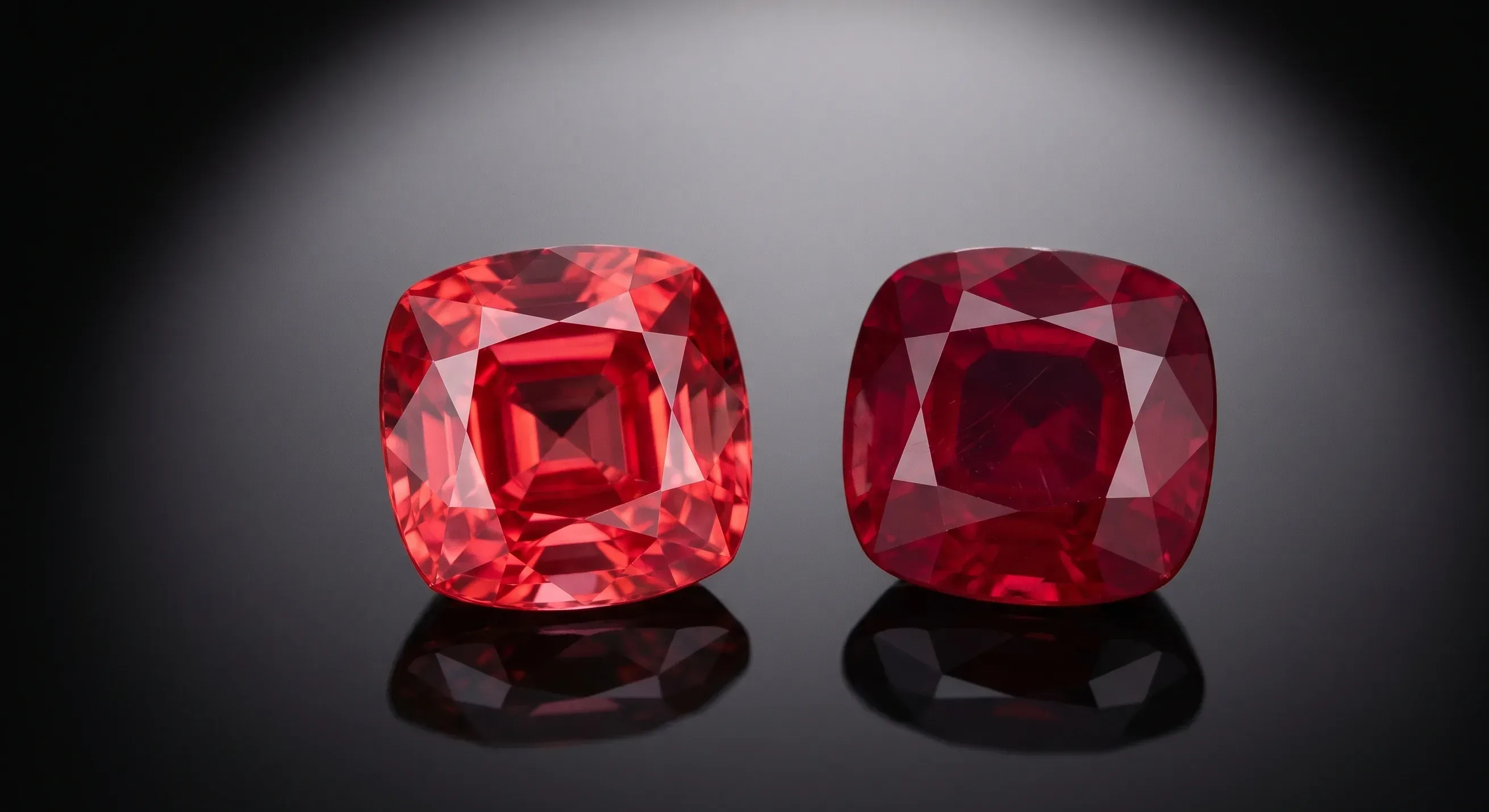
Sri Lanka has produced red spinel from the same Ratnapura and Elahera gem gravels that produce Ceylon sapphire for centuries. Sri Lankan red spinel is typically a medium-saturation red with a slightly pinkish or orangey modifier, distinct from the purer "pigeon blood" red of Burmese Mogok material but equally natural and equally untreated.
The key structural difference between spinel and sapphire at the trade level: spinel is almost always untreated. No-heat is the industry default, not the exception. That said, a small number of Burmese spinels have recently started appearing with heat treatment, and GIA, SSEF, Gübelin, and Lotus now test for it routinely. Always request a laboratory report confirming no thermal enhancement. For buyers who value gemological cleanness, spinel's near-universal untreated status is part of the appeal, but the verification still matters.
A client came to us two years ago with a stone inherited from their grandmother's estate, labeled as "ruby" in the family paperwork and assumed to be worth tens of thousands. We ran the refractometer and saw a single reading at 1.718, characteristic of spinel, not corundum. The initial disappointment was visible. But when we explained what they actually had — a 2.1-carat natural Sri Lankan red spinel, untreated, from a mid-20th-century Ratnapura sourcing context where the provenance made sense — the conversation changed. The value sat closer to $5,000 than $50,000. But the stone had real gemological character: Mohs 8 durability, no treatment to disclose, and the same species that sat in European crowns for five centuries. They kept it. That is almost always the right call with an inherited spinel.
How Much Does Spinel Cost Compared to Sapphire?
Approximate 2026 prices per carat for Sri Lankan spinel across quality tiers:
| Size | Commercial red | Fine red | Fine pink/purple | Cobalt blue |
|---|---|---|---|---|
| Under 1 ct | $200 to $600 | $800 to $2,500 | $400 to $1,500 | $1,500 to $4,000 |
| 1 to 3 ct | $600 to $1,500 | $2,500 to $6,000 | $1,500 to $4,500 | $4,000 to $9,000 |
| 3 to 5 ct | $1,500 to $3,500 | $6,000 to $15,000 | $4,000 to $10,000 | $6,000 to $15,000 |
| 5 ct and up | $2,500 to $5,000 | $10,000 to $25,000 | $8,000 to $20,000 | $15,000 to $35,000 |
A note on origin and color. Sri Lanka's strongest spinel categories are pink, purple, lavender, softer medium-toned reds, and violet-modified blues. The absolute top tier of fine red spinel (pure "stop-sign" reds with no modifier) typically comes from Burma's Mogok valley. The most vivid cobalt blues come from Vietnam's Luc Yen district. The brightest neon pink-reds come from Tanzania's Mahenge deposit. A Sri Lankan "fine red" at 5 carats is a genuine stone, but for a pure pigeon-blood red at that size you are almost always looking at Burmese material at two to three times the Sri Lankan price. The pink and purple column above is where Sri Lanka actually competes at the top of the global market.
For reference, a fine Ceylon blue sapphire in the 1 to 3 carat band typically trades at $3,000 to $8,000 per carat in 2026, with unheated stones at $7,000 to $18,000 per carat. An equivalent Sri Lankan red spinel in the same size band sits at $2,500 to $6,000 per carat for fine material, roughly 60 to 80 percent of heated sapphire pricing for a stone that is, by some measures, rarer and that is almost always untreated. Our Ceylon sapphire price per carat guide has the full comparable breakdown on the sapphire side.
Why Spinel Remains Undervalued
Three structural reasons spinel has not yet closed the price gap with sapphire and ruby:
Brand recognition. Most jewelry buyers have never heard the word spinel. "Ruby" and "sapphire" carry thousands of years of cultural reinforcement; "spinel" is a mineralogical term most buyers encounter for the first time in a dealer's shop. This gap is closing slowly as collector publications and auction coverage feature more spinel, but the lag is measured in decades, not years.
No dedicated birthstone or cultural anchor. Sapphire is September's birthstone; ruby is July's. Spinel was added to the American Gem Trade Association birthstone list as an alternative for August in 2016, replacing peridot as a secondary option. Awareness is still limited, but the addition is a meaningful first step.
No major house has marketed it at scale. Cartier, Bulgari, Tiffany, and Van Cleef all sell spinel occasionally, but it has never received the sustained campaign treatment that would reprice it upward. The moment a major house decides to build a spinel-centric collection, the market pricing shifts.
For collectors, this is the opportunity. A fine red Sri Lankan spinel bought today has meaningful capacity to appreciate if any of the three conditions above shift, and two of them are already moving. Compare spinel's current trajectory to the padparadscha sapphire, which went from obscure trade term to auction-house celebrity over the past thirty years. Spinel is roughly where padparadscha was in the late 1990s.
Explore the Crestonne collection for certified Ceylon sapphires and other Sri Lankan gems, including red and cobalt blue spinel as availability allows. For a specific stone sourced to your color, carat, and certification requirements, submit your specifications through our custom sourcing service and we will search our Ratnapura and Colombo network with species, color, and size constraints on the brief. Every stone we handle comes with laboratory documentation confirming exactly what it is, because the whole point of understanding the spinel-vs-sapphire distinction is trusting your stone's paperwork.
Common questions
Frequently Asked Questions
Is spinel a type of sapphire?
No. Spinel and sapphire are two entirely different minerals. Sapphire is corundum (aluminum oxide, Al₂O₃), and spinel is magnesium aluminum oxide (MgAl₂O₄). They occur together in the same gem gravels in Sri Lanka and Burma, which is why they were confused historically, but gemologically and chemically they are distinct species.
How can I tell spinel from ruby or sapphire?
The definitive test is refractive index. Spinel is singly refractive (one reading, typically 1.712 to 1.736). Ruby and sapphire are doubly refractive (two readings that differ by about 0.008 to 0.009). A gemological laboratory identifies them in under a minute. Without a refractometer, inclusion patterns help: spinel often shows octahedral (eight-sided) crystal inclusions in geometric arrays, while corundum shows silk needles or liquid fingerprints.
Is red spinel valuable?
Yes, particularly fine Sri Lankan and Burmese red spinel. Prices for top-quality red spinel have appreciated roughly ten percent per year over the past decade and the category is increasingly tracked by collectors. Fine one-to-three-carat red spinel from Sri Lanka trades at $2,500 to $6,000 per carat in 2026. Still substantially less than fine ruby, but the gap is closing.
Why is spinel cheaper than sapphire?
Three structural reasons: brand recognition (most buyers have never heard the word spinel), the absence of a dedicated birthstone or strong cultural anchor until recently, and the lack of sustained marketing by major jewelry houses. None of these reflect any gemological inferiority. Spinel is rarer than sapphire in fine colors, equally durable for daily wear, and almost always untreated, though a small number of recent Burmese stones have been heated, so a no-heat laboratory report is still worth requesting.
Can spinel be used in an engagement ring?
Yes. At Mohs 8, spinel is hard enough for daily wear with sensible setting choices. Red, pink, cobalt blue, and lavender spinels all work well as center stones. The main consideration is size availability: fine spinel above three carats is rarer than fine sapphire above three carats, so expect a shorter shortlist. For a durable, distinctive, and undervalued alternative to ruby or sapphire, spinel is a strong choice.