Specialty Stones
Star Sapphire from Sri Lanka: How the Six-Rayed Star Forms
A Sri Lankan star sapphire shows a sharp six-rayed star because microscopic rutile silk inclusions align along three crystal axes. Here is how asterism forms, what separates a great Ceylon star from an average one, and why the Star of India still sits at the top of the category.
Published Updated 11 min read
By Naseef AR
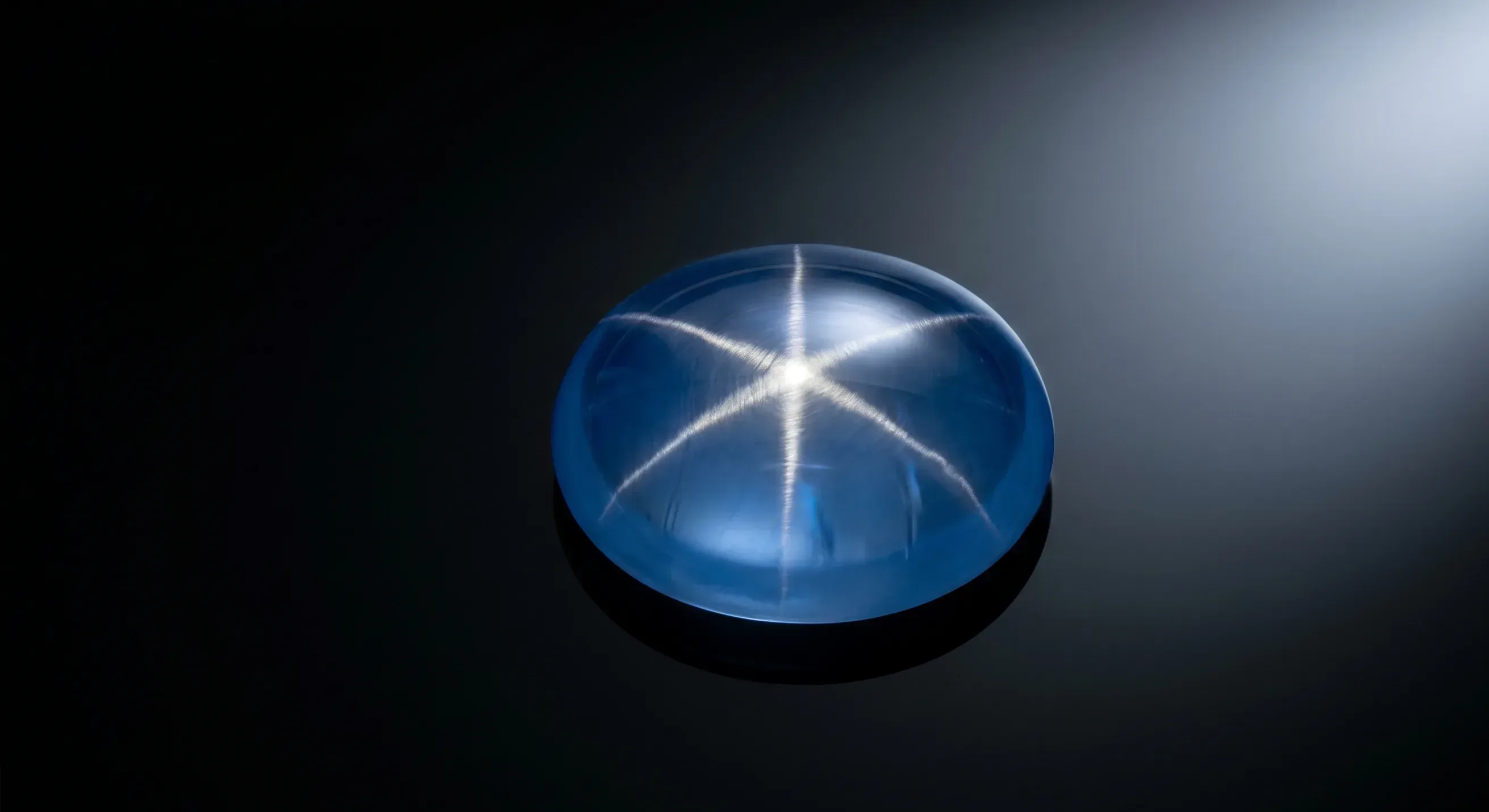
A star sapphire from Sri Lanka shows a sharp six-rayed star because microscopic rutile (titanium dioxide) needles align inside the stone along three crystallographic axes. When the sapphire is cut as a cabochon with its base perpendicular to the c-axis, light reflecting off those aligned inclusions produces three intersecting bands that read as a star. The effect is called asterism. Sri Lanka has been the most important source of fine star sapphires for at least a thousand years, producing lighter blue and grey body colors with well-centered, translucent stars. The most famous example, the 563-carat Star of India in the American Museum of Natural History, is a Ceylon stone. This guide covers how asterism forms, what separates a great Sri Lankan star from an ordinary one, and what to look for before you buy.
What Causes the Star in a Star Sapphire?
Asterism is an optical phenomenon caused by oriented inclusions inside a gemstone. In sapphire (and ruby, which is the same mineral with different trace coloring), the inclusions responsible are tiny needles of rutile. Rutile is titanium dioxide, the same compound that gives many sapphires their blue color when trace amounts are dissolved in the crystal structure. When the titanium content exceeds what the crystal can hold in solution, it precipitates out as solid needles during slow cooling over millions of years.
These needles don't form randomly. The corundum crystal structure imposes three preferred directions (the a-axes) for the needles to grow along, each sixty degrees apart from the next. Looked at end-on down the c-axis, you see three sets of parallel needles crossing at sixty-degree intervals. When a cutter shapes the rough into a cabochon with the flat base perpendicular to that c-axis, light entering the dome reflects off each set of needles as a single bright band. Three bands crossing at sixty degrees produces a six-pointed star.
The finer and more densely packed the needles, the sharper and better defined the star. Too few needles and the star is faint or broken. Too many and the stone becomes overly opaque, the body color washes out, and the star loses contrast against a milky background. Sri Lankan stars sit at the ideal density for most buyers: enough silk to produce a crisp star, not so much that the body becomes opaque.
This is where the term asterism gemstone comes from. It refers to any gem showing a star effect caused by oriented inclusions, including star ruby, star garnet, star diopside, and star rose quartz. Sapphire is the most prized member of the group because it combines durability (Mohs 9) with the clearest translucent body colors.
How Do Sri Lankan Star Sapphires Form Underground?
Sri Lankan sapphires form in metamorphic rock deep in the Highland Complex, a geological zone that runs roughly through the center of the country and includes the Ratnapura, Elahera, and Balangoda gem fields. For more on the physical process, see our guide on how Sri Lankan gems are mined.
The crystals grow over tens of millions of years as aluminum-rich rock is subjected to high pressure and temperature. Trace amounts of titanium, iron, and chromium enter the crystal lattice during growth. When the rock eventually cools, excess titanium that was dissolved in the hot crystal precipitates as rutile needles. The slower the cooling, the longer and more oriented the needles become.
Most of these crystals never reach the surface intact. They weather out of the host rock, wash down rivers, and end up in alluvial gravels (illam beds) that Sri Lankan miners have worked for centuries. When a rough corundum crystal is recovered and the cutter holds it against a strong overhead light, the presence or absence of silk tells you immediately whether it will become a faceted sapphire or a star sapphire. Silky rough goes toward star cabochons. Clean rough goes toward faceted stones. The cutter makes the call within seconds.
The Star of India and the Rest of Sri Lanka's Famous Stars
The Star of India is the most famous star sapphire in the world. It is a 563-carat grayish-blue Ceylon stone, roughly the size of a golf ball, housed at the American Museum of Natural History in New York. J.P. Morgan donated it in 1900 as part of a collection of over 2,000 gemstones he assembled for the museum. The stone was mined in Sri Lanka approximately three hundred years earlier, though the exact date and pit are unrecorded. It shows a sharp six-rayed star visible on both the top and bottom of the cabochon, a feature that occurs when silk is densely distributed throughout the stone rather than concentrated in a single zone.
The Star of India is not alone. The Midnight Star (116 carats, black star sapphire), the Star of Bombay (182 carats, violet-blue), and the Logan Sapphire (423 carats, though non-star) are all Sri Lankan. The 1404-carat Star of Adam, recovered near Ratnapura in 2015, is reportedly the largest star sapphire ever documented. Every major star sapphire above 100 carats known to the trade has come from Sri Lankan gem gravels, with occasional Burmese exceptions.
This concentration of record-setting stars in one source is not coincidental. The slow metamorphic cooling history of the Highland Complex produced the long, well-oriented rutile needles that make for sharp asterism in large stones. No other deposit in the world combines size potential, body color range, and silk quality at the same level.
Six-Rayed vs Twelve-Rayed Star Sapphires
Almost every star sapphire on the market is a six-rayed star sapphire. The standard six-ray pattern comes from a single set of rutile silk aligned along the three a-axes of the corundum crystal. This is the geometry described above and it produces the familiar three-band, six-point star.
A twelve-rayed star is a genuinely rare phenomenon. It occurs when a second generation of oriented inclusions (usually hematite or ilmenite, both iron-oxide minerals) precipitates along a different crystallographic direction than the rutile. The two sets of inclusions produce two overlapping stars, one rotated thirty degrees from the other, giving a twelve-point effect.
Twelve-rayed stars are almost exclusively found in Sri Lankan and Thai material. They trade at significant premiums over six-rayed stones of equivalent size and color, often two to four times the price for fine examples. Before paying that premium, always request a laboratory report confirming the twelve-ray effect is caused by natural double-inclusion alignment rather than a cutting or lighting artifact. The guide to reading a GIA sapphire certificate covers what the report should say.
How to Buy a Ceylon Star Sapphire
Five things to evaluate, roughly in order of importance:
Star sharpness. The three rays should be clearly visible, of roughly equal brightness, and extend smoothly from the center to near the edge of the dome. A weak, broken, or off-center star is the biggest value-killer.
Star centering. When viewed from directly overhead under a single light, the center of the star should sit at or very near the apex of the cabochon. An off-center star indicates the cutter misaligned the rough with the c-axis, which is uncommon in reputable Sri Lankan cutting but does happen.
Body color. Sri Lankan stars come in blue, grey-blue, violet, pink, orange, yellow, and black. Blue is the most commercially demanded; pink and orange stars are rarer and often command higher per-carat prices above two carats. Translucency matters more than raw color saturation for star sapphires. A translucent medium-toned blue with a sharp star usually outperforms a darker, more opaque stone with a slightly stronger color.
Cabochon proportions. The dome should be symmetric, the base flat and true, and the height-to-width ratio should allow the star to read at normal viewing angles. A too-flat cabochon produces a spread-out, weak star; a too-tall one concentrates the star into a small high spot.
Certification. For any stone above one carat, a report from GIA, SSEF, Gübelin, or Lotus Gemology confirming natural origin and treatment status is standard. Heat treatment dissolves rutile silk, so an unheated star sapphire (naturally formed, never enhanced) is the benchmark. Most fine Sri Lankan stars are unheated by necessity, because heating would destroy the very feature that makes them valuable. One treatment to watch for specifically on star sapphires is lattice diffusion (typically titanium diffusion), which can create or strengthen asterism on stones with weak or no natural star phenomena. This has been a persistent issue in the market since the early 2000s and produces stones that retail for $50 to $200 per carat regardless of size. A proper laboratory report should explicitly state no indications of diffusion treatment alongside the no-heat statement. If the report only addresses heat, ask the seller to return the stone to the lab for diffusion testing. For the broader certification walkthrough, see our guide on how to tell if a Ceylon sapphire is real.
A Note from a Ratnapura Cutting Bench
Orienting a star sapphire rough is one of the harder jobs in the Sri Lankan lapidary trade. Last year I spent an afternoon watching a master cutter in Ratnapura set up a 40-carat piece of silky blue rough on the dop stick. He held the rough against an overhead fluorescent tube, rotated it slowly, and tilted it until the star pattern sharpened into three crisp, symmetric rays. That angle became the plane of the flat base. He marked it in wax, cemented the rough to the dop, and began grinding.
The tolerance is a degree or two. Misalign the c-axis by three degrees and the star sits off-center; misalign it by five and the star is weak on one ray and strong on another. Thirty years of training goes into recognizing that moment of alignment under a swinging fluorescent light. Cutting a star is less about grinding and more about reading what is already inside the stone. A faceted sapphire you can improve through cutting; a star sapphire you mostly just reveal.
That bench skill is one of the reasons fine Sri Lankan stars remain distinct from material cut elsewhere, even when the rough itself travels internationally. When we source a star sapphire for a client, we prioritize stones cut in Sri Lanka by a lapidary who has done a thousand of them.
Ceylon Star Sapphire Prices in 2026
Approximate 2026 prices per carat for certified Sri Lankan star sapphires, unheated, with well-centered six-rayed stars:
| Size | Commercial (opaque) | Fine (semi-translucent) | Exceptional (translucent, vivid) |
|---|---|---|---|
| Under 3 ct | $100 to $400 | $500 to $1,500 | $2,000 to $5,000 |
| 3 to 10 ct | $300 to $900 | $1,200 to $4,000 | $5,000 to $15,000 |
| 10 to 30 ct | $600 to $1,800 | $2,500 to $8,000 | $8,000 to $25,000 |
| 30 ct and up | $1,200 to $3,500 | $5,000 to $15,000 | $15,000 to $50,000+ |
Star sapphires sit at meaningfully lower per-carat pricing than comparable faceted Ceylon blue sapphires, which is part of the appeal. A fine 5-carat translucent blue Sri Lankan star with a sharp six-rayed pattern is often available at a fraction of what a 5-carat faceted unheated Ceylon sapphire would cost. The trade-off is that stars read as softer, gentler gemstones (no brilliance from faceting), which suits some settings better than others. Compare the faceted pricing in our Ceylon sapphire price per carat guide to see the gap. For a different angle on Sri Lankan rarity driven by color chemistry rather than size, the padparadscha sapphire guide covers the pink-orange variety that emerges from the same gem gravels.
Browse the Crestonne collection for certified Ceylon star sapphires and other Sri Lankan gems. For a specific star sourced to color, carat, and star-sharpness requirements, submit your specifications through our custom sourcing service and we will search our Ratnapura and Colombo network with those constraints on the brief. Every star we offer comes with a laboratory report confirming natural origin and treatment status, because with stars more than with any other sapphire, the proof of natural formation is the proof of value.
Common questions
Frequently Asked Questions
What causes the star in a star sapphire?
Microscopic needles of rutile (titanium dioxide) inclusions align along three crystal axes inside the sapphire. When the stone is cut as a cabochon with its base perpendicular to the crystal's c-axis, light reflecting off those three sets of needles produces three intersecting bands, which read as a six-rayed star. The effect is called asterism.
Are all star sapphires from Sri Lanka?
No, but Sri Lanka is the most historically important source. Star sapphires also come from Myanmar (Burma), Thailand, Madagascar, Australia, and the United States (Montana). Sri Lankan stars are prized for lighter blue and grey body colors with sharp, well-centered stars on a translucent background, distinct from the darker, more opaque Thai and Australian material.
Can a star sapphire be heat-treated?
Yes, and it matters more for star sapphires than for faceted stones. Heat treatment can dissolve the rutile silk that creates the star, weakening or destroying the asterism. Most fine natural star sapphires are therefore unheated, and laboratory reports confirming no thermal enhancement carry a meaningful premium.
Why are some star sapphires six-rayed and others twelve-rayed?
A standard six-rayed star comes from one set of rutile needles aligned along three crystallographic axes. A rare twelve-rayed star occurs when a second generation of inclusions (often hematite or ilmenite) aligns along a different set of axes, producing a second overlapping star rotated at a different angle. Twelve-rayed stars are unusual and command significant collector premiums, typically 30 to 50 percent above equivalent six-rayed stones.
What is titanium diffusion and why does it matter for star sapphires?
Lattice diffusion with titanium can create or enhance a star on a sapphire that naturally shows weak or no asterism. The treatment has been used since the early 2000s and produces stones that retail for $50 to $200 per carat regardless of size. A proper laboratory report for a star sapphire should state no indications of diffusion treatment alongside the no-heat statement. If the report only addresses heat, request that the seller submit the stone for diffusion testing before purchase. This is the most common way buyers overpay on star sapphires.