Ethics & Sourcing
How to Choose a Trustworthy Gemstone Dealer
A trust-and-provenance guide to picking a gemstone dealer without getting burned, from certification and return policy to how deep the supply chain actually runs.
7 min read
By Naseef AR
A trustworthy dealer in gems does four things without being asked: names the lab that certified the stone, states treatment plainly, explains where the gem came from with real specifics, and stands behind a clear return policy. Everything else is decoration. If a seller dodges any of those four, walk.
The gap between a good gemstone dealer and a risky one is rarely about price. It comes down to a simpler question: did the person selling the stone actually handle it before you did, or did they just forward a photo someone sent them?
This guide covers how to vet those four pillars, why direct sourcing beats reselling, and the questions that separate accountability from marketing copy.
What makes a gemstone dealer trustworthy?
Trust comes from traceability, not testimonials. A dealer worth buying from can walk a stone backward through its history: which mine region, which cutter, which lab, which treatment if any. That chain is the whole point.
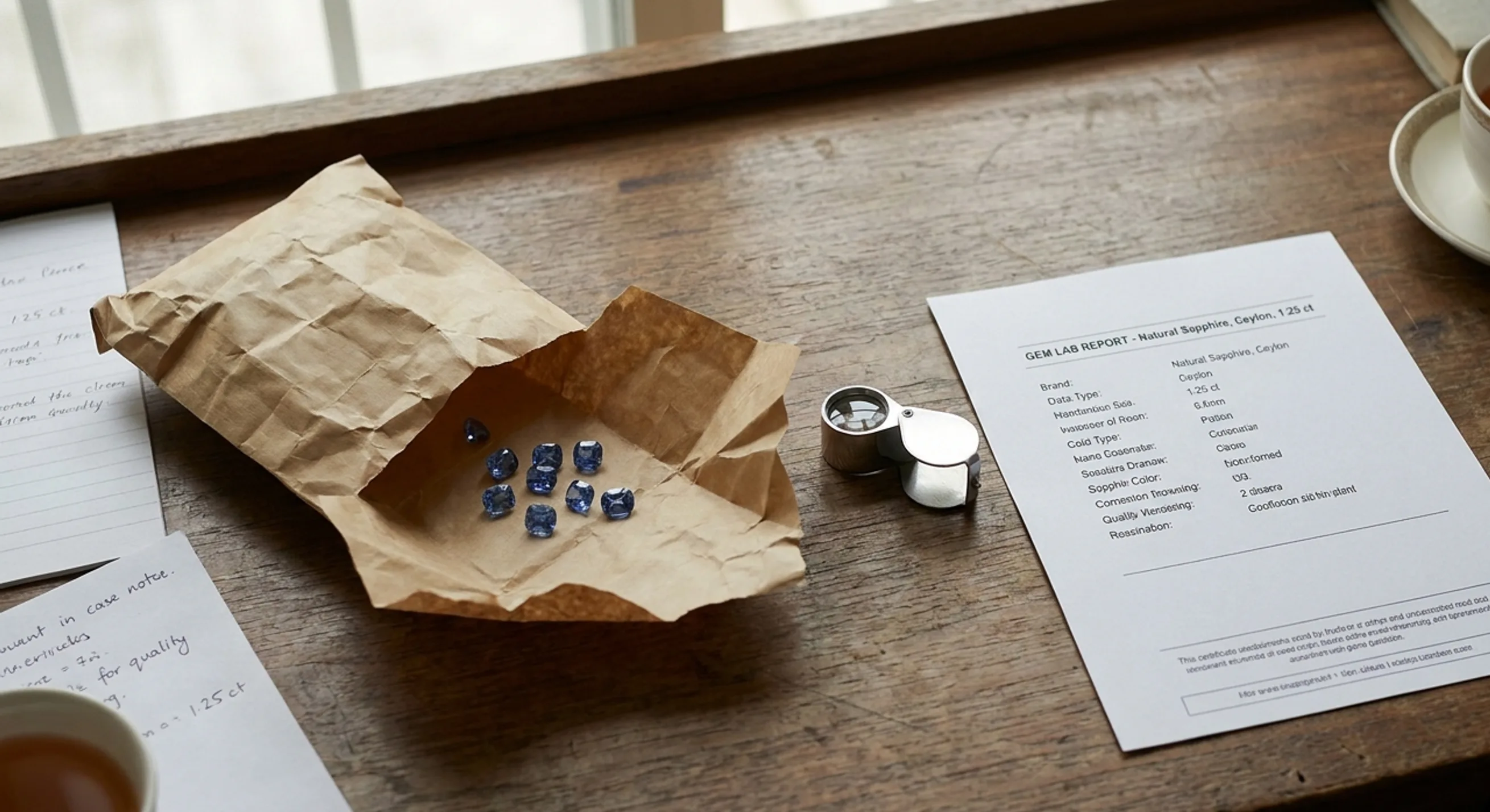
Start with certification. Any colored stone above roughly a carat, and certainly anything in the premium range, should carry a report from a recognized independent lab. For Ceylon sapphires that means GIA, SSEF, or Gubelin, with SSEF and Gubelin carrying the most weight for high-value unheated stones. A report from an unnamed "in-house lab" is not a certificate. It is a sales tool. A serious gemstone dealer submits stones to third parties precisely because their own opinion is not supposed to be the final word.
Then there's treatment disclosure. Heat treatment is the industry norm and has been for generations. Most sapphires on the market are heated, and a well-heated stone is a legitimate, beautiful gem sold honestly at a fair price. Unheated stones sit in the premium tier because they are genuinely scarce, and they command it. The real test isn't whether a stone is heated. It's whether the dealer tells you before you ask. A trustworthy dealer states "heated" or "no indications of heating, per SSEF" as a matter of routine. Vague language like "natural, untreated" with no lab backing is a red flag.
How to choose a gem dealer without getting burned
Knowing how to choose a gem dealer comes down to pressure-testing the same four pillars in the same order, every time.
Certification, independently verifiable. Ask which lab issued the report and request the report number. Legitimate reports can be cross-checked against the lab's own records. If the seller hesitates or offers only a photo of a stone with no matching document, that tells you what you need to know.
Treatment, stated up front. You should never have to extract this. It should be in the listing.
Return policy in writing. A confident gemstone dealer offers a defined return window and puts it in writing. The logic is simple: a dealer who has personally inspected a stone has nothing to fear from you inspecting it too. Short or nonexistent return terms often signal someone who has not seen the stone closely themselves.
Sourcing transparency. This is the one most buyers skip, and the one that reveals the most. Ask where the stone came from. A direct sourcer answers with specifics: a region, a market, a supply route. A reseller answers with adjectives.
Reseller versus direct sourcing: why it matters
Most online gem sellers are resellers. They buy from a wholesaler, who bought from a broker, who bought from a dealer at origin. Each link adds margin and subtracts information. By the time a stone reaches a reseller's website, the story attached to it may be three hands removed from the truth, and nobody in the chain can verify it.
Direct, first-hand sourcing collapses that chain. When a dealer buys stones themselves at origin, in the gem markets of Ratnapura, at the mines around Elahera, from trusted cutters and dealers in Balangoda and Colombo, they carry the provenance forward personally. They saw the rough. They watched the cut. They submitted the stone to the lab. That is a different category of accountability from forwarding a supplier's JPEG.
This is also where photography honesty enters. Colored stones are notoriously easy to flatter with lighting and editing, and some listings online lean hard on that. The answer isn't to distrust every photo. It's to buy from a dealer whose images reflect the stone in normal conditions and who will show you more angles or video on request. Crestonne's approach is to photograph the stones it represents as they actually appear and to back every image with the lab report, so what you see is what arrives. If a photo looks too perfect and the seller will not send additional views, treat that as a caution.
To understand why origin claims carry weight, it helps to see a sapphire's journey from mine to market in full. The number of hands a stone passes through directly affects how much of its history survives.
What questions should you ask a gem dealer?
Use these as a filter. The quality of the answers matters more than the answers themselves.
- Which lab certified this stone, and what is the report number?
- Is it heated or unheated, and what does the report say about treatment?
- Where was it sourced, and how did you acquire it?
- What is your return policy, in writing?
- Can you send additional photos or video under different lighting?
A direct sourcer answers all five quickly and specifically. A reseller tends to slow down on sourcing and returns, because those are the two areas where the chain breaks. Pay attention to who you're actually talking to, as well. A founder-led operation puts a name and a face behind the stones. When the person selling is also the person who inspected and stands behind the gem, accountability has an address.
Ethical sourcing is part of trust
Provenance is not only about authenticity. It is about conditions at origin too. Sri Lanka's gem trade is largely small-scale and artisanal, with a long tradition of comparatively responsible mining, but "ethical" is a word that gets stretched thin in marketing. A trustworthy gemstone dealer can tell you what the term means in their specific supply chain rather than using it as a badge. Read what ethically sourced really means before you accept the label at face value, because the honest version is specific and the marketing version is not.
Price signals, honestly read
Price alone proves nothing, in either direction. A stone priced far below the market for its size, color, and clarity is usually telling you something the listing is not, whether that is undisclosed treatment, a synthetic origin, or a certificate that does not match the stone. Fine unheated Ceylon sapphires often run to several thousand per carat and climb steeply with size and color saturation, so a "no-heat" stone at a fraction of that price deserves hard questions. A fair price backed by real certification and clear return terms is not a bargain to be suspicious of. It is what buying from a direct sourcer looks like. Judge price in context of the four pillars, never on its own.
The Crestonne benchmark
Crestonne was built as a founder-led answer to the reseller problem. The stones Crestonne represents are sourced first-hand in Sri Lanka, certified by independent labs, disclosed honestly on treatment, and photographed as they truly look. There is a name behind the catalogue and a defined return policy behind every stone. That is the standard any dealer in gems should be measured against, whether or not you buy from Crestonne.
If you want a specific stone sourced to these standards, start a custom order and tell us what you're looking for, or browse the current collections to see certified, first-hand-sourced Ceylon gems.
Common questions
Frequently Asked Questions
How do I verify a gem dealer's certification?
Ask which independent lab issued the report and request the report number, then cross-check it against the lab's own records. For Ceylon sapphires, GIA, SSEF, and Gubelin are the recognized labs, with SSEF and Gubelin carrying the most weight for high-value unheated stones. An unnamed in-house report is a sales tool, not a certificate.
Is it safe to buy gemstones online?
Yes, if the dealer meets the four pillars: independent certification you can verify, clear treatment disclosure, a written return policy, and specific sourcing information. Buying from a direct, founder-led sourcer rather than an anonymous reseller reduces the main risks, since fewer hands means more of the stone's history survives intact.
What is the difference between a reseller and a direct gemstone dealer?
A reseller buys from wholesalers and brokers and forwards supplier photos, often several hands removed from origin, so provenance is hard to verify. A direct sourcer buys stones themselves at origin, inspects the rough, oversees the cut, and submits the gem to the lab, carrying the full provenance forward with personal accountability.
Does a heated sapphire mean I'm being cheated?
No. Heat treatment is the long-standing industry norm and most sapphires on the market are heated. A well-heated stone is a legitimate gem sold honestly at a fair price. Unheated stones sit in the premium tier because they are genuinely scarce. What matters is honest disclosure, not whether the stone was heated.