Ethics & Sourcing
From Mine to Market: One Sapphire's Journey Through Crestonne
A Ceylon sapphire passes through six to nine hands between the pit and a buyer's finger. Here is the real supply chain, traced through one stone we currently sell, and how Crestonne shortens it.
Published Updated 10 min read
By Naseef AR
A Ceylon sapphire passes through six to nine hands between the pit it comes out of in Ratnapura and the finger of the person who eventually wears it. The traditional Sri Lanka sapphire supply chain runs: pit miner, mine-side aggregator, Ratnapura dealer, Colombo specialist, cutter, polisher, lab, export agent, retailer. Crestonne's chain runs three: miner via the aggregator we work with, our cutter in Beruwala, then us. This post traces one specific stone, The Meridian, through every step of that journey, with the dates, the prices, and the handoffs.
What Does Sapphire Mine to Market Actually Mean?
"Mine to market" is the most overused phrase in the colored stone trade. Almost every direct mine to market sapphire brand uses some version of it, and almost none of them mean exactly the same thing.
The honest definition is this: a documented chain of custody from a licensed Sri Lankan mining permit through cutting and certification to the final buyer, with no anonymous intermediaries. It does not mean the brand bought the stone from the miner with their own hands. That is not how Sri Lankan artisanal mining actually works, and any brand claiming otherwise is either stretching the truth or describing an unusual one-off transaction.
The reason is structural. A pit miner in Ratnapura works a six-by-six meter shaft with three or four laborers, washes the gravel by hand in the river, and sees maybe one stone above two carats per month if the pit is productive. That miner does not have an export license, does not speak English, does not have the bank infrastructure to invoice a foreign buyer, and cannot afford to hold inventory waiting for the right deal. They sell to a mine-side aggregator the same day the stone is washed clean, for cash, at a price that lets them eat that week. We covered the mining stage in detail in how Sri Lankan gems are mined.
What a genuine short supply chain looks like is different. It is one where each handoff between the pit and the final buyer is named, dated, and priced, and where the brand can show you the dealer they bought from, the cutter they used, and the lab that certified the stone. Not less than three steps. Just no anonymous steps.
The Nine Stages of a Traditional Ceylon Sapphire Supply Chain
Before walking through Crestonne's chain, here is the full traditional version. Most jewelry-chain sapphires in your local mall have travelled this exact path:
- The pit miner. Washes a 4 to 8 carat rough sapphire out of the gem-bearing gravel layer near Ratnapura, Elahera, or Balangoda. Receives the equivalent of $200 to $500 for it from the aggregator standing at the pit edge.
- The mine-side aggregator. Buys daily from 10 to 30 miners in a small geographic area. Sorts roughs by color and quality at the end of each week. Sells weekly to a Ratnapura dealer in lots of 50 to 200 stones. Markup roughly 30 to 50 percent.
- The Ratnapura dealer. Specialist in a particular color or quality tier. Cleans the rough, takes preliminary photos, and either cuts it in-house or sells it on to a Colombo specialist. Markup 15 to 25 percent.
- The Colombo specialist. Has international relationships. Holds the rough for the right buyer (an Indian, Thai, Chinese, or Western jeweler) and brokers the deal. Markup 20 to 40 percent.
- The cutter. Receives the rough with cutting instructions. Plans the stone to maximize color and carat retention rather than ideal proportions. Returns a finished stone roughly 35 to 55 percent of the rough weight. We covered the craft side of this in Sri Lankan gem cutters.
- The polishing house. Often the same operation as the cutter, but for fine stones sometimes a separate specialist who handles the final polish on the table facet and crown.
- The lab. GIA, SSEF, Gübelin, AGL, or Lotus Gemology. Performs identification, treatment analysis, and (at premium tier) origin confirmation. Charges $80 to $400 per stone depending on lab and report type. No markup, just a fee.
- The export agent. Handles the Sri Lankan customs documentation, the CITES paperwork if relevant, and the actual shipment. Markup 5 to 10 percent.
- The retailer. Mounts the stone, displays it in a shop or online, and applies the retail markup. Typically 100 to 200 percent over their landed cost.
Add it all up and the rough that paid the miner $400 lands on a retail shelf at $4,000 to $7,000 finished and mounted. Some of that is real value-add: cutting transforms the stone, certification underwrites trust, retail provides the buyer experience. But a meaningful slice is friction, and friction is what shortening the chain is supposed to reduce.
The Crestonne Chain: Three Handoffs
The chain we operate has three named handoffs between pit and buyer.
1. Mine-side aggregator. We work with one aggregator family near Pelmadulla, a short drive south of Ratnapura. We have been buying from them since 2022. They sort and price their weekly stock, we visit roughly every six weeks, and we buy in batches of three to twelve stones depending on what they have. We see the rough before they have shown it to other dealers, which is a privilege earned over years of consistent business.
2. Our cutter in Beruwala. A second-generation lapidary working in a family workshop on the coast. He has cut roughly 80 percent of the finished stones in our collection. We discuss the cutting plan together for each stone, weigh the trade-offs between color retention and ideal proportions, and agree on a target finished carat weight. The full sapphire traceability record we keep for each stone includes his cutting notes and a video of the rough being marked.
3. The lab. Every stone above one carat goes to SSEF or Lotus Gemology in Switzerland or Bangkok respectively. Smaller stones go to GIA in Bangkok. We never list a stone without the report in hand.
That is the full chain. There is no Colombo specialist link, no export agent (we handle the documentation ourselves), and no retailer markup because we are the retailer. The two removed links are roughly where 40 percent of the traditional retail premium lives.
The Meridian: A Specific Stone, Traced
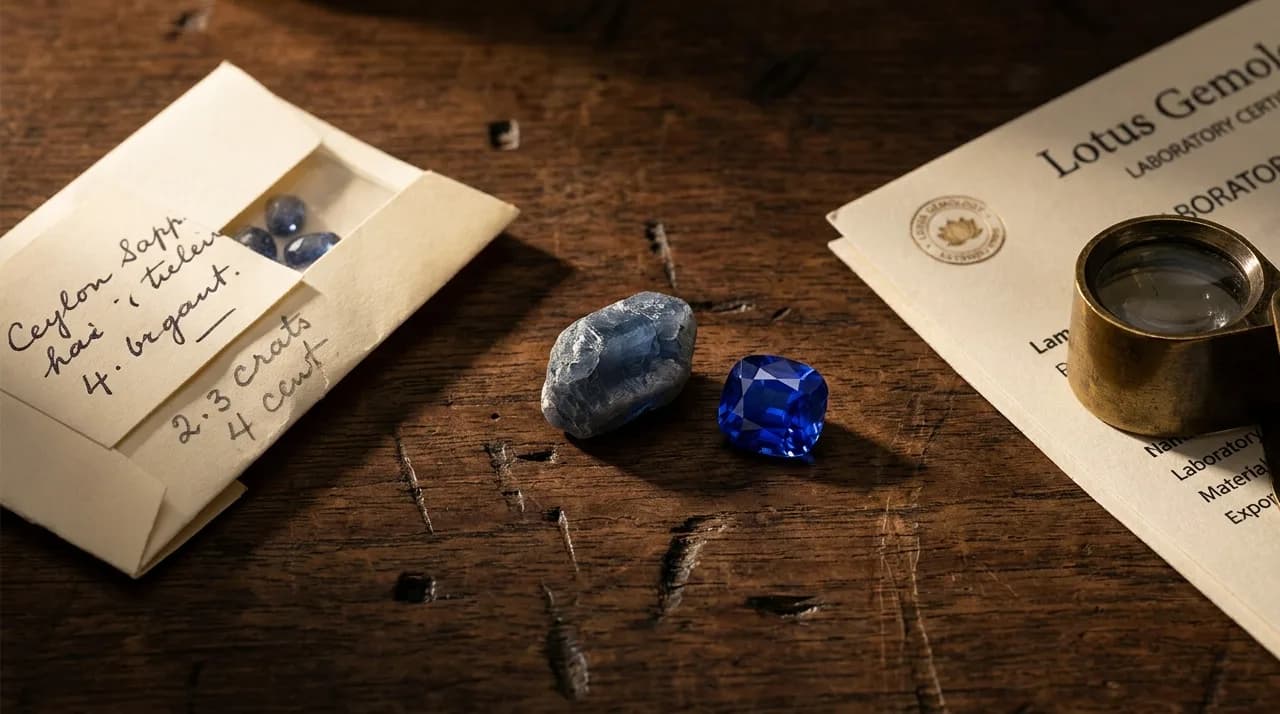
The cleanest way to show what a short chain actually produces is to trace one stone all the way through. The Meridian is the unheated royal blue cushion currently listed in our collection, and here is its full provenance.
October 2025, Pelmadulla. A 4.84 carat rough Ceylon sapphire is washed out of a pit on land owned by a smallholder family who lease mining rights to a four-person mining team. The rough goes to our aggregator the same afternoon for the equivalent of $310. We see a photograph that evening via WhatsApp.
Late October 2025, Pelmadulla. We visit the aggregator the following week. The stone is sitting in a small folded paper packet labeled in Sinhalese with the pit reference and date. The rough has good color visible through the cleaning solution, no obvious black inclusions, and a shape that suggests a cushion or oval cut. We agree a price of $740 and pay in Sri Lankan rupees. We photograph the rough on a calibrated background and weigh it on the aggregator's scale.
November 2025, Beruwala. The rough goes to our cutter. We sit with him for an hour discussing the plan. The stone has a slight zoning band that runs at a thirty-degree angle through the centre. Cutting along the band would yield a 2.6 carat stone with visible zoning. Cutting against it would yield 2.3 carats with the zoning effectively hidden inside the pavilion. We choose the smaller, cleaner version. He marks the stone with a fine-tip pencil. We photograph it before cutting begins.
November to December 2025, Beruwala. The cutter works the stone over roughly twelve days, with the bulk of the time on initial shaping and the table facet. The final piece comes off the wheel at 2.31 carats, a cushion measuring 7.9 by 7.4 by 4.8 millimeters.
January 2026, Bangkok. We submit the stone to Lotus Gemology with a brief on origin. The report comes back four weeks later: Sri Lankan origin confirmed, no indications of heating, transparent royal blue with a slight violet modifier, eye-clean. The report references the spectroscopic and inclusion data they used to reach those conclusions.
February 2026, Colombo. We photograph the finished stone on the same calibrated background we used for the rough, against a black velvet tray, and again held in tweezers under standardized lighting. The stone, the report, the rough photograph, and the cutter's notes go into our internal provenance record.
March 2026, online. The Meridian goes live on the Crestonne site at $7,200, which is roughly 35 percent below the retail price comparable stones command at major Western jewelers. The price reflects fewer markups, not lower quality.
This is what a documented Sri Lanka sapphire supply chain actually looks like, end to end. Five named handoffs over six months, with each step photographed or recorded.
Sapphire Traceability: What Goes Into the Record
For every stone in our collection, the traceability file contains:
- The rough photograph from the aggregator, dated and weighed.
- The cutter's pencil-marked rough photograph showing the cutting plan.
- The cutter's notes on yield, decisions, and any complications.
- The finished stone photographs on standardized backgrounds.
- The lab report (GIA, SSEF, or Lotus Gemology) in full.
- Our own measurements on a calibrated electronic scale and digital caliper.
- The internal handoff dates and prices.
The point of the record is not vanity. It is so that the buyer, or a resale buyer ten years from now, can trust the stone without having to verify everything from scratch. A clean traceability file is what makes a sapphire genuinely investment-grade in the long-hold sense, and we walked through that math in the Ceylon sapphire investment guide.
It also makes our ethical sourcing claims auditable rather than aspirational. We describe what ethical sourcing means in practice in our piece on ethically sourced Ceylon sapphires, and the traceability file is the receipt behind that claim. We can show you exactly which pit, which aggregator, which cutter, and which lab.
What This Means When You Buy a Stone From Us
Three things follow from a short, documented chain.
Price. You pay roughly what you would pay through one or two layers of dealer markup, not five or six. On stones above two carats, the saving is twenty to forty percent versus equivalent stones at chain retailers.
Trust. Every claim we make about origin, treatment, and ethics is backed by a record we can show you. There is no "we trust our supplier" link in the chain where the audit trail goes dark.
Resale credibility. Years from now, when you (or the next owner) wants to sell, the provenance file travels with the stone. A documented chain is a meaningful resale asset on its own, separate from the stone itself.
Behind all of it is a fairly simple thesis. The Sri Lanka sapphire supply chain has worked the same way for two hundred years. We are not trying to reinvent it. We are trying to make it shorter, more transparent, and easier for an end buyer to trust. That is the entire business.
If you want to start with a stone in our collection, the current listings are linked. If you want something specific, larger, or in a particular color that is not currently in stock, our custom sourcing service is how we go back into the aggregator network with your brief in hand. Either way, the same chain applies. Three handoffs, fully documented, from the pit to the stone in your hand. The full Crestonne story is the longer version of why we built it that way.
Common questions
Frequently Asked Questions
What does 'mine to market' actually mean for a Ceylon sapphire?
It means a documented chain of custody from a licensed Sri Lankan mining permit through cutting and certification to the final buyer. In practice, that does not always mean buying from the miner directly. Artisanal Sri Lankan miners almost never have the capital or export licensing to deal with international buyers themselves. A genuine mine-to-market chain is one where each handoff is documented and the markup at each stage is transparent, not one with zero dealers.
How many people handle a Ceylon sapphire before it reaches a buyer?
In the traditional Sri Lankan trade, six to nine: the pit miner, a mine-side aggregator, a Ratnapura dealer, often a second Colombo dealer, the cutter, a polishing house if separate, the lab, an export agent, and the final retailer. Each adds a markup ranging from five to forty percent. A shortened chain, like Crestonne's, removes the middle-dealer and export-agent links, leaving roughly three handoffs between miner and end buyer.
Can you really buy a sapphire direct from a Sri Lankan miner?
Almost never, and any brand that claims to is either oversimplifying or stretching the truth. Sri Lankan artisanal miners typically sell rough to a mine-side aggregator the same day it is washed out. The aggregator has the relationship with cutters and dealers in Ratnapura. Direct mine-to-market sapphire from an individual miner happens occasionally on very small stones, but as a sustainable sourcing model it does not exist at scale. What is possible is a short, documented chain with the aggregator and dealer steps fully transparent.
What is sapphire traceability and why does it matter?
Sapphire traceability is the documented record of a stone's journey from rough to finished, including photographs of the rough, cutter records, lab certificates, and shipping documentation. It matters for two reasons. First, it lets the next buyer (today's customer or a resale buyer in ten years) trust the stone's origin and treatment claims without re-doing the verification work. Second, it makes ethical sourcing claims auditable rather than aspirational.
Does a shorter supply chain mean a cheaper sapphire?
Usually yes, but not always dramatically. Each removed intermediary saves between five and twenty percent. Removing two layers can cut retail price by twenty to thirty-five percent versus a comparable stone bought through a traditional jewelry-chain supply line. The savings show up most clearly on certified unheated stones above two carats, where the chain is longest and each markup compounds against a higher base price.