Understanding
What Causes the Violetish-Blue Color in Natural Sapphire?
Blue sapphire gets its blue from iron-titanium pairs, and its violet edge from small amounts of chromium and vanadium. This covers the chemistry, the optics, and how to judge a violetish-blue Ceylon stone before you buy.
9 min read
By Naseef AR
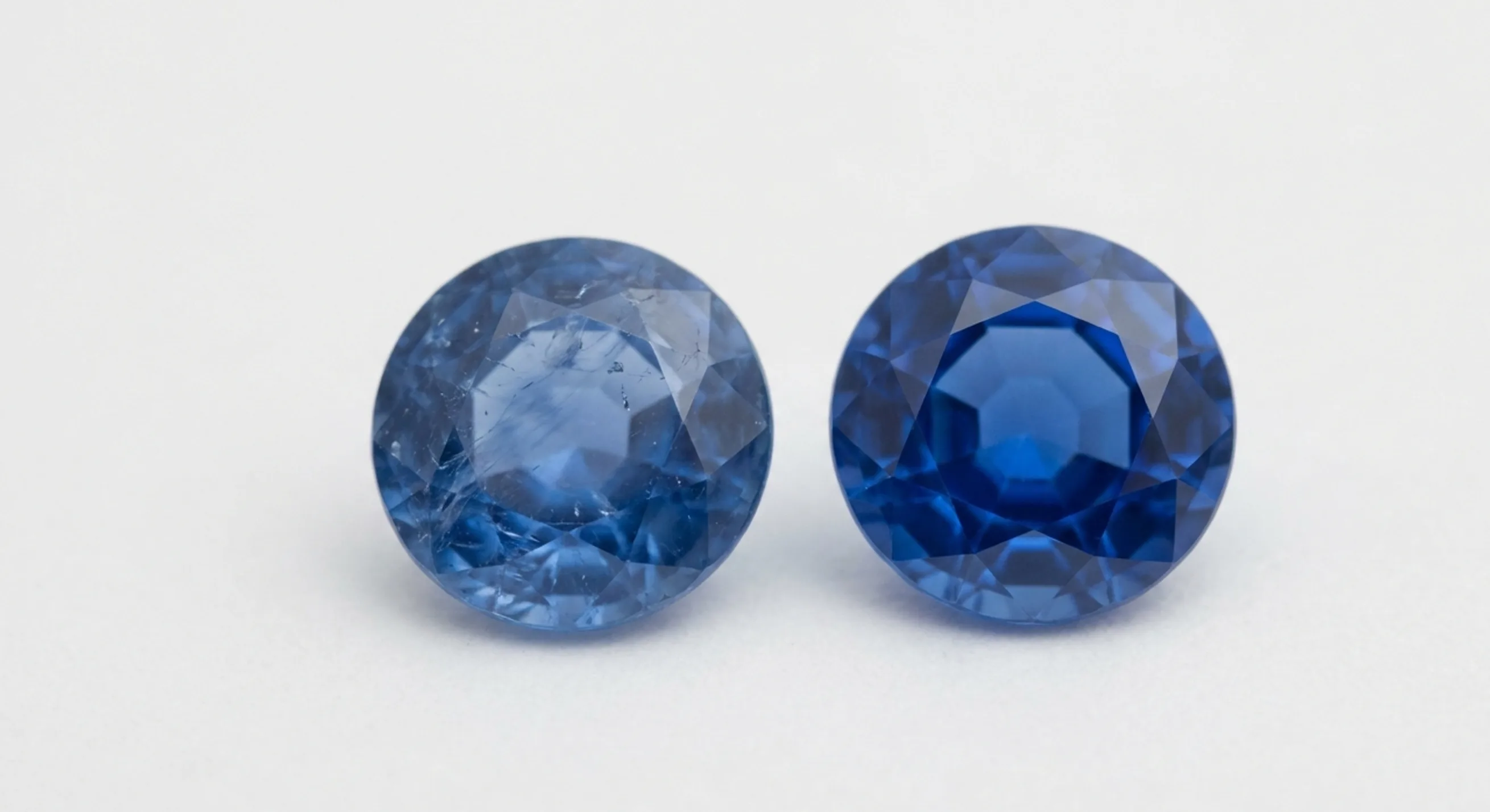
A violetish-blue sapphire gets its blue from iron and titanium and its violet edge from a trace of chromium, sometimes with vanadium. Those are the sapphire trace elements that matter here. Iron-titanium pairs absorb yellow to red light, so blue is what passes through. A few parts per million of chromium or vanadium let a little red back in, and your eye reads red mixed with blue as violet. After that, optics take over. Sapphire is pleochroic, so the way the cutter oriented the crystal and the light you look under both move the colour.
Here is how this side of sapphire color science works, and what it means when you are buying.
What gives blue sapphire its colour?
Sapphire is corundum, which is aluminium oxide. Pure corundum is colourless. All of its colour comes from foreign atoms taking the place of aluminium in the crystal lattice. If you want the wider picture of how corundum becomes sapphire or ruby, that piece covers it. This one stays with blue and violet.
The blue comes from a process called intervalence charge transfer. When ferrous iron (Fe2+) and titanium (Ti4+) sit on neighbouring aluminium sites, incoming light can push an electron from the iron to the titanium. For that moment the pair becomes Fe3+ and Ti3+. The transfer absorbs a broad band of light centred near 588 nm, which covers the yellow, orange and red end of the spectrum. Take those colours out of white light and what reaches your eye is blue.
You need surprisingly little to do this. A few hundredths of one percent of iron and titanium replacing aluminium is enough to give a strong blue. Sri Lankan material follows the same rule. Measurements on sapphires from Bagangoda and Dangdiyagala put the iron-titanium absorption peak near 570 nm, with iron at roughly 137 to 247 ppma and titanium at 63 to 209 ppma. That band is the main reason those stones are blue.
Which sapphire trace elements add the violet tint?
Chromium and vanadium, and they work in a completely different way. Iron-titanium colour depends on an electron jumping between two neighbouring atoms. Chromium (Cr3+) and vanadium (V3+) colour corundum through localised, crystal-field absorption inside a single ion. No electron moves between atoms. The ion's surroundings in the lattice decide which wavelengths it absorbs, and with chromium the light that gets through carries a red-pink component.
Chromium is the colouring element in ruby, so scale is important. Ruby typically holds about 1,500 to 7,000 ppm chromium. Pink to purple sapphire sits around 90 to 1,140 ppm. A blue sapphire with a violet tint holds far less again. One measured blue sapphire from Balangoda in Sri Lanka contained 514 ppmw iron, 110 gallium, 42 titanium, 17 chromium and 6 vanadium. That is a tiny amount of chromium and vanadium, but against a blue background even a faint red contribution shifts the hue toward violet.
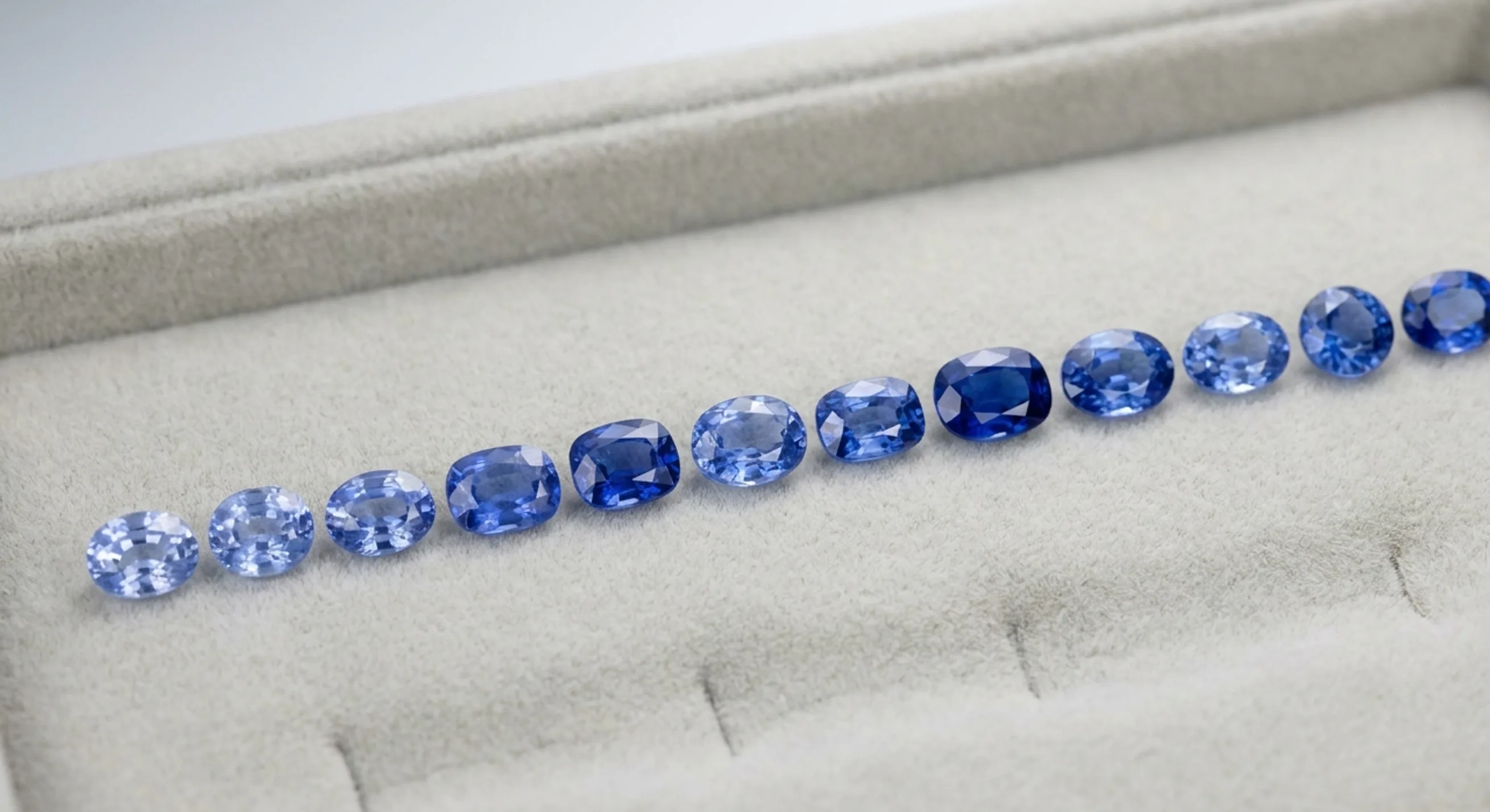
Sources disagree on which element deserves the credit. Some popular references put purple in sapphire down to vanadium alone: small amounts give a purple hue and larger amounts produce colour-change sapphire. Others name chromium and vanadium together. I read the chemistry as both playing a part. The two interact with titanium too, because titanium alongside chromium is known to push a pink sapphire toward purple. What nobody has published is a reliable ppm threshold where blue turns "violetish". If anyone quotes you an exact figure for that, be sceptical. In practice gemmologists treat blue violet corundum as one continuous range, and where a stone sits in it depends on the balance between its iron-titanium pairs and its chromium and vanadium.
Why do Ceylon sapphires often lean violet?
Geology. Sri Lankan blue sapphires are metamorphic, with zircon inclusions dated to around 549 million years. They carry relatively little iron, often under 1,000 ppm, along with low gallium and more magnesium than sapphires from basalt-related deposits.
Low iron matters in two ways. First, the blue doesn't get buried under the dark, inky tones that heavy iron gives some basaltic sapphires, so the stones stay bright and highly transparent. Second, with less iron darkening the body colour, a small red contribution from chromium and vanadium has room to show. Low iron also explains why many Ceylon sapphires show orange-red fluorescence under long-wave UV. The glow comes from their trace chromium, and there is too little iron to suppress it.
Under artificial light, some blue and greyish-blue Sri Lankan sapphires show a reddish or violet-red tint. How strong it is depends on how much chromium and vanadium the stone contains. So when you see a Ceylon blue go slightly violet indoors, you are looking at its sapphire trace elements at work. Nothing has been done to it.
Does cutting orientation change a sapphire's colour?
Yes, and a lot. Sapphire is uniaxial negative, with a refractive index of about 1.762 to 1.770 and birefringence of 0.008 to 0.010. Because the crystal treats light differently depending on direction, it is pleochroic: it shows different colours along different axes.
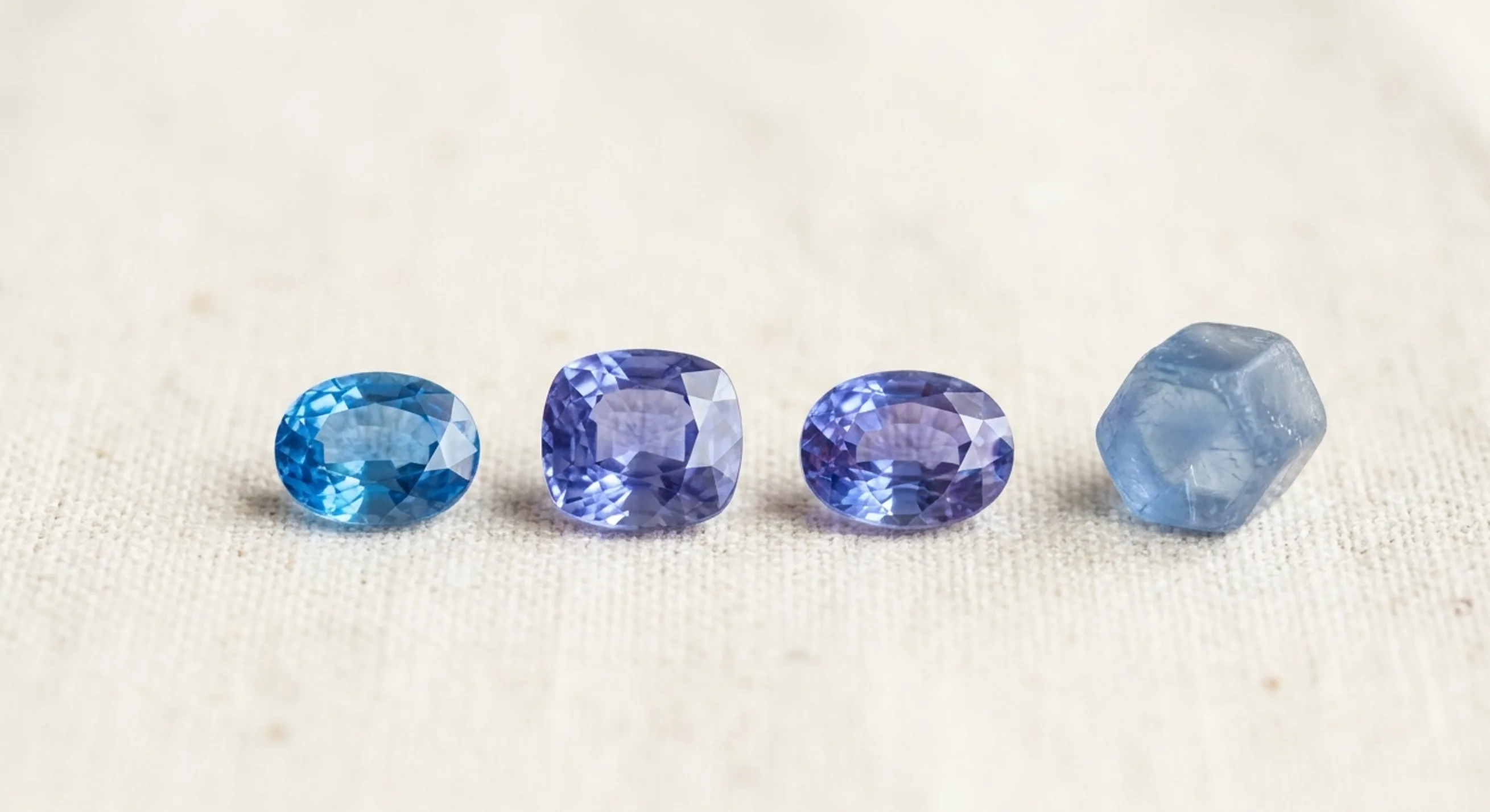
In blue sapphire this is strong. Looking one way through the crystal gives violetish blue, and the other way gives greenish blue. The Gemological Institute of Ceylon describes the pleochroism of blue sapphire as very pronounced, violet-blue against blue-green. Purple sapphire splits into violet and orange.
GIA's guidance is that cutters should ideally orient the stone so the violetish-blue direction faces up. In practice that means putting the table across the crystal's optic axis. Ceylon rough doesn't always cooperate, though. Orienting for colour can cost weight, so a cutter has to balance yield against face-up colour. A stone cut for maximum carats may show a greener blue face-up, or green flashes toward the girdle, while a stone cut for colour shows the violetish blue most buyers want. The chemistry sets what colours a stone can show. The cut decides which one you see.
Why does a sapphire look more purple under warm light?
Two separate effects get confused here. Pleochroism depends on viewing angle and shows up even under one fixed light. Colour change depends on the type of light. A stone can have one without the other.
Warm light, such as incandescent bulbs and many warm-white LEDs, carries a lot more red than daylight. A sapphire with some chromium or vanadium has more red to transmit under that light, so its violet component gets stronger. Push the chemistry further and you reach true colour-change sapphire: blue in daylight, purple under incandescent light. The common type combines ruby's chromium chromophore with blue sapphire's iron-titanium pairs. A rarer type, known from Mogok, is coloured by vanadium.
Most violetish-blue Ceylon stones fall short of full colour change. Many shift a little more violet indoors and settle back to blue outside, though how far varies from stone to stone, and some barely move. That shift is a natural property of the stone.
Is a violet tint a sign of heat treatment?
No. Heat treatment is the industry norm for blue sapphire. An estimated 90 to 95% of sapphires on the market have been heated, and it is a legitimate, stable process. High-temperature heating moves iron and titanium through the lattice and increases the number of Fe2+-Ti4+ pairs. That deepens the blue and clears out grey or green modifiers.
Sri Lanka has a long history with it. Milky geuda has been heated above 1500°C since about 1975 to dissolve rutile silk and develop blue. Heat-with-pressure treatment, at roughly 1200 to 1800°C under nearly 1 kbar, is mostly used on Sri Lankan material, either geuda or already-heated blue, to intensify colour.
Conventional heating works with the iron and titanium already in the stone. It doesn't add chromium or vanadium. So a violet secondary hue comes from the stone's own chemistry whether the stone is heated or not. A tint tells you nothing about treatment either way.
Treatment has its own clues. Silk broken into dotted specks is a classic sign of heat, and heated geuda-type sapphire often shows chalky short-wave UV fluorescence. But only a lab report settles it. Unheated stones are the premium tier because fewer of them reach fine colour without help. Every stone Crestonne lists comes with a written treatment statement and a lab report, so you never have to guess.
How should you judge a violetish-blue sapphire?
Look at it in more than one light, and look at it moving.
- Daylight first. Indirect north light or overcast daylight shows the base blue most honestly. This is the colour the stone will have most of the time outdoors.
- Then warm light. Watch how far it moves toward violet. A little is normal for Ceylon material. If you love it in daylight and dislike it under your home lighting, that matters more than any grading term.
- Tilt it. Rock the stone and watch the edges. Greenish-blue flashes toward the girdle are pleochroism, and they show how carefully the stone was oriented.
- Insist on video. A still photo can't show pleochroism or lighting shifts, and colour calibration varies between screens. Every Crestonne stone has its own video, so you can see it move before you commit.
On price, colour quality and treatment status outweigh the violet modifier on its own. For current prices by size and grade, see my Ceylon sapphire price per carat guide. For how the violet tint itself affects desirability and price, read my piece on violetish blue sapphire rarity and value.
Once you understand sapphire trace elements, a violet tint stops being a mystery. It is chromium and vanadium in a low-iron Ceylon crystal, brought out or held back by the cut and the light. If you have a specific balance of blue and violet in mind, describe it through the custom order form for a loose stone, or browse what's available now in the collections.
Common questions
Frequently Asked Questions
What trace elements make sapphire blue?
Iron and titanium. When Fe2+ and Ti4+ sit on neighbouring aluminium sites, an electron transfer between them absorbs yellow to red light near 570 to 588 nm, so blue is transmitted. A few hundredths of one percent of each is enough.
Why does my blue sapphire look purple indoors?
Warm indoor light contains more red than daylight. If the sapphire holds small amounts of chromium or vanadium, it passes more of that red, and the blue leans toward violet. In stones with enough of these elements, the effect becomes a full colour change.
Is a violet tint in sapphire natural?
Yes. The violet component comes from chromium and vanadium already in the crystal. Conventional heat treatment rearranges iron and titanium but does not add chromium or vanadium, so a violet tint does not indicate treatment either way. A lab report confirms heating status.
What is the difference between pleochroism and colour change in sapphire?
Pleochroism is a change in colour with viewing direction, such as violetish blue one way and greenish blue the other, and it shows under a single light. Colour change is a shift caused by the type of light, such as blue in daylight and purple under incandescent light.