Buying Guides
Princess Cut Sapphire: Color, Brilliance & Buying Tips
Square sapphires are scarcer and pricier than ovals because Ceylon rough grows as barrel-shaped hexagonal crystals. Here is how the princess cut handles sapphire's colour and light, and what to check before buying one.
11 min read
By Naseef AR
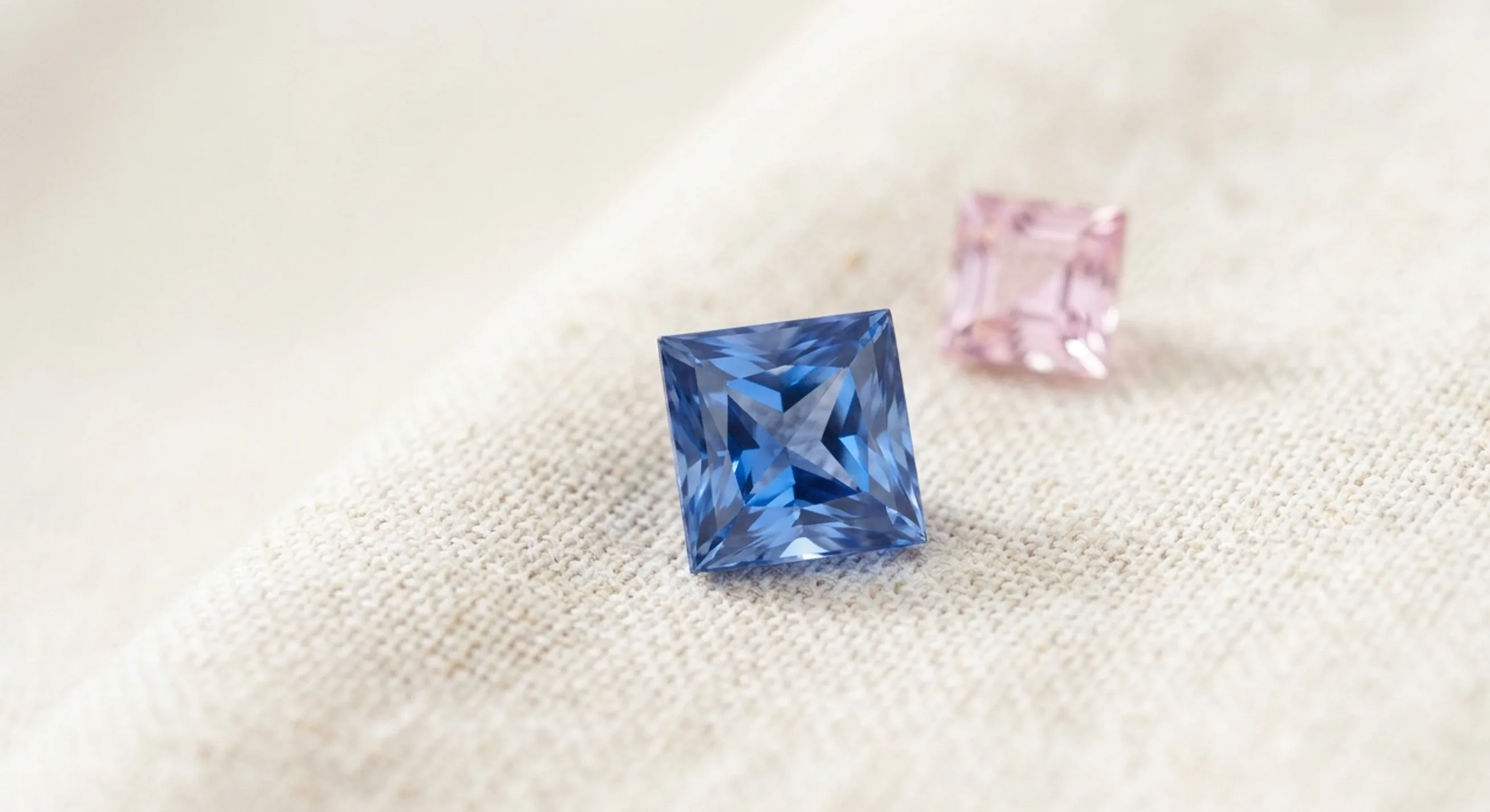
A princess cut sapphire is a square sapphire with a brilliant-style pavilion of chevron facets and four sharp corners. In natural Ceylon material it is one of the harder shapes to find, and it usually costs more than an oval or cushion of the same quality. The reason is the rough. Sri Lankan sapphire grows as barrel-shaped hexagonal crystals, and cutting a square out of a barrel loses more weight than cutting an oval does. If you want one, judge it on six things: no window, sound corners, even colour, a true square outline, a certificate that states treatment clearly, and a setting that protects the points. Below is how I assess each one.
What is a princess cut sapphire?
The princess cut was developed for diamond. A common version has 58 facets: 21 on the crown, 4 on the girdle and 33 on the pavilion. Published counts run anywhere from 49 to 76. Under the table, the pavilion facets run as long chevrons that form an X, and that pattern gives the cut its crisp, tiled look. To count as square, the length-to-width ratio has to be 1.05 or lower. Anything longer reads as a rectangle.
Coloured stone cutters treat that layout as a starting point. A sapphire cutter will often change the number and angle of the pavilion facets to suit the colour and depth of the rough, so two princess cut sapphires can look quite different under the table even when their outlines match. If you want the general picture first, I've written separately on how the princess cut works across gemstones. This piece covers only sapphire, because corundum changes nearly everything about how the cut behaves.
Why is a square sapphire so hard to find?
Start with diamond, because it works the opposite way. Diamond rough often grows as an octahedron, which is two pyramids joined base to base. Saw one across the middle and you get two blocks that are already close to a princess shape. That is why princess-cut diamonds keep much more of the rough than a round does, often quoted at 60 to 80 percent of its weight against roughly 40 to 50 percent for a round brilliant, and why they sell for roughly 20 to 40 percent less per carat than an equivalent round brilliant.
Sapphire offers no such shortcut. Corundum belongs to the trigonal crystal system, and Ceylon rough usually turns up as barrel-shaped hexagonal prisms, tapering bipyramids or flat tabular crystals. Seen end-on, the crystal is a hexagon. Seen from the side, it is a barrel that narrows at each end. Ovals and cushions follow those curves naturally. A square has to be carved out of the middle of the hexagon, with its corners pushed out toward the edges of the crystal, and everything outside that square becomes dust.
Finished sapphire is sold by the carat, so the cutter's instinct is always to keep weight. In practice a square sapphire usually gets cut only when the rough is already unusually blocky, or when the owner is willing to give up weight for the shape. That makes good princess cuts uncommon in any size, and more so above 2 carats.
No published price table gives a separate figure for princess-cut sapphire. My view, based on that yield loss, is simple: expect to pay more per carat than for an oval of the same colour and clarity, and expect to wait longer to find the right stone.
How much does a princess cut sapphire cost?
Treatment, colour and size drive the price far more than the shape does. Here are the per-carat ranges for Ceylon sapphire as of 2026, from my Ceylon sapphire price per carat guide:
| Quality tier | Under 1 ct (per ct) | 1 to 3 ct (per ct) |
|---|---|---|
| Commercial heated | $300 to $800 | $500 to $2,500 |
| Fine heated | $800 to $2,000 | $3,000 to $8,000 |
| Fine unheated | $2,000 to $4,500 | $7,000 to $18,000 |
| Exceptional unheated | $4,500 to $8,000 | $10,000 to $20,000 |
Most certified Ceylon stones between 1 and 3 carats sell for $1,500 to $6,000 per carat. Retail princess-cut listings fit the table above: a 0.89 ct natural blue princess at around $1,100 per carat and a 1.33 ct at around $3,200 per carat are typical. Per-carat prices step up sharply at 1, 2, 3 and 5 carats, so a stone just over one of those weights costs noticeably more per carat than one just under it.
For comparison, a lab-created princess sapphire costs about $400 for a 1 ct (6x6 mm) stone and about $2,000 for a 4 ct (9x9 mm) one. Lab-grown is real corundum with the same hardness, but it isn't rare and doesn't hold value the way natural Ceylon material does. Those prices show what you're paying for when you buy natural.
Does a princess cut sapphire sparkle like a diamond?
Not in the same way, and you shouldn't expect it to. Corundum has a refractive index of 1.762 to 1.770, far lower than diamond's. Brilliance depends on light hitting the pavilion facets and bouncing back up through the crown. Whether it bounces or leaks out depends on the critical angle, which is arcsin(1/RI). For sapphire that works out to about 34.5 degrees, against about 24.4 degrees for diamond, so light escapes through a sapphire's pavilion far more easily.
In practical terms, sapphire needs steeper pavilion angles to send light back to your eye. Cut the pavilion too shallow and light passes straight through. That causes a window: a washed-out, see-through patch in the middle of the stone, where you can read print through it. Commercial cutters sometimes cut shallow pavilions on purpose to keep weight, because cutting flat rough shallow keeps more of its weight than cutting a smaller stone to a proper depth would.
The opposite fault is extinction: dark dead spots that stay dark at every viewing angle. It usually comes from pavilions that are too deep or badly angled. A princess cut sapphire is especially exposed to both faults because of its geometry. The pavilion has to reach the culet from the midpoints of the sides and from the corners, and the corners sit farther away. So the corner facets and side facets run at different angles, and keeping both above the critical angle without making the stone deep and heavy takes real skill. If it's done badly, you get a dark X across the stone or a pale window in the centre.
Sapphire's dispersion is also low, at 0.018, so it shows little of the rainbow fire a diamond gives off. A well-cut princess sapphire gives you strong, even brilliance and saturated colour. That combination is the whole appeal.
Why does colour concentrate in the corners?
Light travelling toward the corners of a square stone passes through more material before it comes back out. A longer path means more absorption, and more absorption means deeper colour. That is why the corners of a princess cut sapphire often look more saturated than the centre.
This often works in your favour with Ceylon material. Sri Lanka is known for lighter, brighter blues, and a princess cut can frame a cornflower centre with richer corners. With already dark material it works against you, because the corners can go inky and close to black. Lighter to medium tones tend to suit a princess cut best.
The corners also come from the outer edges of the rough. Naturals (small unpolished patches of original crystal skin), inclusions and colour bands tend to end up there. Corundum grows in hexagonal layers, and its colour zoning runs in straight bands parallel to the crystal faces. The straight edges of a square can line up with those bands and make them look like stripes, or the cutter can turn the stone so the zoning sits low in the pavilion where it blends in. Each cutter has to decide how to handle this.
How does cutting orientation affect face-up colour?
Sapphire is doubly refractive, with a birefringence of 0.008 to 0.010. It is also dichroic, meaning it shows slightly different colours along different directions in the crystal. Viewed down the long axis of the barrel, blue sapphire usually looks its purest. Viewed from the side, a greenish or greyish tint can creep in.
The best colour comes from placing the table at right angles to that long axis. The problem is that the barrel is longest along that axis, so cutting it that way means grinding away much of that length, which leaves a smaller, lighter finished stone. Cutters sometimes tilt the orientation to save weight, and the face-up colour can then shift toward green or look uneven from one half of the table to the other. A square outline leaves the cutter less room to correct this than an oval would.
The check is simple. Look at the stone face-up in daylight and decide whether the blue (or pink, or yellow) is even across the table or changes from one side to the other. A video that rotates the stone shows this far better than a still photo. That's why every stone Crestonne lists comes with its own video.
Should you buy a heated or unheated princess cut sapphire?
Around 90 to 95 percent of sapphires on the market have been heat-treated. Heating is the industry standard. It is stable and permanent, it is accepted by every major lab and trade body, and it improves colour and clarity by dissolving fine rutile silk. A heated princess cut sapphire with good colour and a well-made pavilion is a sound purchase.
Unheated stones are the premium tier. They cost around 2 to 5 times more than an equivalent heated stone, because the colour came out of the ground that way. The gap grows with size: about 2 times at 1 ct, about 3 times at 3 ct, and up to 5 times at 5 ct and above for fine stones. One classic sign of heat is silk broken into dotted specks rather than long, intact needles. Your eye can't settle the question, though. The lab report can.
The lab report should state treatment plainly, either "heated" or wording such as "no indication of heating". Every stone Crestonne lists comes with a report from an independent laboratory (TGL, Guild or GIC) and a written treatment statement, so you know which tier you are buying.
Sapphire buying tips for a princess cut: my checklist
These are the points to check on any square sapphire before it goes anywhere near a setting.
- Check for windows. Look at the stone face-up and tilted. If the centre goes pale or see-through, the pavilion is too shallow. A slight window in a light stone can be acceptable. A large one drains the colour.
- Look for chipped or thin corners. Sapphire is Mohs 9 and has no cleavage, but it can part along internal planes, and a sharp point can still chip from a knock. Inspect all four corners for nicks, and check that the girdle isn't knife-thin there. Some cutters soften the corners slightly for durability, and I think that trade-off is worth it.
- Check colour zoning. Look for straight bands across the table, particularly bands that line up with an edge. Zoning that sits low in the pavilion is usually invisible face-up. Zoning that crosses the table is not.
- Confirm heat-treatment disclosure on the certificate. Make sure the report says heated or unheated in writing, and that the stone in the video matches the report's weight and measurements.
- Check the outline. Measure length against width. At 1.05 or under, the stone is square. Above that, it is a rectangle and should be priced as one.
- Choose a corner-protecting setting. V-prongs at each corner are the classic choice, and a bezel or half bezel gives even more protection for a ring worn every day. Never set a princess sapphire with plain round prongs that leave the points exposed. If you're still choosing between shapes, I've compared the best sapphire cuts and shapes for engagement rings side by side.
If you buy online, the video does most of the work here. A rotating clip shows windows, extinction, corner condition and zoning in a way a single retouched photo can't.
Finding the right princess cut sapphire
Good princess cut sapphires are uncommon, and well-cut ones with sound corners and even colour are rarer still. If you have a size, colour or treatment tier in mind, describe it in our custom-order form for a loose stone. If you'd rather look at what's in stock first, browse the collections, where every listing includes its own video, treatment statement and lab report.
Common questions
Frequently Asked Questions
Are princess cut sapphires more expensive than oval sapphires?
Usually, yes. Ceylon sapphire rough grows as barrel-shaped hexagonal crystals, so cutting a square loses more weight than cutting an oval. No price table lists a fixed premium, but expect to pay more per carat for a princess cut of the same colour and clarity, and expect it to take longer to find.
Do princess cut sapphires chip easily?
Sapphire is Mohs 9 with no cleavage, so it is very durable. Still, the four sharp corners are the weak points and can chip from a hard knock. Check the corners for nicks and thin girdles before you buy, and set the stone with V-prongs or a bezel to protect them.
Is a princess cut sapphire as brilliant as a princess cut diamond?
No. Sapphire's refractive index (1.762 to 1.770) is much lower than diamond's and its dispersion is low, so it shows less fire. A well-cut princess sapphire gives strong brilliance and saturated colour instead. The main faults to watch for are windows from shallow pavilions and extinction from badly angled ones.
Is a heated princess cut sapphire a good buy?
Yes. Around 90 to 95 percent of sapphires are heat-treated, and heating is the accepted industry standard for improving colour and clarity. Unheated stones are a premium tier that costs roughly 2 to 5 times more. Whichever you choose, make sure the lab report states the treatment clearly.