Buying Guides
Cushion vs Oval Sapphire: Which Shape Shows Color Better?
On color alone, a well-cut cushion usually concentrates saturation and an oval usually gives more face-up size for each carat. Which one suits a stone depends on its tone, its saturation and where its color sits in the crystal.
11 min read
By Naseef AR
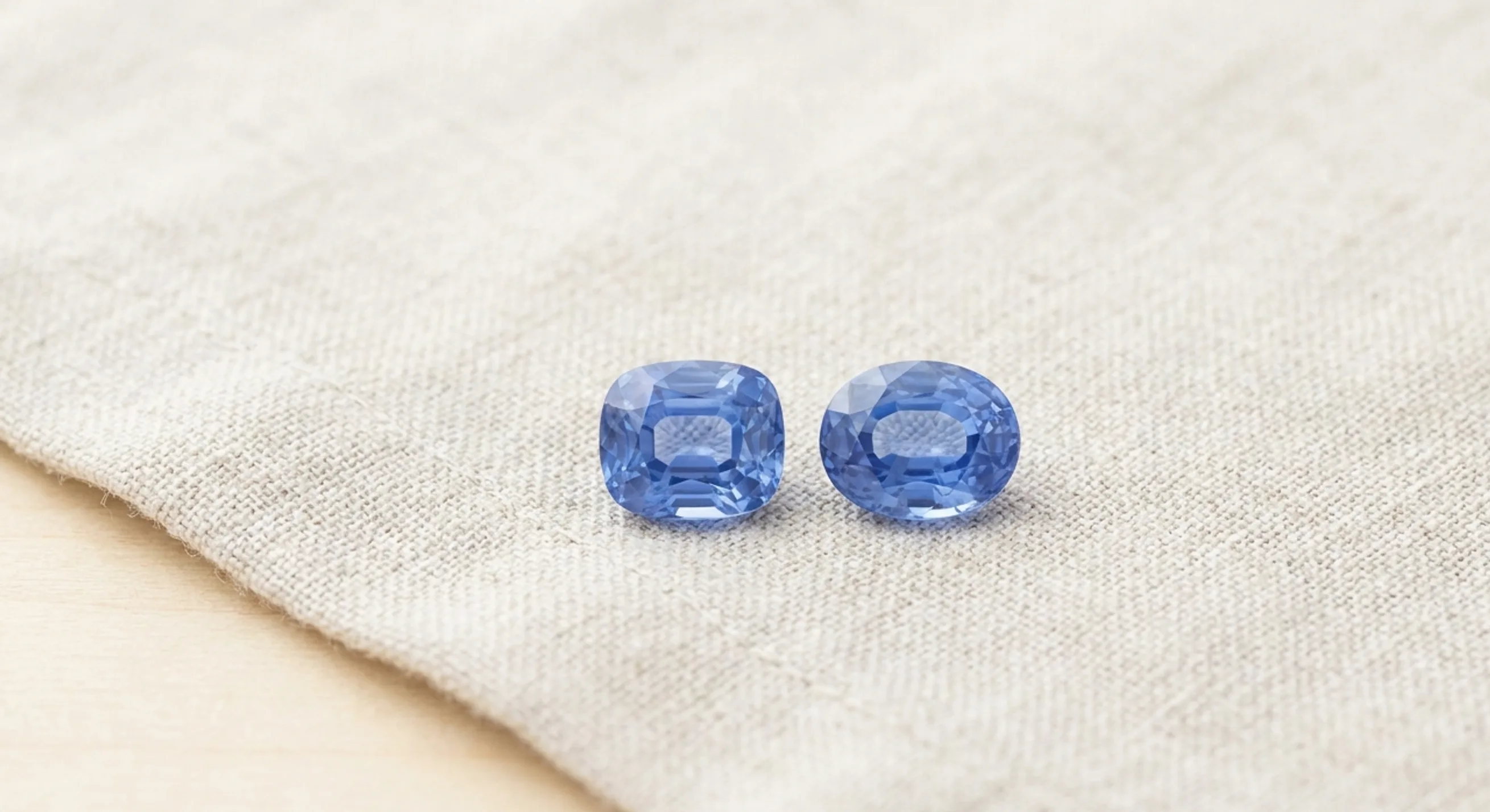
If you judge on color alone, a well-cut cushion usually shows more saturated color than an oval of the same weight. An oval usually shows more face-up area for each carat. That is my short answer to cushion vs oval sapphire. A cushion has a deeper pavilion and broad corners, so light travels further through the stone and the color concentrates. This matters most with lighter-toned Ceylon rough. An oval spreads the same weight over a longer outline. It looks bigger, but it can read paler or show a bowtie. Which one wins depends on the particular stone's tone and saturation, not on the shape in a catalogue.
Below I go through the optics, the traps and the prices, and finish with a checklist I'd use on any loose stone.
Cushion vs oval sapphire: which shape shows color better?
Sapphire gets its color by absorbing part of the light that passes through it. The longer the path light takes inside the stone before it comes back to your eye, the more it gets absorbed and the deeper the color looks. Every cutting decision about color starts there.
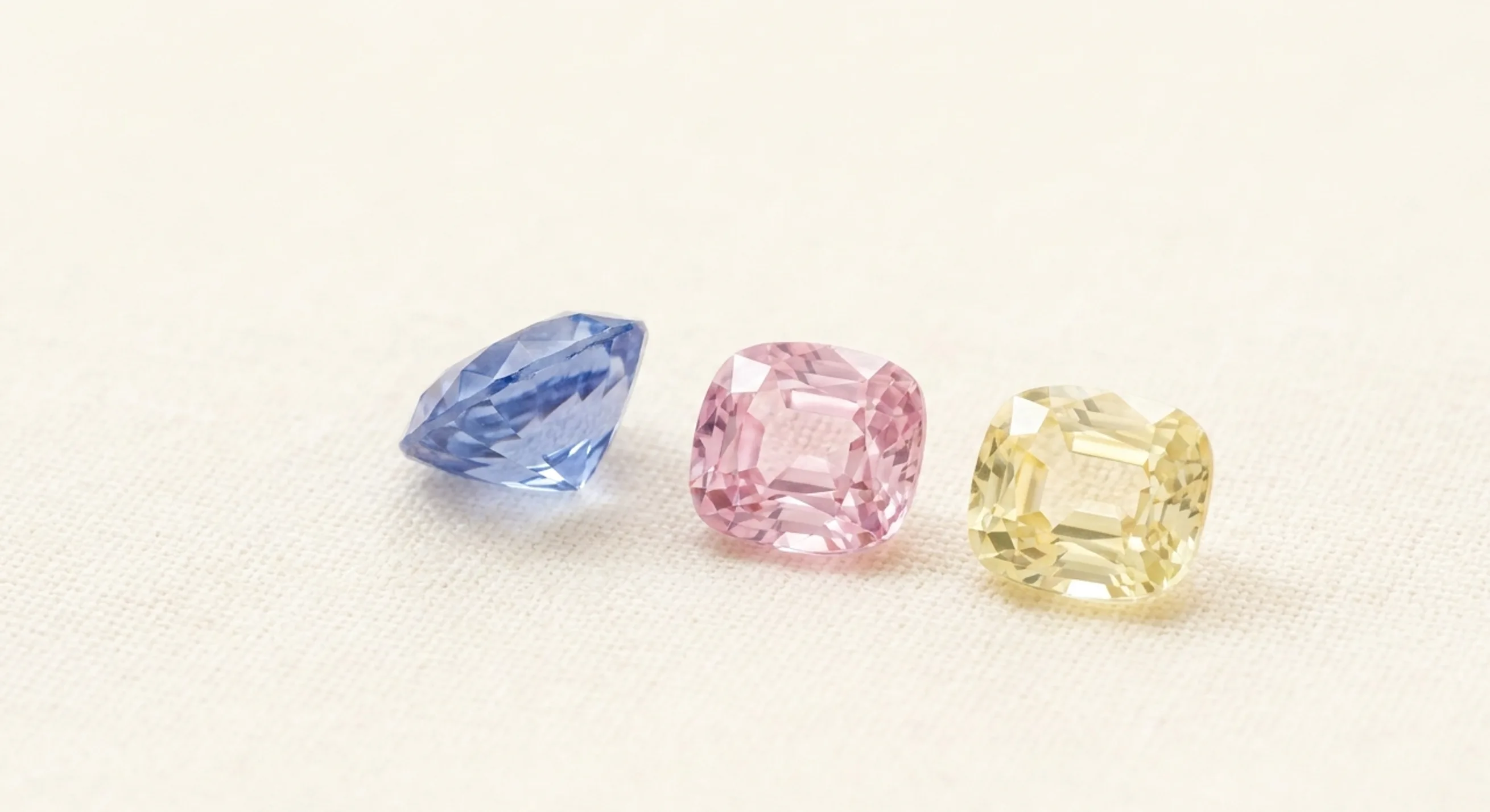
Cushions are normally cut with a fuller, deeper pavilion. Their facets, often a brilliant crown over a mixed or modified pavilion, break returning light into broad, chunky flashes, and the eye reads those as saturated color. Ovals are normally cut for spread. The outline is long and the pavilion is usually a bit shallower compared with that length, so light has a shorter trip and the color can look lighter across the face.
So in a straight sapphire cut comparison judged only on color:
- Light to medium tones: the cushion usually wins, because depth adds saturation the rough doesn't have on its own.
- Medium to medium-dark tones with strong saturation: both shapes work, and the oval gives you more size for the money.
- Dark stones: the oval often wins. Extra depth pushes an already dark stone into black patches.
I explain the practical side of this choice in more detail in the piece on why the cushion cut works so well for sapphire. Here I'm sticking to color.
Why are Ceylon sapphires so often cut as cushions?
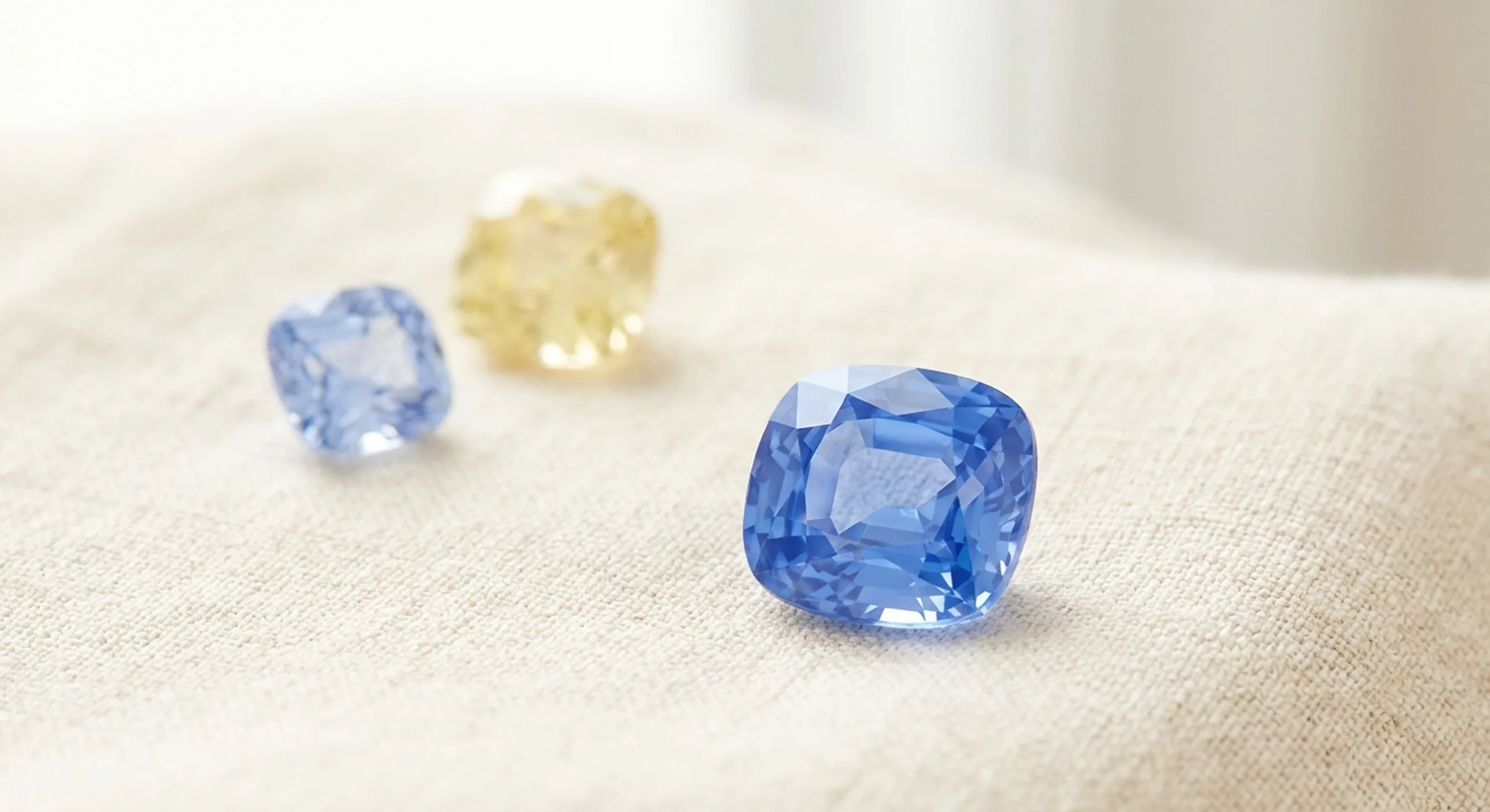
Sri Lankan rough sits mostly in the lighter, brighter part of the blue range. That's the cornflower look the island is known for, and it's lighter in tone than much Australian or Thai material. Light-toned rough needs help from depth, and the cushion gives it.
The crystals help too. In many Sri Lankan sapphires the color sits near the outer surface of the crystal and the core is paler or close to colorless. A skilled cutter puts the culet, the bottom point of the pavilion, inside that colored layer. The color then reflects up through the whole stone and the stone faces up fully blue, even though most of its body is lighter. A deep cushion is very good at placing the culet where the color is.
Weight matters as well. Weight is usually estimated as length × width × depth × specific gravity (4.00 for sapphire) × a shape factor. The oval's factor is about 0.0020 and the cushion's is about 0.0022. For the same outline and depth, a cushion holds roughly 10% more weight. Rough is valued by the carat, so the cushion keeps more of it. Many native-cut Ceylon stones are deep, belly-heavy cushions for that reason. Recutting them for better light return usually costs about 15 to 25% of the weight, which is why plenty of owners leave them as they are.
Does an oval sapphire look bigger than a cushion?
Yes, for the same weight it generally looks bigger. A 1 ct oval sapphire measures about 7 × 5 mm, which covers about 27.5 mm² face-up, much the same as a 6 mm round of the same weight at about 28 mm². The oval looks bigger because its length reads larger on the hand. The cushion's extra depth takes it the other way.
At 2 ct the gap is easy to see. A typical oval runs about 8.5 to 9.5 mm long and 6.5 to 7 mm wide. A typical cushion sits near 7 × 7 mm. The oval reads longer and larger on the hand. The cushion looks more compact, and if the rough is light it usually looks richer in color.
Typical oval sizes by weight:
| Weight | Approx. oval size |
|---|---|
| 0.50 ct | 6 × 4 mm |
| 1 ct | 7 × 5 mm |
| 1.5 ct | 8 × 6 mm |
| 2 ct | 9 × 7 mm |
| 3 ct | 10 × 8 mm |
If face-up size matters more to you than depth of color, the oval is the logical pick. Our guide to the best sapphire cuts and shapes for engagement rings compares the shapes on style, fit and setting. The short version: the oval wins on size, and the cushion wins on color concentration.
What is the bowtie effect in an oval sapphire?
A bowtie is a dark, bow-shaped shadow across the width of an oval or pear. It forms where pavilion facets send light out the back of the stone, or reflect your own head back at you, instead of returning light to your eye. Nearly every oval has some. A well-cut oval keeps it to mild darkening that shifts as the stone moves. A poorly cut one shows a solid dark band that never goes away.
Tone makes the bowtie stronger or weaker. In a light Ceylon stone a mild bowtie can actually help, because it adds contrast and makes the blue look deeper. In a dark stone the same bowtie can go close to black and take over the face. So a mild bowtie is no worry in a bright stone, but a dark blue oval needs a careful cut that keeps the bowtie soft.
Cushions can show a bowtie too, mostly in elongated cushions. Their broken facet pattern usually scatters it into smaller patches, so it bothers the eye less.
How do windowing and extinction differ between the two shapes?
These two cutting faults are opposites, and each shape tends towards one of them.
Windowing happens when the pavilion is too shallow. Light passes straight through instead of reflecting back, and you see a washed-out, glassy patch in the center where you can read the surface beneath the stone. Cutters sometimes go shallow to save weight or to stretch spread. Shallow-cut ovals are the most common offenders, because spread is the reason to cut an oval in the first place.
Extinction happens when the pavilion is too deep, or the stone is too dark for its depth. Areas of the face go dark or black as light leaks away. Deep cushions, especially heavy native cuts, are most at risk, and the corners usually go dark first.
My rule of thumb: if dark patches cover more than about 30 to 40% of the face when you rock the stone, the extinction is excessive. Faults like these cost real money. A windowed or lopsided stone can be worth around 20 to 40% less than a clean cut from the same rough. When you weigh up cushion vs oval sapphire options, check the depth before you decide on the shape.
How do pleochroism and color zoning affect the choice?
Blue sapphire is pleochroic. It shows two colors depending on the direction you look through the crystal: a greenish blue and a violetish blue. Cutters orient the table to bring the violetish blue up through the top, because that's the color buyers pay for. Ceylon rough often shows this effect clearly, so orientation matters a great deal.
Shape affects how well the cutter can manage it. In a cushion, the face is compact and light stays close to the best viewing direction. A long oval spreads the face over a greater length. In stones with strong pleochroism, the ends can pick up a slightly different tint, sometimes a faint greenish cast. It's often subtle, but you should check for it.
Color zoning is the other factor. Many sapphires grow in bands of stronger and weaker color. Cutters hide zoning by running the bands parallel to the girdle, or by putting the most concentrated color at the culet so it spreads across the whole face. A deep cushion does this well. An oval can do it too, but if the bands end up running along its length, you may see faint stripes face-up.
Which shape suits your stone's tone and saturation?
This is how I'd match shape to material:
| Stone character | Better shape for color | Why |
|---|---|---|
| Light tone, moderate saturation (pastel cornflower) | Cushion | Depth adds saturation |
| Medium tone, strong saturation | Either; oval for spread | Color holds up in a shallower cut |
| Medium-dark to dark tone | Oval, cut with care | A deep cushion risks extinction |
| Color concentrated near the crystal surface | Cushion | Culet placed in the colored layer |
| Strong zoning | Cushion, usually | Easier to hide bands and concentrate color |
| Size face-up is the priority | Oval | About 10% less weight for the same outline |
The same logic applies to heated and unheated stones. Heat treatment is the industry norm: roughly 90 to 95% of sapphires on the market are heated. It's a legitimate, stable way to improve color and clarity, and a well-heated stone with even color gives the cutter more freedom to pick an oval for spread. Unheated stones are the premium tier and usually cost about two to five times as much as an equivalent heated stone. With those, the cutter is working with whatever color the crystal grew with, and that often favors the deeper cushion.
Is a cushion or an oval sapphire more expensive?
Neither shape carries a real premium. In comparable grades, cushions and ovals sit roughly level on price. Color, treatment, size and certification set the price, and shape barely does. Asking prices for Sri Lankan cushions and ovals in similar size ranges overlap heavily. Royal blues of the same size and grade list at similar per-carat prices whichever the shape.
For the 1 to 3 ct band, the 2026 ranges in my Ceylon sapphire price per carat guide are:
- Commercial heated: $500 to $2,500/ct
- Fine heated: $3,000 to $8,000/ct
- Fine unheated: $7,000 to $18,000/ct
- Exceptional unheated: $10,000 to $20,000/ct
Watch the size thresholds. Per-carat prices jump at 1, 2, 3 and 5 ct, and most sharply at 3 and 5 ct. For the same quality, a stone that just reaches 3 ct costs noticeably more per carat than one that just misses it. A deep cushion that just reaches 3 ct puts part of that premium into weight you can't see face-up. An oval at 2.8 ct can look as big and cost a lot less. This is the real money trade-off in cushion vs oval sapphire: with a cushion you pay for depth that adds color, and with an oval you pay for spread.
How to judge a loose cushion or oval sapphire: a checklist
- Window check. Hold the stone face-up over a white surface. If the center looks glassy and you can make out the surface through the table, it's windowed.
- Extinction check. Tilt the stone slowly. Dark patches that shift are normal. Dark areas covering more than about 30 to 40% of the face are too much.
- Bowtie check (ovals). A soft, moving shadow is fine. A solid black band across the width is not.
- Profile check. Look at it from the side. A bulging belly on a cushion adds carats you pay for without adding color.
- Pleochroism check. Look at the ends of an oval and the corners of a cushion in daylight. You want violetish blue across the face, not green-tinged edges.
- Zoning check. Look through the side for bands of color, then confirm the face-up color looks even.
- Outline check. Square cushions run about 1.00 to 1.05 length-to-width, and elongated cushions usually about 1.15 to 1.30. Pick the ratio you actually like.
- Paperwork check. Read the treatment statement and the lab report before you look at the price.
Still photos are the weak point when you buy colored stones online, because one flattering angle can hide a bowtie or extinction completely. That's why every stone Crestonne lists comes with its own video, a written treatment statement and a lab report. You can watch the face as the stone moves and run the window, extinction, bowtie and pleochroism checks from your screen.
If you already know your tone and budget and want the shape matched to the rough rather than the other way round, request a loose stone through our custom-order form, or browse the current collections to compare cushions and ovals side by side.
Common questions
Frequently Asked Questions
Does a cushion or oval sapphire show more color?
On the same rough, a well-cut cushion usually shows more saturated color because its deeper pavilion lengthens the path light takes through the stone. An oval spreads the weight over a longer outline, so it faces up larger but can read lighter, especially with pale Ceylon material.
Why are Sri Lankan sapphires often cut as deep cushions?
Ceylon rough tends to be lighter in tone, and its color often sits near the crystal surface. A deep cushion lets the cutter place the culet in that colored layer so the whole stone faces up blue, and the cushion shape also keeps more weight from the rough.
Is an oval sapphire bigger than a cushion of the same weight?
It looks bigger. A 2 ct oval typically measures around 8.5 to 9.5 mm long by 6.5 to 7 mm wide, while a 2 ct cushion sits near 7 x 7 mm. The cushion holds more of its weight in depth.
Is a cushion sapphire more expensive than an oval?
Not as a rule. Cushion and oval sapphires of comparable grade are priced roughly level. Color, treatment, size and certification drive price far more than shape does.
What is an acceptable bowtie in an oval sapphire?
Almost every oval shows some bowtie. A soft shadow that moves as you tilt the stone is normal and can even add contrast to a light stone. A solid dark band that stays put across the width points to a weak cut.