Understanding
Cushion Cut Gemstones: Shape, Brilliance & Proportions
The cushion is one of the two standard cuts for Ceylon sapphire, with the oval, but a standard lab report does not grade its cut. Here is how the shape developed, what the outline and faceting options are, and the proportions to check before trusting one.
12 min read
By Naseef AR
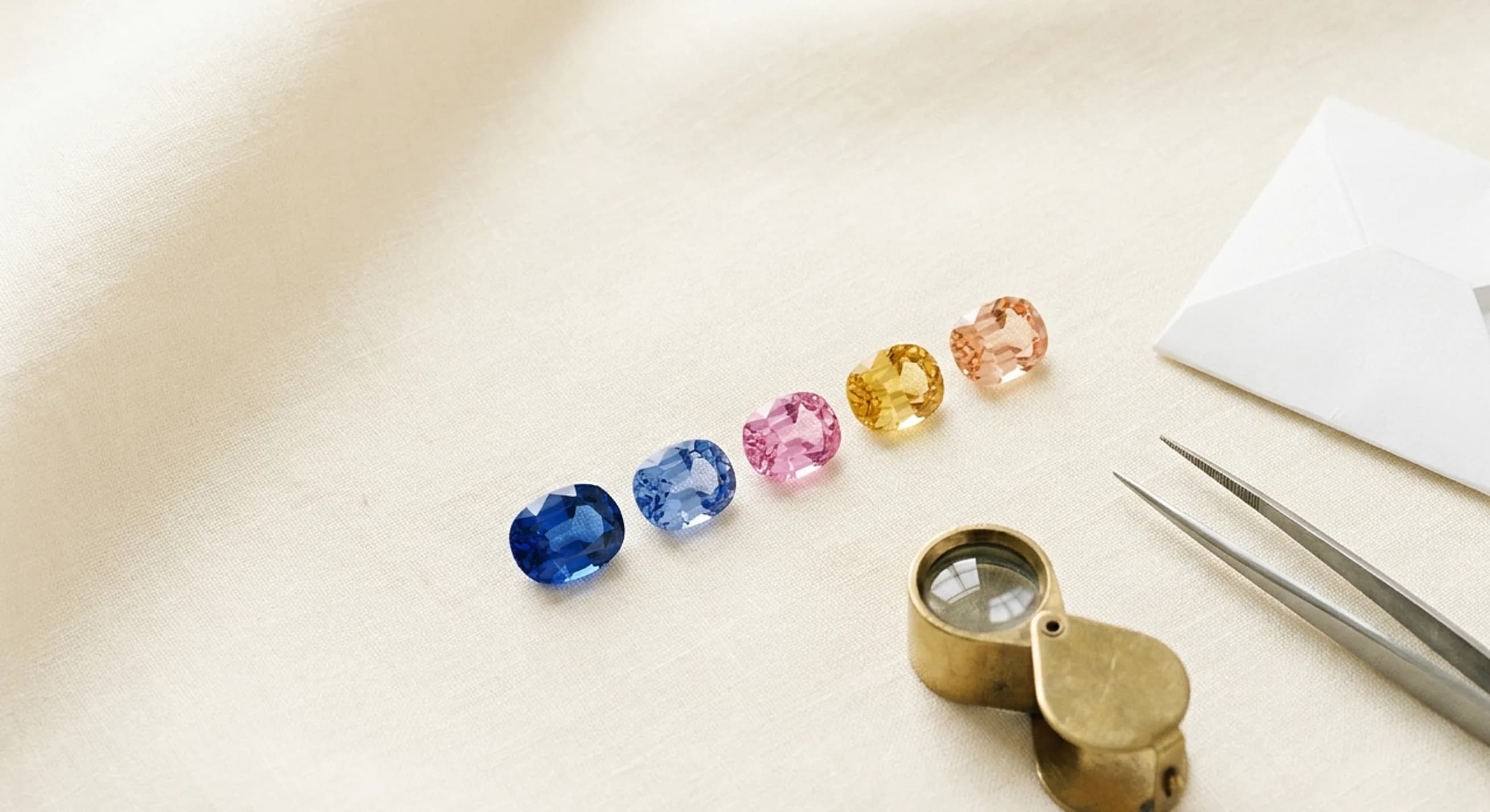
A cushion cut gemstone has a square or rectangular outline with rounded corners and softly curved sides, so from above it looks a bit like a pillow. Below the girdle it has a full pavilion, cut with brilliant-style facets or, in many coloured stones, step-style ones. Among coloured stones it is one of the most forgiving shapes, and with the oval it is one of the two standard cuts for Ceylon sapphire. Whether a cushion looks bright or dull comes down to three things: total depth, length-to-width ratio and how far the pavilion bulges. Below I cover where the shape came from, the outline and faceting choices, and the proportions I check before I'd call any cushion well cut.
What is a cushion cut gemstone?
Any faceted stone has four parts: a table (the flat top facet), a crown (the angled facets above the girdle), the girdle (the edge) and a pavilion (the angled facets below it). What makes a cushion cut gemstone a cushion is its outline: more rounded than a square step cut and more angular than an oval. The sides are not straight lines. They bow outwards slightly, and the corners are rounded rather than clipped.
That outline is why the cushion shape works on so many materials. Rounded corners are less likely to chip than sharp points. That matters less for sapphire, which is Mohs 9 and tough with no cleavage, than for softer or more brittle stones, but it still helps in a ring that gets worn every day. The curved sides also leave the cutter room to follow the natural form of the rough instead of grinding it down into a precise geometric figure.
There is one thing buyers rarely hear: there is no universally accepted cut-grading standard for cushions. A standard lab report identifies the stone, describes its colour, states any treatment and records measurements, but it does not give a cushion a cut grade. You, or the person selling it, have to judge the cut. That is the reason for this article.
Where did the cushion cut come from?
The modern cushion descends from the Old Mine cut. That cut was in use from the 1700s and stayed the most common diamond cut until the late nineteenth century. It covered the Georgian (1714 to 1837) and Victorian (1837 to 1901) periods and still appears in Edwardian (1901 to 1915) pieces, so anything sold as "antique cushion" jewellery usually means one of those eras.
The name looks back from later on. Old Mine cuts suited the rough coming out of Brazil. When South African diamonds were discovered in the late 1800s, people began calling the Brazilian deposits the "old mines", and the cut took that name.
The defining features of an Old Mine cut are:
- a squarish outline
- a high crown
- a small table
- a deep pavilion
- a large, open culet (the small facet at the bottom point)
None of that was about style. Cutting was done by hand, with real limits, and the aim was to keep as much weight from the rough as possible. An Old Mine cut typically has 58 facets. A modern cushion typically has 64.
One myth needs correcting. Elongated "antique" cushions are mostly a fiction. Old Mine cutters were saving weight, not cutting long silhouettes, so genuine period cushions are mostly close to square. In diamond, long rectangular cushions are largely a modern taste. Sapphire is different: its rough is often elongated, so a slightly long cushion usually just follows the crystal.
Square or elongated: which cushion shape should you choose?
Outline is measured by length-to-width ratio (L/W): length divided by width. The bands below come from the diamond trade, but dealers use them for coloured stones too:
| L/W ratio | How it reads |
|---|---|
| 1.00 to 1.05 | Square |
| 1.05 to 1.10 | In-between: neither clearly square nor rectangular |
| 1.10 to 1.15 | Starting to read as rectangular |
| 1.15 to 1.30 | The popular elongated range |
For a square look, aim for 1.00 to 1.05. For a definite rectangle, go above 1.15. The 1.05 to 1.10 band is a matter of taste. Some people like the softness, while others think it looks like the cutter couldn't decide. I'd tell you to view the stone before committing to a ratio in that band.
With sapphire, the rough has more say than the trend. A cutter working Ceylon corundum follows the crystal, so you'll find more variety in L/W ratios than in a calibrated diamond range. That is not a defect. It is part of why a cushion cut sapphire keeps its weight. If you're choosing a stone for a ring, I've written separately about how the cushion compares with other sapphire cuts for engagement rings.
What is the difference between an antique and a modern cushion?
"Cushion" describes an outline. The facets inside that outline can vary a lot, and they fall into roughly three styles.
Classic or antique-style cushion. Fewer, larger facets, often with a higher crown and a smaller table, in the Old Mine tradition. Light comes back in broad, chunky flashes. In a well-saturated sapphire, I think this is often the best choice, because each flash carries a lot of colour.
Modern brilliant cushion. A more even facet layout, typically around 64 facets, with sparkle that is smaller and more evenly spread. This is the most common style today.
Crushed-ice cushion. Extra facets on the pavilion break the light into a fine, scattered glitter. It suits paler material, where sparkle does more work than colour. In a richly coloured sapphire, busy faceting can split the colour into points of light rather than one solid body of blue, and I usually prefer chunkier facets on stones like that.
Many coloured-stone cushions are mixed cuts, with brilliant-style facets on the crown and step-style facets on the pavilion. Traditional Sri Lankan cutting also tends towards fewer, larger facets and deeper pavilions. I'll explain why below.
What proportions make a cushion cut gemstone bright?
This is where a cushion succeeds or fails. Most published cushion numbers come from diamonds, where the ideal depth is often given as roughly 62 to 68%. Over 70% hides weight in the belly, so the stone faces up small, and below about 60% light leaks out. Use those as a rough guide only. Coloured stones are cut for colour, not for the light return of a diamond.
Depth
Coloured-stone grading guidance puts total depth (depth as a percentage of width) at normally 60 to 70%, provided the crown and pavilion angles are acceptable. For blue sapphire the accepted range is wider, about 60 to 80%, though many well-cut stones sit between 60 and 70%. Cutters add depth when material is light in tone, because a longer light path deepens colour. They also adjust it for the stone's pleochroic axis.
A good rule for any cushion cut gemstone: between 60 and 70% is comfortable, and between 70 and 80% it is worth seeing the stone face-up on video before you trust it.
Crown, pavilion and table
At 60 to 65% depth, about a quarter to a third of the stone should sit above the girdle and the remaining two-thirds to three-quarters below it. A crown that is too shallow flattens the stone and can leave it lifeless. Table size in coloured stones varies widely, anywhere from about 30 to 80% of width, so table percentage tells you less here than it would on a diamond.
Pavilion bulge
Look at the stone from the side. A slight outward curve in the pavilion is normal and acceptable. An obvious bulge, where the bottom of the stone swells like a belly, is not. It is weight the buyer pays for and never sees face-up, so the stone looks smaller than its carat weight suggests.
Windows and extinction
These are the two classic cushion faults.
- A window is a see-through, washed-out patch, usually in the centre of the stone. A pavilion cut too shallow lets light pass straight through instead of reflecting back.
- Extinction is an area where the body colour goes very dark or almost black. It comes from a pavilion that is too steep. A little extinction is normal and gives a sense of depth. Large dark areas, especially a dark centre, are a cutting problem.
A cushion cut gemstone with good angles shows an even field of colour across the face, with a few dark facets moving as you tilt it and no glassy hole in the middle.
Why is the cushion so common for Ceylon sapphire?
Walk through any Sri Lankan sapphire parcel and most of what you see will be cushions and ovals. There are four reasons, and none of them is fashion.
It keeps weight from the rough
Sapphire crystals grow as barrels and tapering bipyramids. A cushion outline sits comfortably inside that form, so less material is cut away. Carat weight drives price per carat, so the cushion is the economically sensible shape for most Ceylon rough.
It handles colour zoning
Colour in Sri Lankan sapphire rough is often concentrated near the crystal surface instead of spread evenly through it. A skilled cutter places the culet and lower pavilion in the colour-rich zone. Light entering the table travels through that zone and returns to the eye, so the stone looks fully blue face-up even when much of the crystal is paler. A deep cushion pavilion is a very practical shape for doing this.
It copes with pleochroism
Blue sapphire is dichroic. Viewed along one direction it shows violetish-blue, and along the other it shows greenish or yellowish blue. Natural corundum is generally cut with the c-axis (the crystal's main axis) perpendicular to the table, which tends to give the best colour. If the c-axis lies parallel to the table, a pleochroic bow-tie effect can appear. Orienting for the best colour often costs weight, and the cushion's flexible outline lets the cutter put colour first with less loss than a rigid geometric shape would.
It is how Sri Lankan cutters work
Traditional Sri Lankan cuts favour deeper pavilions and fewer, larger facets. The longer light path deepens the colour of the island's typically lighter-toned blues. That is a deliberate choice for the material, not a lack of skill, and I go into it further in how Sri Lankan gem cutters cut for colour and weight. When a weight-first stone does need correcting, recutting to remove a window and improve face-up colour typically costs 15 to 25% of the weight, which is why buyers should want a good cut the first time.
Does cut affect the price of a cushion cut sapphire?
Yes, in both directions. A stone that windows, goes dark or shows uneven colour sells for less, however good the colour is. A well-cut stone holds its full value.
For context, most certified Ceylon sapphires in the 1 to 3 carat range sit around $1,500 to $6,000 per carat, depending on colour, clarity and size. An estimated 90 to 95% of sapphires on the market have been heated. That is the accepted industry norm and gives beautiful, stable colour. Unheated stones are the premium tier and cost roughly two to five times as much as a comparable heated stone. Cut matters equally in both tiers. A heated cushion with excellent proportions often looks better in the hand than a poorly cut stone at a higher price.
How do you judge a loose cushion cut sapphire before buying?
With no lab cut grade available, this is the checklist to use.
- Get the measurements. You need length, width and depth in millimetres. Divide length by width for the L/W ratio, and depth by width for depth percentage.
- Check the ratio against what you want. For square, 1.00 to 1.05. For clearly elongated, above 1.15. Ratios between those are a matter of taste.
- Check depth. 60 to 70% is the comfortable range. Up to 80% is acceptable for sapphire if the stone still faces up at a sensible size and colour.
- Look at the profile. A gentle pavilion curve is fine. An obvious belly means weight you pay for but won't see.
- Do the window test. Lay the stone face-up on white paper and look straight down. If you can see the paper through the centre, it has a window.
- Watch for extinction. Tilt the stone or watch it move on video. A few dark facets shifting around is good. A fixed dark centre is not.
- Read the colour across the face. Look for even colour, with no strong greenish streaks or bow-tie that would suggest poor orientation.
- Confirm treatment and origin on paper. Heated or unheated, the lab report and treatment statement should agree with what you've been told.
Steps 5 to 7 are the ones a still photo can't show, and online buyers have reasonable doubts about photographs. That is why every stone Crestonne lists comes with its own video, a written treatment statement and a lab report, so you can judge the cut yourself rather than taking it on trust.
If you want a cushion with particular proportions, such as a near-square 1.02, an elongated 1.20, or a classic chunky facet pattern in a saturated blue, tell me through the custom-order form for a loose stone. Or browse the current collections and use the checklist above on each stone's video and report.
Common questions
Frequently Asked Questions
What is a cushion cut gemstone?
A cushion cut gemstone has a square or rectangular outline with rounded corners and slightly curved sides, like a pillow seen from above. Underneath it has brilliant-style or step-style facets, and many coloured-stone cushions mix the two. It descends from the Old Mine cut of the 1700s and 1800s and, with the oval, is one of the two most common cuts for Ceylon sapphire.
What is the best length-to-width ratio for a cushion cut?
For a square look, aim for 1.00 to 1.05. Above about 1.15 the stone reads as clearly rectangular, and 1.15 to 1.30 is the popular elongated range. Ratios of 1.05 to 1.10 fall in between and come down to personal taste.
What depth should a cushion cut sapphire have?
Most well-cut sapphires sit at 60 to 70% depth (depth as a percentage of width). Up to about 80% is accepted for blue sapphire, particularly lighter-toned material, but check that the stone still faces up at a sensible size without a large dark centre.
Why do some cushion cut sapphires have a dark centre or a window?
A window, a washed-out see-through patch, comes from a pavilion that is too shallow, so light leaks out. A dark centre, called extinction, comes from a pavilion that is too steep. A little extinction is normal. A fixed dark or glassy centre is a cutting fault.
Do labs grade the cut of cushion cut stones?
Not on a standard report. There is no universally accepted cut-grading standard for cushions, so a standard lab report records measurements, colour and treatment but gives no cut grade. You need the stone's measurements and a video to judge its proportions yourself.