Understanding
Cushion Cut Sapphire: Why This Classic Shape Works So Well
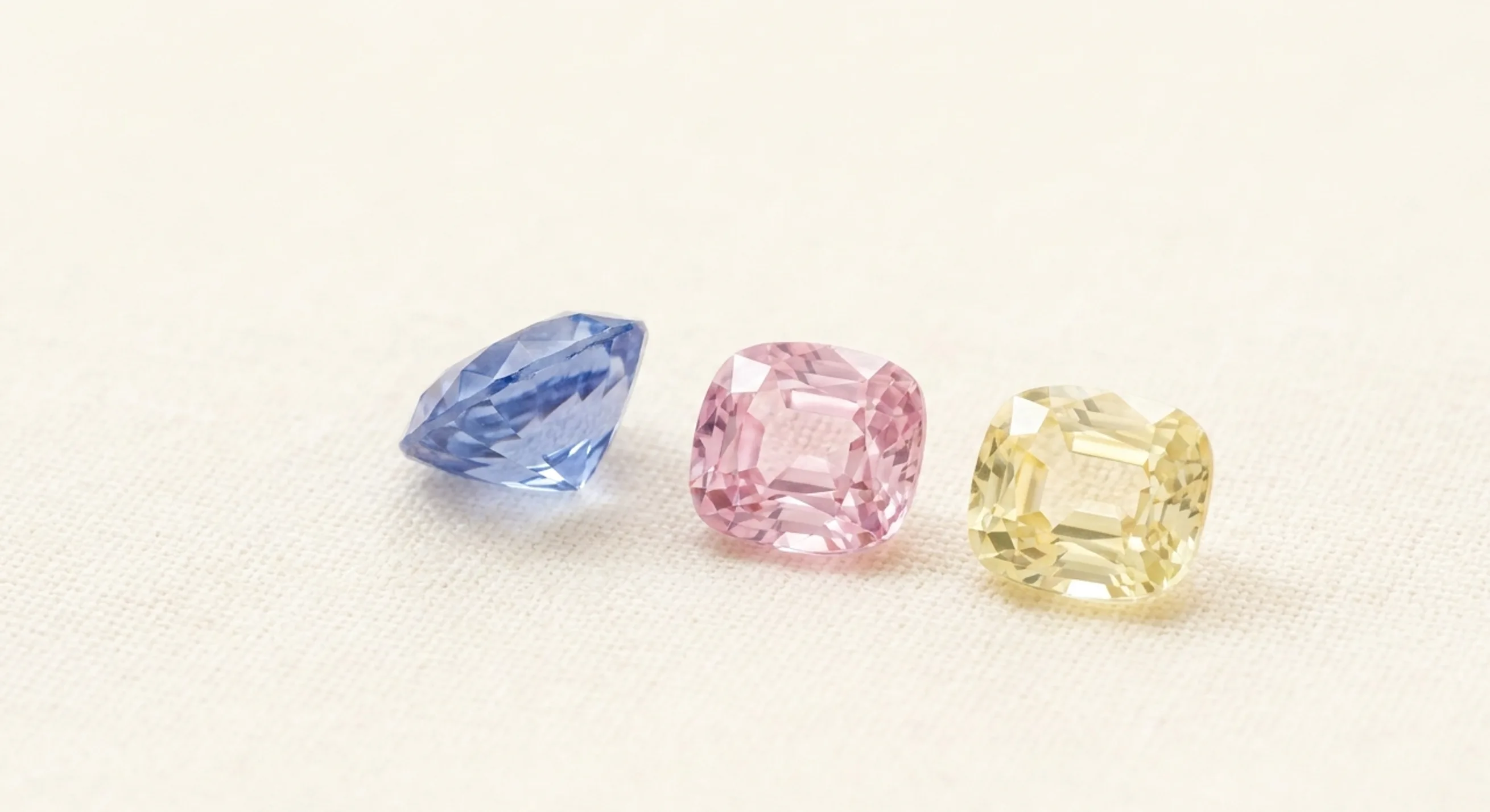
The cushion suits sapphire because it follows the barrel-shaped Ceylon crystal, holds colour in lighter blues and leaves room to orient the stone around pleochroism. Here is why, plus a checklist for judging a loose stone.
10 min read
By Naseef AR
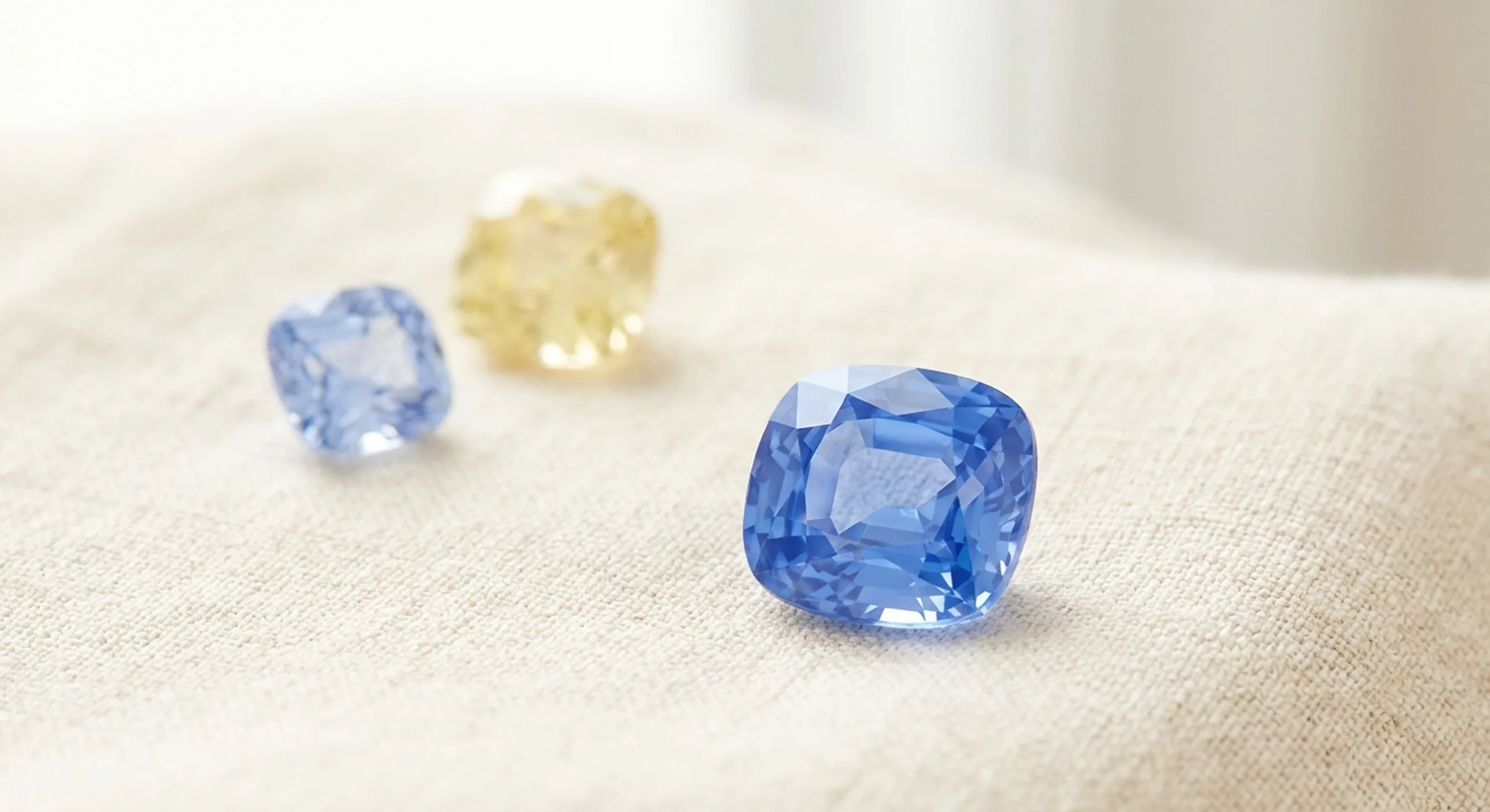
A cushion sapphire works for a simple reason: the shape follows the crystal. Ceylon corundum tends to grow as barrel-shaped hexagonal crystals, and the rounded-square outline of a cushion sits inside that barrel with far less waste than a round. The cushion also carries a deep pavilion, which holds colour in paler Ceylon blues, and it gives the cutter room to orient the stone around pleochroism and colour zoning. Sri Lankan cutters have leaned on it for generations. Below I walk through the reasoning, place the cushion among the other sapphire shapes, and share my checklist for judging a loose stone.
If you'd like the general geometry first, I've covered cushion cut proportions and outline options across all gemstones in a separate piece. This piece is purely about sapphire.
Why do so many sapphires end up as cushions?
It all starts with the rough. Sapphire most often crystallises as a barrel- or spindle-shaped hexagonal pyramid, and the shape of that rough steers both the shape and size of the finished stone. Sri Lankan crystals are textbook examples: mostly prismatic to barrel-shaped, hexagonal in outline, with pointed bipyramidal ends. Plenty come out of the gem gravels already waterworn and rounded, their corners softened further still.
Now consider what the cutter has to grind away. A finished sapphire typically keeps about 20 to 45 percent of the rough's weight, and depending on the shape chosen, losses can hit 90 percent. Preforming alone can strip 40 to 70 percent of the original crystal. Every shape decision is really a weight decision.
A round forces a perfect circle onto a crystal that is rarely circular in cross-section, so it wastes the most material, which is partly why round sapphires carry a higher per-carat price. A cushion, with its soft corners and gently curved sides, fits a rounded barrel much more naturally. The cutter keeps more carats. The buyer gets more face-up size for the money.
The same logic explains why so many cushions run slightly long. Sapphire rough is naturally elongated, so a cushion that's a touch longer than square usually reflects the crystal it came from, not just a passing fashion.
How do Sri Lankan cutters orient a cushion sapphire for colour?
Weight is only half the job. Sapphire is pleochroic: it shows different colours depending on which direction you look through the crystal. In blue sapphire, those two colours are violetish blue and greenish blue.
For the best colour, the cutter aims to put the table perpendicular to the c-axis, the crystal's main optical axis. Looking straight down that axis gives the most even face-up colour, and a dichroscope then shows no pleochroism through the table. The catch is that the crystal is longest along that axis, so a perfectly oriented stone comes out deep and costs weight. Many natural stones are tipped off the axis to save carats, which is also where most slightly long outlines come from. Verneuil synthetics, by contrast, are often cut with the c-axis parallel to the table, and gemmologists treat that as a clue. Even when the orientation is right, a faint shift can linger: colour a little stronger near the culet, fading toward the girdle. Cut with the c-axis parallel to the table, a stone can show a pleochroic bow tie across its face.
Then there's colour zoning. Blue sapphire often shows angular zones of deeper and lighter blue, and in Sri Lankan material the colour usually sits near the surface of the crystal. The standard fix is to place the culet in that patch of colour. Light enters the table, bounces off the pavilion and passes through the coloured zone at the bottom, so the whole stone reads blue face-up even when much of the crystal is pale.
This is where the cushion earns its place among Ceylon sapphire cuts. Its deep, often rounded pavilion gives the cutter room to put the culet exactly where the colour is, with no rigid outline to fight. An oval can manage the same trick, but the cushion's fuller profile usually leaves more depth available.
Why do lighter Ceylon sapphires need a deeper pavilion?
Ceylon is famous for brighter, lighter blues than the inky material from some other sources. That brightness is the appeal. It also creates a technical problem.
Sapphire's critical angle is about 34.5 degrees, but light has to bounce off the pavilion twice to come back out, so the main pavilion facets need to sit at around 41 to 44 degrees. Cut them shallower than that and light no longer reflects back up through the table. It leaks straight out of the bottom instead, leaving a washed-out, see-through patch in the middle of the stone. That's called a window. It shows up more in a pale stone, simply because there is less body colour to hide it, and a windowed stone also exposes any colour zoning far more clearly than one with even brilliance.
As a rough guide, a depth below about 60 percent tends to cause windowing. A deeper pavilion cures it, and a cushion has one built in. That's why lighter and pastel Ceylon blues usually suit a cushion. Darker stones often do better as ovals, where a shallower profile lets more light through.
Push too far the other way, toward 80 percent depth and beyond, and you risk extinction: dark, dead areas where light escapes out through the sides, and a stone that looks small for its weight.
Facet style matters too. A chunky, modified cushion with broad facets shows body colour in broad, bold flashes. A cushion brilliant, with many fine facets, breaks the light into more, smaller sparkles. Neither is wrong. They just suit different material.
What are the most popular sapphire shapes?
Oval, round and cushion are the three main sapphire shapes, and because the rough is elongated, oval and cushion both turn up more often than round. Emerald cuts, pears and hearts appear when a particular crystal allows for them. They're the exception.
If you are choosing for a setting, my guide to the best sapphire cuts and shapes for engagement rings compares them side by side. In short, the oval often suits darker stones and also makes the finger look longer. The cushion, meanwhile, concentrates colour in lighter stones and is the traditional shape for old Ceylon blue. Price-wise the two are roughly even, so choose on the stone in front of you, not the shape.
How do you judge a loose cushion sapphire?
Here is a checklist to run through on any loose cushion sapphire. Most of it you can check from a decent video.
1. Window. With the stone face-up, look at the centre. If you can see through it, or the middle looks lighter and more watery than the edges, the stone is windowed. Tilt it. A small window that closes as the stone moves is acceptable in many native cuts. A large one that stays put hurts value, often by 20 to 40 percent.
2. Extinction. Watch for patches that stay dark as the stone rocks. Some darkening at the edges is normal in a deep blue. Big black zones in the centre mean the stone is cut too deep, or its colour is too dark for its proportions.
3. Bulging pavilion. Ask for a side view. Sri Lankan native cuts often carry a belly: a deep, rounded pavilion that helps make a native cut something like 20 to 40 percent heavier than a well-proportioned cut of the same rough. Cutters leave it to keep a stone above the 1, 2, 3 or 5 ct price points. You pay for that weight without seeing it face-up, and a pronounced bulge can knock 20 to 35 percent off the value. It also makes the stone sit high in a setting.
4. Length-to-width ratio. A square cushion runs about 1.00 to 1.05:1, and 1.05 to 1.10:1 sits in between. Elongated cushions start at around 1.15:1, and 1.15 to 1.30:1 is the most common range on the market. Beyond about 1.40:1 the stone looks long and narrow rather than pillow-shaped. No ratio is better than another. It's taste, pure and simple. Just know which one you are buying.
5. Native cut or recut? A native cut is cut for maximum weight and face-up size, not for light return, and many are perfectly attractive. A recut can transform a native stone with a bad window or a heavy belly, but it costs weight. Rough rules of thumb:
- A pavilion-only recut leaves the girdle and face-up size untouched. It often loses around 10 to 15 percent and can close a window.
- A fuller recut to correct colour and windowing commonly loses 15 to 25 percent, and taking out a heavy belly often costs 25 percent or more.
- Taking a native stone to precision standards can be drastic. A 2 ct native cushion can finish at around 1.2 ct, a loss of roughly 40 percent.
Precision-cut stones sell at a per-carat premium, often 25 to 40 percent, which claws back some of that lost weight. Here's my own judgement. Recut when the window or belly clearly spoils the look and the colour is good enough to justify the loss. Don't recut a pleasing native stone just to chase symmetry. And be careful if a recut would drop the stone below 1, 2, 3 or 5 ct, because price per carat jumps sharply at those sizes.
Does a cushion sapphire cost more than other shapes?
No. Colour, treatment and size drive the price far more than shape. Shapes that waste more rough, such as round and princess, cost more per carat, but a cushion does not.
Heat treatment is the industry norm: an estimated 90 to 95 percent of sapphires on the market have been heated. It's stable, accepted and disclosed. Unheated stones form the premium tier and typically sell for around two to five times the price of comparable heated stones. Most certified 1 to 3 ct Ceylon blues fall between about $1,500 and $6,000 per carat. Across the whole market, prices run from around $300 per carat for commercial heated stones to $20,000 and up for fine unheated ones. Expect clear jumps at 1, 2, 3 and 5 ct, which I explain in my guide to what sets a Ceylon sapphire price.
A cushion sapphire and an oval of equal quality should land squarely in the same price band.
Buying a cushion sapphire from Crestonne
Almost everything on that checklist depends on seeing the stone properly. That's why every stone Crestonne lists comes with its own video, a written treatment statement and a lab report. You can check the window, extinction and colour as the stone moves, and see in writing whether it is heated or unheated. If you're after a particular colour, size or ratio, you can ask for a stone through the custom-order form. Or browse the collections to see what's available now.
Common questions
Frequently Asked Questions
Why are so many Ceylon sapphires cut as cushions?
Sri Lankan sapphire rough is usually barrel-shaped with hexagonal outlines, and a cushion's rounded-square outline fits that crystal with much less waste than a round. The cushion's deep pavilion also helps cutters place the culet in the stone's colour, so the whole stone looks blue face-up.
Is a cushion sapphire more expensive than an oval?
No. A cushion and an oval of the same quality usually sit in roughly the same price band. Colour, size and treatment drive the price far more than shape. Unheated stones typically sell for around two to five times the price of comparable heated ones.
What is windowing in a sapphire?
A window is a washed-out, see-through patch in the centre of a stone. It happens when the pavilion is cut too shallow, with the main facets flatter than about 41 degrees, so light leaks out of the bottom. It shows up most in lighter stones, and a deeper pavilion such as a cushion's helps prevent it.
What length-to-width ratio is best for a cushion sapphire?
A square cushion is about 1.00 to 1.05:1, and elongated cushions usually run 1.15 to 1.30:1. Ratios from 1.05 to 1.10 sit in between, and past about 1.40:1 the stone looks long and narrow. No ratio is better than another; it comes down to taste.
Should I recut a native-cut cushion sapphire?
Only if a window or heavy belly clearly spoils the look and the colour justifies the loss. A pavilion-only recut often loses about 10 to 15 percent, and a fuller recut 15 to 25 percent or more. Avoid recuts that would drop the stone below the 1, 2, 3 or 5 ct price points.