Understanding
Princess Cut Gemstones: A Guide to the Modern Square Cut
The princess cut was engineered for diamond, and its geometry plays out very differently in sapphire. This guide covers where the cut came from, why fine princess sapphires are scarce, the proportions that work in corundum, and how to protect those sharp corners.
10 min read
By Naseef AR
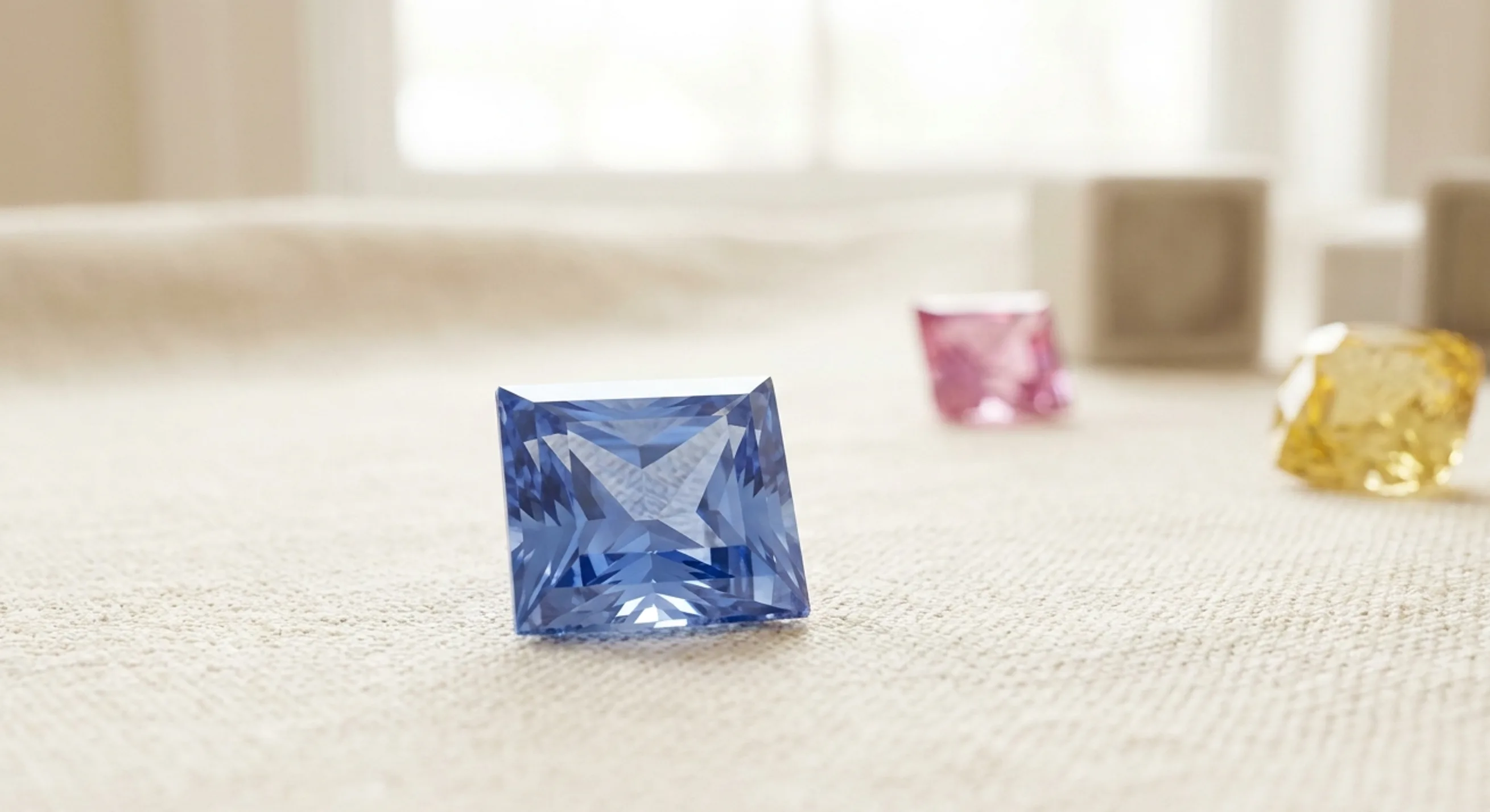
A princess cut gemstone is a square stone with sharp, uncut corners and a pavilion of chevron-shaped facets that tapers to a point, like an upside-down pyramid. Its technical name is the square modified brilliant. It was designed for diamond in Israel around 1979 to 1980, and in diamond it works brilliantly: it sparkles hard, saves rough, and is the second most popular shape after round. Coloured stones are another matter. In sapphire the same geometry can leak light, go dark at the corners and use up rough fast. That is why a well-cut princess sapphire is much scarcer than most buyers expect.
Below I cover where the cut came from, why it acts the way it does in corundum, and what I look for before I'd call one good.
Where did the princess cut come from?
The name came before the cut. In 1961 the London cutter Arpad Nagy developed what he called the "profile cut", which was also sold as the princess cut. It was not the stone we know today. Two more square brilliants followed: Basil Watermeyer's Barion in 1971, with more than 80 facets, and the Quadrillion in 1979, with 49.
The modern princess was created by Betzalel Ambar, Ygal Perlman and Israel Itzkowitz in Israel. Sources disagree on the year, some saying 1979 and others 1980, so treat it as the turn of the decade. What they settled on became the industry standard: a square outline with a brilliant-style crown and a pavilion of chevron facets.
It sold very well. By 2015 roughly 30% of engagement rings used princess diamonds, against about 50% round and 8% cushion. Those figures are old now, but the princess has stayed near the top of diamond shape rankings ever since.
How does a princess cut make a square stone sparkle?
Seen from the side, a princess looks like an inverted pyramid with four bevelled sides. The pavilion is where the work happens. Instead of the long kite-shaped mains of a round brilliant, it carries rows of chevron facets, and the whole stone has anywhere from about 49 to 76 facets, depending on the design. A common layout has 58.
Those chevrons break light into many small, sharp flashes. You get a crisp, criss-cross scintillation rather than the broad flashes of a step cut. The outline is meant to be close to a true square, with a length-to-width ratio of about 1.00 to 1.05. Anything much longer starts to read as a rectangle.
In diamond there is a neat economic reason the cut caught on. Diamond rough often grows as an octahedron, which is two pyramids joined at the base. Cut one through the middle and each half is already close to a princess. Published figures vary, but a princess is often quoted as keeping 60 to 80% of the rough, against roughly 40 to 50% for a round brilliant. That yield is a large part of why the cut exists.
Why is a princess cut gemstone harder to find in sapphire?
Three problems stack up once you move from diamond to corundum.
1. A narrower optical window. Every gem has a critical angle: the angle at which light inside the stone stops reflecting back and escapes through the pavilion instead. Diamond, with its very high refractive index, has a critical angle of about 24.4°. Sapphire and ruby, with an RI of roughly 1.762 to 1.770, sit at about 34.4° to 34.6°. That is ten degrees less room to work with. Cut any pavilion facet too shallow and light falls out the back, leaving a washed-out "window" you can see straight through.
2. The corner problem. This is the part most buyers never hear about. In a square pyramid the line running down to a corner is longer than the line running down to the middle of a side, so the corner facets end up at a lower angle than the side facets. Set the sides at 42° and the corner diagonals come out near 32°, which is below sapphire's critical angle. Steepen everything until the corners are safe and the sides go too steep and turn dark. Diamond's wide margin absorbs this. Corundum's doesn't. The result in a poorly made princess sapphire is the classic pairing of windowed or blackened corners and colour pooling into a dark centre under the culet.
3. The rough doesn't fit. Corundum doesn't grow as octahedra. It forms hexagonal barrels and tapering bipyramids, and Ceylon rough is often colour-zoned along those crystal directions. Getting a sharp-cornered square out of a six-sided crystal, then cutting the pavilion deep enough to keep the corners lit, removes a great deal of material. So the yield advantage the princess has in diamond turns into a penalty in sapphire.
Since sapphire is sold by the carat, that loss is real money. Sri Lankan cutters around Ratnapura generally put fine rough into ovals and cushions, which follow the crystal and hold weight and colour. The princess tends to be kept for the occasional piece of rough that is already squarish and flat-sided. That is why a fine natural princess sapphire, properly lit edge to edge, is an uncommon stone, and why most princess sapphires you see are small or lab-created.
What proportions should a princess cut sapphire have?
First, ignore the diamond benchmarks. The usual advice of 64 to 75% total depth for a princess diamond does not carry over to corundum, because it was worked out around diamond's optics. Judge a sapphire on its angles and on what you can actually see.
Here is what I look for:
- Pavilion angles of roughly 42° to 44°, measured on the facets that matter, corners included. Few experienced cutters go below about 41° on sapphire. A facet only a few degrees above the critical angle still lets light leak out in normal viewing, so the critical angle is a floor, not a target.
- Depth matched to tone. Lighter material can take a slightly deeper pavilion, which deepens its colour. Dark material goes black sooner, so it needs a shallower cut. A strong body colour does hide a slight window better than a pale one.
- A modest table. A smaller table reduces how much windowing shows through the top of the stone. A big, open table on a square sapphire is a warning sign.
- A near-square outline. Stay within about 1.00 to 1.05. Beyond that you are looking at a rectangle with princess faceting.
- Even life in all four corners. Tilt the stone. If a corner stays grey or see-through at every angle, the pavilion is too shallow there.
Still photographs are poor at showing windows and dead corners, which is why I put more weight on moving footage. Every stone Crestonne lists comes with its own video, so you can watch the corners as the stone turns rather than relying on one well-lit frame.
Do princess cut stones chip easily?
They can. Sapphire is Mohs 9, second only to diamond, so it resists scratching very well. But hardness and chip resistance are different things. A 90° point is one of the thinnest, most exposed edges a stone can have, and a sharp knock on a corner is the classic way any princess cut gemstone gets damaged, diamond included.
The fix is the setting, not the stone. GIA's advice for princess cuts is to protect each corner with a V-shaped prong, so a princess usually gets four V-prongs, one per point. Other options:
- Box prongs, which wrap metal a short way along the edge at each corner. They suit both princess and Asscher cuts.
- A bezel, which encloses the whole girdle and gives the most protection, at some cost to light entry from the sides.
- A halo, which puts a frame of smaller stones between the corners and the outside world.
Avoid plain round claws sitting on the faces of a princess sapphire you plan to wear every day. For a wider view of how shape and setting work together in rings, see my guide to the best sapphire cuts and shapes for engagement rings.
How much does a princess sapphire cost?
Pricing data for princess-cut sapphires specifically is thin, because so few are cut. The general Ceylon ranges are the better guide, with the cut adding a premium on top.
Heat treatment is the industry norm: something like 90 to 95% of sapphires on the market have been heated, and it is a stable, accepted way to bring out colour and clarity. Unheated stones are the premium tier. Broad ranges for Ceylon blue:
- Commercial heated: roughly $300 to $800 per carat under 1 ct, and $500 to $2,500 from 1 to 3 ct
- Fine heated: roughly $800 to $2,000 per carat under 1 ct, and $3,000 to $8,000 from 1 to 3 ct
- Fine unheated: roughly $2,000 to $4,500 per carat under 1 ct, and $7,000 to $18,000 from 1 to 3 ct
- Exceptional unheated: roughly $4,500 to $8,000 per carat under 1 ct, and $10,000 to $20,000 from 1 to 3 ct
The full table by size is in my Ceylon sapphire price per carat guide.
Certified unheated stones generally sell at about two to five times comparable heated material, and the gap is widest at the top.
As specific examples, retail listings for natural princess-cut blue sapphires have run from about $1,100 to $3,200 per carat, with square Asscher and octagon blues at roughly $3,900 to $4,100 per carat. A 1 ct lab-created princess sapphire of 6 x 6 mm can sell for around $400, which shows how much of a natural stone's price comes from rarity rather than the shape.
Expect a well-made natural princess to cost more per carat than an oval of similar colour. Cutting for beauty loses weight, and the cutter has to recover that loss somewhere.
What other square gemstone cuts should I compare?
If you want a square gemstone but the princess's trade-offs don't suit you, there are three alternatives I'd look at:
- Asscher. A square step cut with cropped corners and a high crown, giving the layered "hall of mirrors" look. The cropped corners greatly reduce the chipping risk, and step cuts show colour in calm, broad planes, which suits sapphire well.
- Carré. A square step cut that keeps sharp corners. It is cleaner and more architectural than a princess, with flashes rather than sparkle. The corners still need V-prongs or a bezel.
- Square cushion. Rounded corners, a softer outline and a pavilion that follows sapphire rough far better. For Ceylon material it is often the best value per carat of the square options. I've written in more detail about how the cushion cut compares as a softer square.
Your choice comes down to what you value most. If you want maximum sparkle and a crisp modern outline, choose a princess and accept the extra cost and setting work. If you want colour shown in broad, calm planes and safer corners, look at an Asscher or carré. If weight retention, wearability and value per carat matter most, a square cushion is the sensible pick.
Is a princess cut gemstone right for you?
A princess sapphire is a confident, modern stone. It is also a hard one to cut well, so when you find a good one, the angles should show: lively corners, no window through the table, and colour that holds across the face. Check the video, read the treatment statement, and look at the lab report before you go by the photo. Every Crestonne listing comes with all three.
If what you want isn't in the collection, describe the colour, size and treatment status you're after through the loose stone custom-order form, or browse the current collections first to see how different square cuts handle Ceylon colour.
Common questions
Frequently Asked Questions
What is a princess cut gemstone?
A princess cut gemstone is a square modified brilliant: a square stone with sharp corners and a pavilion of chevron facets shaped like an inverted pyramid. The modern version was developed in Israel around 1979 to 1980 by Betzalel Ambar, Ygal Perlman and Israel Itzkowitz, with a length-to-width ratio of about 1.00 to 1.05.
Why are princess cut sapphires rare?
Sapphire's critical angle (about 34.5°) is much higher than diamond's (about 24.4°), so the lower-angled corners of a princess easily window or go dark. Corundum also grows as hexagonal barrels rather than octahedra, so cutting a sharp square wastes a lot of rough. Sri Lankan cutters usually put fine rough into ovals and cushions instead.
What pavilion angle should a princess cut sapphire have?
Aim for roughly 42° to 44° across the pavilion, corners included. Few sapphire cutters go below about 41°, because shallower facets let light leak out as a window. Diamond depth benchmarks such as 64 to 75% don't apply to corundum.
What is the best setting for a princess cut sapphire?
Protect the four sharp corners. V-prongs, one per corner, are the standard choice, and box prongs, a bezel or a halo are good alternatives. Sapphire is Mohs 9 and resists scratches, but an exposed 90° point can still chip.
Why does the princess cut work so well in diamond?
Diamond rough often grows as an octahedron, two pyramids joined at the base, so sawing one through the middle gives two shapes already close to a princess. That keeps far more of the rough than a round brilliant does. Diamond's low critical angle, about 24.4°, also leaves enough margin to keep the corners bright.