Understanding
Raw Sapphire: How to Identify Rough Ceylon Stones
A field guide to reading rough sapphire crystals before they ever reach the cutting wheel, drawn from Crestonne's work in the Ratnapura markets.
7 min read
By Naseef AR
A raw sapphire is corundum straight out of the ground, uncut and unpolished, still wearing the shape the earth gave it. To identify one you look at four things: crystal form (sapphire grows as a six-sided barrel or tapered bipyramid), luster (a glassy to slightly greasy shine, not chalky), weight (corundum is dense, noticeably heavier than quartz of the same size), and hardness (Mohs 9, so it scratches almost everything it touches). Color is the least reliable clue. Much of the finest blue in Sri Lanka arrives at market as dull grey, milky, or plain brown rough.
What does a raw sapphire look like?
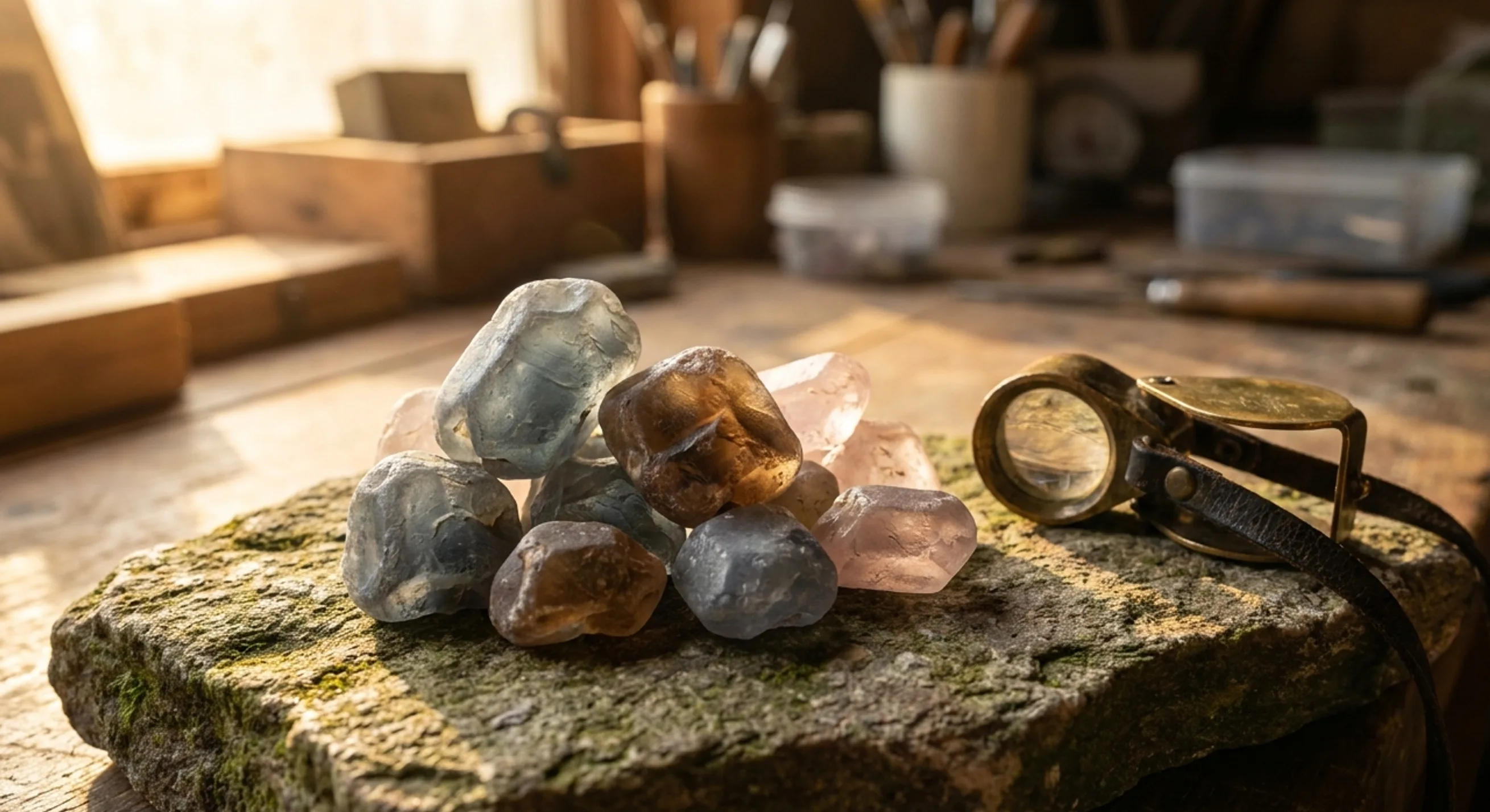
Rough Ceylon sapphire rarely looks like the gem it will become. The classic crystal habit is hexagonal: a stubby six-sided barrel, sometimes tapering to a point at one or both ends like a spinning top. Faces often show fine horizontal striations, parallel lines running around the crystal that are a strong tell for corundum. Edges get rounded and frosted when the stone has tumbled through gravel beds, which is how most Sri Lankan material is found.
Surface texture varies. Some crystals come out with a smooth, waxy skin. Others are etched and pitted from millennia in the ground. The luster underneath that skin matters more than the outside. Wet the stone or hold it to the light and you should see a bright, glassy reflection. A flat, sugary, or dead surface points away from sapphire.
Size and shape connect directly to how a stone is recovered. Alluvial rough from the gem gravels, the illam, tends to be waterworn and rounded, while material closer to the primary source keeps sharper crystal faces. If you want the full picture of where this rough comes from, read how Sri Lankan gems are mined in Ratnapura.
How to identify raw sapphire
Learning how to identify raw sapphire comes down to running a short, repeatable checklist rather than trusting a single feature. No one clue is decisive on its own. Together they build a case.
Crystal habit. Look for the hexagonal barrel or bipyramid shape and horizontal striations on the faces. Corundum does not cleave, so you will not see the flat, mirror-like break planes that split minerals like feldspar or fluorite.
Luster. Vitreous, glassy, sometimes faintly greasy. Sapphire raw with a good surface will reflect a sharp highlight.
Hardness. At Mohs 9, corundum is second only to diamond among natural gems. A raw sapphire stone will scratch glass, quartz, and topaz without picking up a mark itself. This is a defining test, though it should be done carefully and on an inconspicuous spot.
Density. Heft it. Corundum has a specific gravity around 4, so a rough sapphire feels dense for its size, heavier than a similar lump of quartz or beryl.
Color zoning. Rough sapphire commonly shows uneven color, patches or bands of blue, yellow, or colorless within one crystal. That zoning is not a flaw. It is one of the clearest signatures that you are holding natural, untreated corundum, and it tells a cutter exactly how to orient the stone.
For the finished-gem version of this process, including refractive index and inclusion clues, see how to tell if a Ceylon sapphire is real.
How to identify rough sapphire from lookalikes
Several minerals share the gravel beds and the general look. Knowing how to identify rough sapphire means separating it from the usual company it keeps.
Spinel turns up alongside sapphire constantly and can be a close match in color, but it crystallises as octahedra, little eight-faced diamonds, rather than six-sided barrels. Quartz is lighter, softer, and grows as long six-sided prisms with pointed terminations, quite different from sapphire's stubbier form. Zircon is dense like sapphire but far softer and often has a more resinous luster. Tourmaline shows a rounded-triangle cross-section and lengthwise grooves instead of horizontal striations.
The hardness and density tests do most of the sorting. A dealer will scratch, weigh, and study crystal shape before ever thinking about color. Beginners reverse that order and get fooled by color every time.
Why is raw sapphire often brown?
Brown is one of the most misunderstood colors in the rough. A raw brown sapphire is simply corundum whose iron and titanium content, and the way heat has or has not moved that chemistry around, reads as brown to the eye in its natural state. Plenty of the world's finest blue sapphire started life looking like an unremarkable brown or grey pebble.
Brown sapphire rough is where experience pays. The color you see on the surface is not the color the stone will finish at. Silk, tiny needle-like inclusions, and geuda-type milkiness can mask blue that only emerges once the material is properly assessed. This is exactly why heat treatment exists and why it is the accepted industry standard: controlled heating is the legitimate, centuries-old process that develops and clarifies color that is already latent in the crystal. Heated stones make up the large majority of fine sapphire on the market and represent excellent value. Unheated stones, where the natural color is already present without any intervention, sit at the premium tier and command higher prices precisely because they are rarer.
So a raw brown sapphire is not a lesser stone. It is often an opportunity that the untrained eye walks straight past. The skill lies in reading what the brown is hiding.
How to tell if raw sapphire is good quality
Judging quality in the rough is a different discipline from grading a cut gem. You are predicting a result, not reading one.
Clarity through the stone. Wet the rough and shine a light through it. Transparency and an even glow are good signs. Heavy fracturing, large dark inclusions, or dense clouding reduce what can be cut from the piece.
Yield. A cutter mentally maps the finished gem inside the crystal. A clean, well-formed shape yields more carat weight and better proportions. Irregular, cracked, or awkwardly zoned rough loses more on the wheel.
Color potential. With blue and other colored rough, the depth and evenness of color where the stone is thickest signals the finished tone. With brown or grey material, potential is read through experience, not appearance.
Size and rarity. Larger clean crystals are exponentially scarcer, so price per carat rises steeply with size. Reliable precise figures vary widely by quality, but fine untreated rough can run to several thousand per carat, while ordinary commercial rough sits far lower.
None of this is guesswork dressed up as expertise. It is pattern recognition built over thousands of stones.
Where Crestonne's rough comes from
The stones Crestonne represents are bought at the source, in and around the Ratnapura and Elahera markets where the gem gravels are still worked by hand. Sitting across the table from the miners and local dealers who pull this material from the ground is what makes honest assessment possible. There is no way to fake the judgement that comes from handling untreated rough day after day, weighing it, wetting it, turning it to the light before a single facet is cut.
That vantage is also why Crestonne is candid about treatment. Every stone is described for what it is, heated or unheated, with lab documentation from GIA, SSEF, or Gubelin on fine pieces. Photographs are shot to show the stone as it actually appears, not lit to invent a color the gem does not have. Buyers deserve to know whether the blue they are paying for came from the earth alone or was developed through standard heat treatment, and both have their place.
Understanding raw sapphire is the foundation for understanding everything that follows: cut, certification, and price. Once you can read a rough crystal, the finished gem holds far fewer surprises.
If you want a stone sourced and cut to your specification, start with a custom order and let the Crestonne team guide you from rough to finished gem.
Common questions
Frequently Asked Questions
How can you tell if a raw stone is a sapphire?
Check four things together: a six-sided barrel or bipyramid crystal shape with horizontal striations, a glassy luster, high density (it feels heavy for its size), and Mohs 9 hardness that scratches glass and quartz without marking itself. Color zoning is a bonus clue that points to natural corundum.
Why is my raw sapphire brown instead of blue?
Brown is a common natural color for rough corundum, and much of Sri Lanka's finest blue arrives at market looking brown or grey. Silk and milkiness can mask latent blue that emerges once the stone is assessed or heat treated, which is the standard, accepted industry process for developing color already present in the crystal.
Is raw brown sapphire valuable?
It can be. Brown sapphire rough often hides fine blue or other color, so experienced buyers value it for its potential rather than its surface appearance. Value depends on transparency, size, and how the color develops, so it is judged case by case.
How do you tell raw sapphire from quartz or spinel?
Quartz is lighter, softer, and grows as long pointed prisms. Spinel crystallises as octahedra, eight-faced shapes, rather than sapphire's six-sided barrels. Sapphire is denser than both and far harder at Mohs 9, so density and hardness tests separate them quickly.