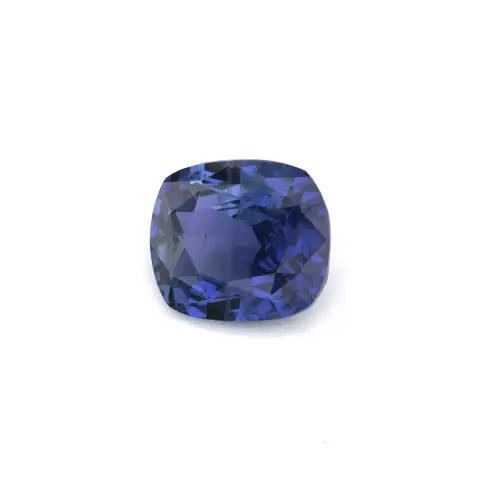
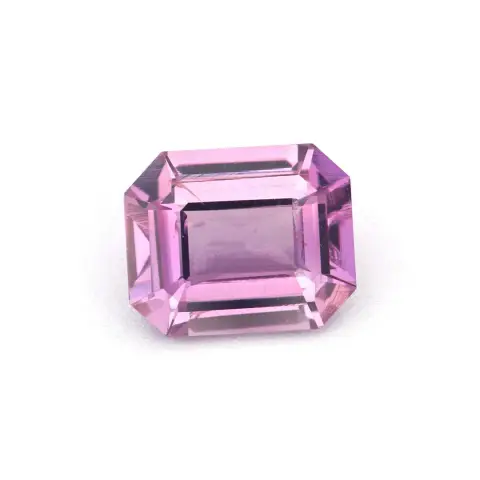
I picked this 1.02ct cushion for its vivid, saturated blue and loupe clean face, a heated Ceylon sapphire cut to catch light evenly across every facet.
/journal/unheated-vs-heat-treated-sapphireI bought this one as a crystal, not a cut stone. A 2.50ct piece of rough sapphire, corundum in its natural hexagonal form, with only the faintest wash of blue running through it. Most buyers would have walked past it. Rough that light-toned rarely tells you what it wants to be until someone with real skill starts working it.
That's the gamble with rough. You're buying potential, not a finished result, and you're trusting the color zoning inside the crystal even though you can't see it from outside.
Rough blue sapphire in crystal form
I handed it to a cutter I trust, someone who has been cutting Ceylon sapphire long enough to read a crystal before he touches the wheel. He oriented the cushion shape to pull the strongest color through the table, which is exactly what separates a good cutter from someone just following a diagram. The stone lost more than half its rough weight getting there, finishing at 1.02ct, but what came out the other side was a vivid, saturated blue with an excellent cut grade and loupe-clean clarity. That's not a small jump from where it started.
Rough blue sapphire in crystal form - 2.50 ct
The stone was heated, standard practice for Ceylon sapphire and nothing I'd apologize for, it's what let this particular crystal reach the color it was always capable of. TGL has certified it, so the color call and treatment aren't just my word.
At 1.02ct and 6.2 x 5.6mm, this sits somewhere between a ring stone and a pendant stone, small enough to wear daily without feeling precious about it, saturated enough to hold its own as a solitaire. I'd point a collector toward it too, particularly one who cares about the story behind a stone as much as the stone itself. There's something satisfying about owning a sapphire you can trace back to a rough crystal that gave no hint, on the outside, of the blue waiting inside it.
What makes this a genuine Ceylon blue sapphire rather than just a blue sapphire from anywhere?
This stone was mined in Sri Lanka, the source that has defined fine blue sapphire for centuries, and its origin is stated plainly in its listing rather than inferred. Sri Lankan blue sapphire tends to show a bright, slightly violet-leaning blue with good transparency, and that is exactly the character you see in this 1.02ct cushion. I chose it because it reads as classic Ceylon color, not a generic blue.
What does 'loupe clean' mean for this stone, and is that different from eye clean?
Loupe clean means that under 10x magnification I could not find inclusions that disturb the stone's face, which is a step above eye clean, where minor inclusions may still be visible to a trained loupe but not to the naked eye. For a Ceylon sapphire at this carat weight, loupe clean is a genuinely strong clarity result. It means the stone looks clean both to the eye and under close inspection.
Is 'Vivid Blue' a grading term or is that your own description?
Vivid Blue is my own working description of this stone's color, not a formal grade issued by any lab. I use it because the sapphire shows a strong, saturated blue with real depth rather than a pale or greyish tone, and I think that description is more useful to a buyer than a marketing name borrowed from the trade. The certificate itself does not assign a color grade.
How does the heat treatment affect this particular stone?
This sapphire is heated, which is the standard and widely accepted treatment for blue sapphire and is disclosed on its certificate. Heating at this level typically improves clarity and evens out color, and in this stone it has produced a clean, vivid blue with strong consistency face up. I treat heated stones as a legitimate and honest category, priced and described accordingly rather than passed off as something else.
How will this 1.02ct cushion actually look once it is set?
At 6.2 by 5.6mm, this cushion has enough spread to read as a proper center stone rather than a small accent, and the excellent cut grade means the color and brightness carry evenly across the face. Its proportions and depth of 3.9mm suit both a ring, where it will catch light from multiple angles, and a pendant, where its color can sit front and center. I chose this cut specifically because it shows the vivid blue without hiding it in the corners.
Shipping and returns
Worldwide shipping
Free standard shipping worldwide. Every stone leaves Sri Lanka fully insured, with a tracking number, and normally arrives within 7 to 10 business days. Customs duties and import taxes, where they apply, are the buyer's responsibility.
Changed your mind? Tell us within 14 days of receiving the stone, and we send you the return paperwork. Send it back unset, unaltered and undamaged, with everything that came with it, fully insured and tracked at your cost. We refund the full price you paid, with no fees. If anything is unclear, just ask.