Buying Guides
Princess Cut vs Cushion Cut Sapphire: What’s the Difference?
A cushion keeps more weight from Ceylon rough, hides colour zoning better and has no sharp corners to chip. A princess gives you a crisp modern square, but true square sapphires above small sizes are hard to find. Here is how to decide between the two.
11 min read
By Naseef AR
In sapphire, the princess vs cushion cut decision comes down to four things. A cushion keeps more weight from Ceylon rough. It is more forgiving with colour zoning, and its rounded corners stand up better to daily wear. A princess gives you a sharp, modern square with lively flash, but it is genuinely scarce once you go past small sizes. On price per carat a princess usually costs a little more, because it wastes more rough, but colour, treatment and size move the number far more than shape does. If you want a square stone over about 1 ct, expect to search for it. If you want the best stone your budget can buy, a cushion usually wins.
Below I explain why, and finish with a single table you can use to decide.
Princess vs cushion cut: what is the actual difference?
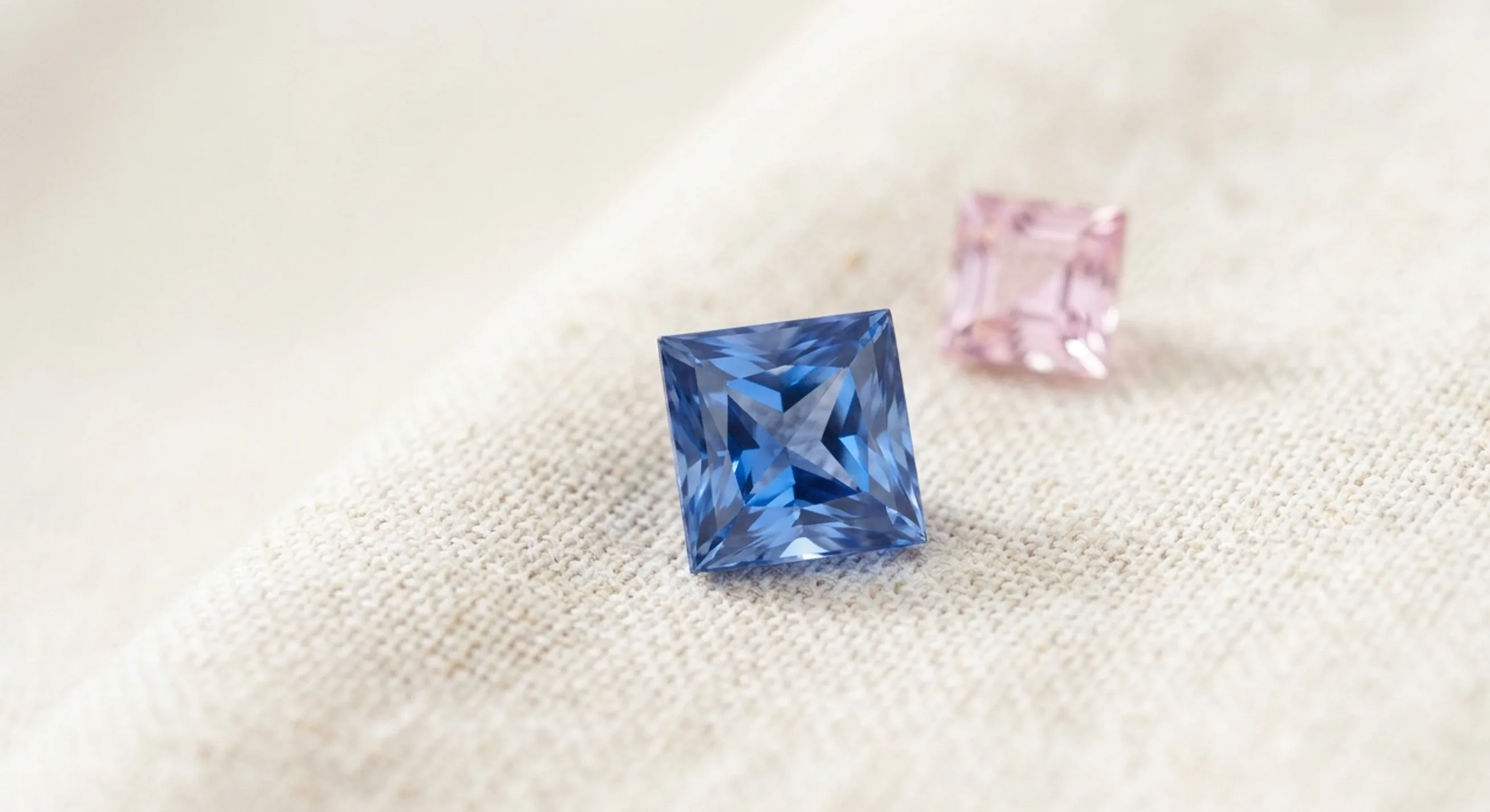
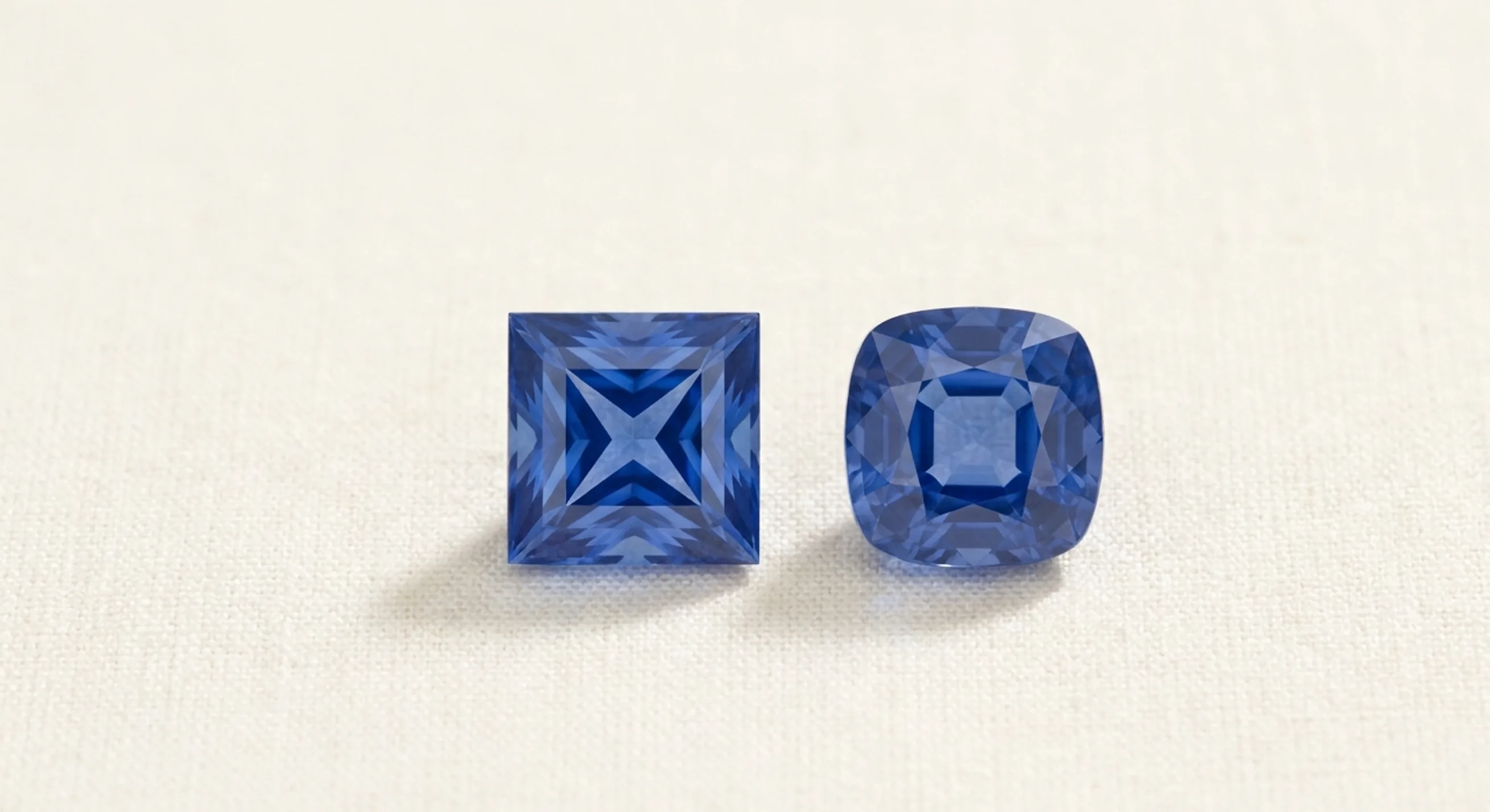
A princess cut is a square brilliant. It has four pointed 90° corners and a pavilion made of chevron-style facets that run down to a point. A well-proportioned princess has a length-to-width ratio between 1.00 and 1.05, which means it should look properly square, not slightly stretched.
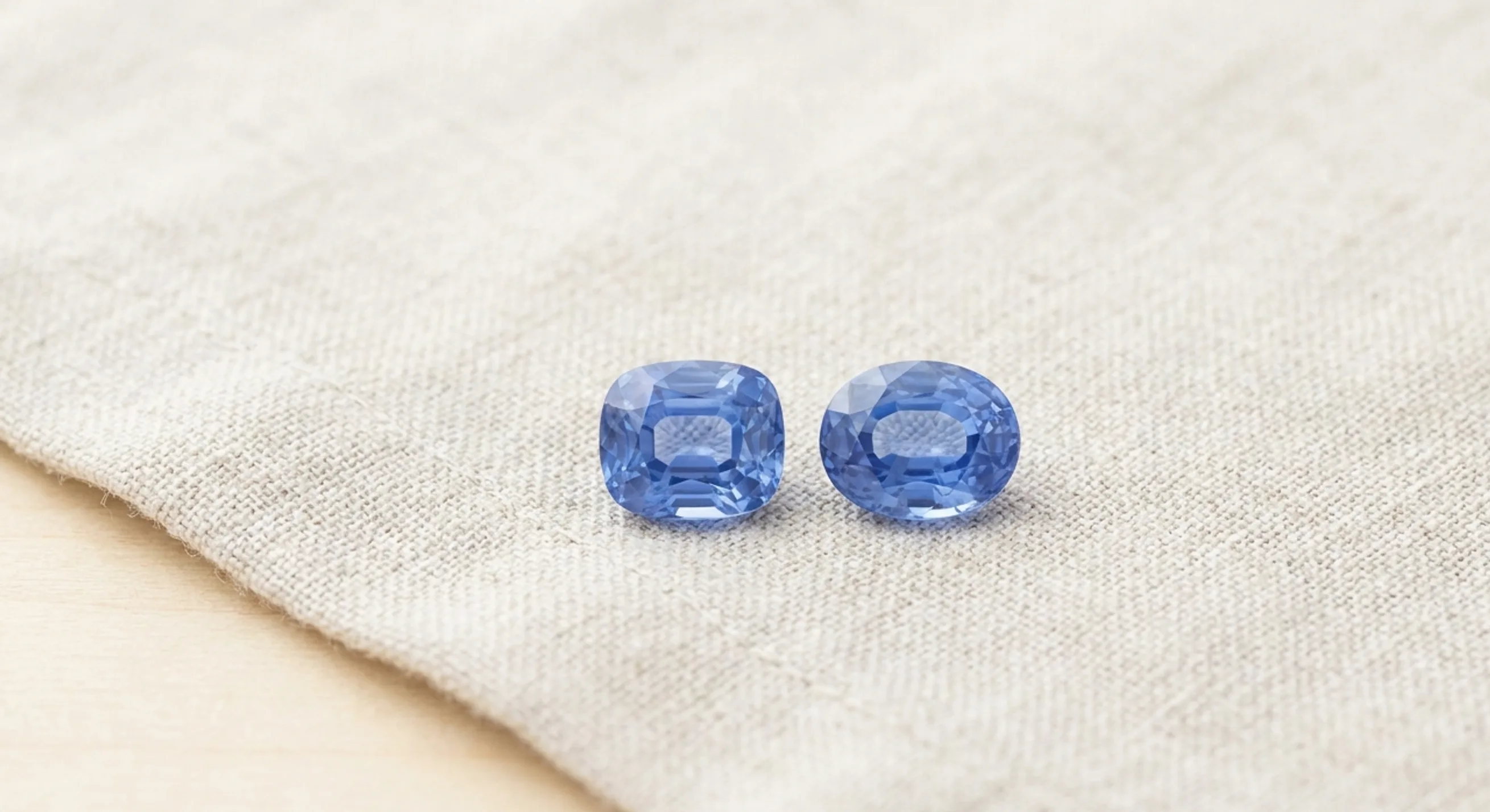
A cushion cut has softly rounded corners and slightly curved sides. The outline can be square or rectangular. In sapphire the cushion is usually cut with fairly large facets and a generous pavilion, which matters a lot for colour, as you will see below.
Both are four-sided stones, and that is why people compare them. Once you look at how sapphire rough actually behaves, though, they turn out to be very different propositions. Among sapphire shapes, the most common cuts are oval, round and cushion. The princess is not on that list, and there is a reason for that.
Why are princess-cut sapphires so rare?
It comes down to weight retention. Ruby and sapphire, both corundum, are mostly cut to keep as much weight from the rough as possible, because every carat lost is money lost. Princess and other square cuts give poor weight retention in corundum, so they are harder to source.
You will read the opposite claim on some dealer sites: that a princess keeps more rough than other shapes. That comes from diamond cutting. Diamond rough often grows as an octahedron, two four-sided pyramids joined at the base, and slicing one gives you two shapes that are almost a princess already. Sapphire is a different crystal. It belongs to the trigonal crystal system and grows as six-sided barrels, spindles and bipyramids. In Sri Lanka much of the rough also comes out of the gem gravels around Ratnapura and Elahera as waterworn pebbles. Forcing a hexagonal or rounded crystal into a sharp square means grinding away the material outside the four corners. In corundum, I side firmly with the gemmological view. A princess costs weight.
A cushion works with the rough. Its rounded corners and curved sides follow the natural outline of a pebble or a barrel section, so a cutter can keep far more of the crystal. With Ceylon rough a cushion can often keep noticeably more weight than an oval cut from the same piece, and its depth helps the colour too.
The practical result shows in the market:
- Princess-cut sapphires mostly come in small sizes, typically around 4 mm and under, where they are cut as calibrated accent stones.
- Cushions are much more common above 5 mm.
- Dealers who handle square stones report finding very few square sapphires around 6 mm (roughly 1 ct or a little more) in any quality.
- Demand is going the same way. Oval and cushion lead 2026 demand for sapphire engagement rings.
So if you want a princess-cut centre stone, accept that the choice will be thinner, especially if you also want unheated material or a specific shade of blue.
How does each shape handle colour zoning?
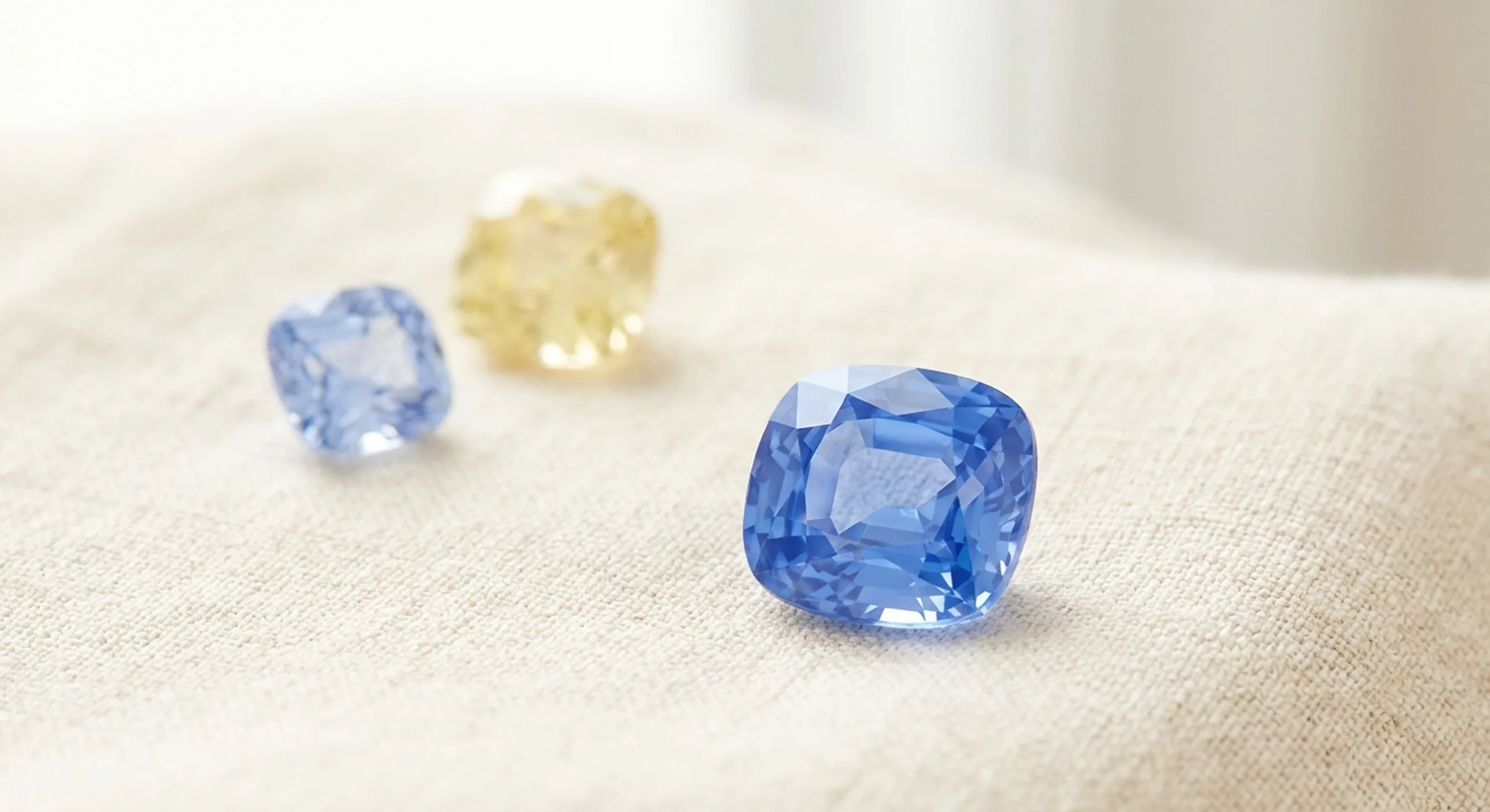
Ceylon sapphire is known for its bright, lighter tones, from cornflower blue to pastel shades. Many crystals also show colour zoning, meaning bands or patches of stronger and weaker colour. A skilled cutter orients the stone so the strongest colour sits low in the pavilion, near the culet, where it reflects through the whole face.
Cushions handle this very well. A cushion's depth and broad pavilion facets mix the colour, so a pale stone can face up more saturated than its rough suggested. Large facets also show saturated colour as broad, even flashes. This is the main reason the shape suits Sri Lankan material, and I go into it further in why the cushion cut suits sapphire.
Princess cuts are less forgiving. The straight edges and long, narrow chevron facets can line up with colour bands and show them as visible stripes. The corners are the hardest part to light. If their pavilion facets end up too shallow they window and look pale, while in darker material the longer light path through the corners can turn them inky. For a princess you need rough that is evenly coloured and clean right out to the corners, and that narrows the supply again.
Do princess or cushion sapphires window more?
A window is a washed-out, see-through patch in the middle of a stone, caused by a pavilion that is too shallow to send light back to your eye. In sapphire it is the most common cutting flaw, because cutters are always tempted to cut shallow to save weight or to make a stone face up larger.
With cushions, the risk depends on the cutter's choices. A deep cushion rarely windows and holds colour well, but too much depth puts weight in the "belly" below the girdle, which you pay for in carats without seeing it face-up. A shallow cushion faces up bigger but can window in pale stones. When you look at a cushion, tilt it. If the centre goes glassy and lifeless while the edges keep their colour, it is windowing.
A princess needs proper depth to work, because its pyramid-shaped pavilion only returns light if the angles are right. The corners are the weak spot. Their facets run at a lower angle than the side facets, so they are the first place a window shows, and keeping them lit without making the stone deep and heavy takes real skill. The catch is that reaching that depth from flat or pebble-shaped rough is exactly what costs so much weight. Shallow princesses do exist, and they look dull and grey in the middle.
Either way, judge a stone on video, not a single still photo. Every stone Crestonne lists comes with its own video, so you can see how the centre behaves as the stone moves.
Which is more durable: princess or cushion?
Sapphire rates 9 on the Mohs scale. It is the second-hardest natural gem after diamond, and it resists scratching and everyday wear very well. Hardness is not the same as toughness, though. A hard knock on a thin point can still chip it.
That makes the corners the deciding factor:
- Princess: the four 90° corners are the weak point. They are thin, exposed and the first thing to hit a door frame. The standard protection is V-prongs that wrap each corner, or a full bezel. Leaving the corners bare in a daily-wear ring is asking for trouble.
- Cushion: the rounded corners have no sharp point to catch, so they are much less prone to chipping. Four or six claws are fine, and the shape suits halos and bezels without needing special corner protection.
One more practical point. A princess faces up about 10% smaller than a round of the same weight, because so much of its weight sits in its depth. A well-cut cushion is not a big-looking shape either, but it puts that depth to work for colour. If face-up size per carat matters to you, look at millimetre measurements, not just carat weight, whichever shape you choose.
For a ring worn every day, a cushion is the safer choice for most people. For earrings or a pendant, where knocks are rare, a princess's corners are much less of a worry.
Is a princess-cut sapphire cheaper than a cushion?
No. If anything, it costs more. Nobody publishes a fixed price premium for princess vs cushion cut sapphire, but a princess wastes more rough, so expect to pay more per carat than for a cushion of the same colour and clarity. Published dealer listings from 2025 show a 1.33 ct natural blue princess at about US$3,200 per carat and a 2.19 ct blue cushion at about US$3,380 per carat. A sold 1.30 ct princess was listed at about US$3,170 per carat. The princess sits close to the cushion per carat even though the cushion is past the 2 ct price step. Treat these as illustrations, not market rates. They are snapshots, and treatment and origin were not always stated.
What actually drives the price is the same for both shapes. My Ceylon sapphire price per carat guide gives these 2026 ranges for Ceylon sapphire in the 1 to 3 ct range:
| Quality tier (1-3 ct) | Typical price per carat |
|---|---|
| Commercial heated | US$500 - 2,500 |
| Fine heated | US$3,000 - 8,000 |
| Fine unheated | US$7,000 - 18,000 |
| Exceptional unheated | US$10,000 - 20,000 |
Heat treatment is the industry norm. An estimated 90 to 95% of sapphires on the market have been heated, and it is a stable, accepted process that brings out colour and clarity. Unheated stones are the premium tier, typically roughly two to five times the price of comparable heated stones: about twice at 1 ct, about three times at 3 ct, and more at 5 ct and above. Size itself pushes price per carat up in steps, sharply at 1, 2, 3 and 5 ct, so a stone just over one of those weights costs noticeably more per carat than one just under it.
Shape also affects your budget through choice. Because square sapphires above small sizes are scarce, you have fewer princesses to compare in any given colour and treatment tier. In practice that can mean compromising on colour or paying more to find the right one. With cushions you have a far wider field, which makes it easier to find good value. Whatever you buy, ask for a written treatment statement and a lab report. Crestonne supplies both with every listed stone.
Princess vs cushion cut decision table
This is the square vs cushion gemstone comparison in one place, based on how Sri Lankan cutters handle Ceylon rough.
| Factor | Princess cut | Cushion cut |
|---|---|---|
| Outline | Sharp square, 90° corners, L/W 1.00-1.05 | Rounded corners, square to rectangular |
| Weight retention from Ceylon rough | Poor; corners are ground away | Good; follows the natural crystal outline |
| Availability above about 1 ct | Scarce; mostly small calibrated sizes | Common; a leading sapphire shape |
| Colour zoning | Can show as stripes; corners may look pale | Depth and broad facets blend colour |
| Windowing | Corners window first; proper depth costs weight | Depends on depth; tilt-test pale stones |
| Chip risk | Higher at the four points | Lower; no sharp corners |
| Recommended setting | V-prongs or bezel | Claws, halo or bezel |
| Price per carat | Usually higher than a cushion at equal quality | Roughly level with an oval at equal quality |
| Best for | Modern, geometric designs; earrings; accents | Daily-wear rings; pale Ceylon colours; value |
Which should you choose?
My honest advice on the princess vs cushion cut question is this. Choose a princess if you want that crisp, architectural square and you will not settle for anything else. Be ready for a narrower search, insist on evenly coloured material, and have it set with protected corners. My princess cut sapphire buying tips cover what to check for colour and brilliance in that shape.
Choose a cushion if you want the strongest colour from a Ceylon stone, the widest range to choose from and a shape that will take daily wear without fuss. In corundum it is the shape that suits the material, and that is why cutters reach for it so often.
If you have a specific shape, size or colour in mind, especially a square stone that is hard to find off the shelf, tell me through the custom-order form. If you would rather see what is available now, browse the collections, where every stone has its own video, a written treatment statement and a lab report.
Common questions
Frequently Asked Questions
Is a princess or cushion cut better for a sapphire engagement ring?
For a ring worn every day, a cushion is usually the safer choice. Its rounded corners resist chipping, it handles Ceylon colour well and it is far easier to find in centre-stone sizes. A princess works too, but its 90-degree corners should be protected with V-prongs or a bezel.
Why are princess-cut sapphires hard to find?
Sapphire grows as hexagonal crystals and, in Sri Lanka, often as waterworn pebbles. Cutting a sharp square from that rough wastes a lot of weight, so cutters usually choose shapes that keep more of the crystal, like cushions and ovals. As a result, princess-cut sapphires mostly come in small calibrated sizes.
Do princess-cut sapphires cost more per carat than cushions?
Usually, yes, though no price table lists a fixed premium. A princess wastes more rough, so expect to pay more per carat than for a cushion of the same colour and clarity. Colour, treatment and size drive price far more. What scarcity does affect is choice, because there are fewer large princesses to compare.
Does a cushion cut make a pale sapphire look darker?
It can help. A cushion's depth and broad pavilion facets blend and concentrate colour, so a lighter Ceylon stone often faces up more saturated than it would in a shallower shape. Check for windowing, though: a cushion cut too shallow can look washed out in the centre.